When, if ever, are film remakes better than the original?
The differing attitudes to creativity between different musical traditions are fascinating. Classical musicians are vessels for the unique genius of the composer, folk musicians are bearers of the collective memory of yesteryear, and jazz musicians simultaneously revere canonical standards while also, on another level, make it up as they go along. Indeed, in one form or another, “remakes” are practically the norm in most music genres, including jazz, traditional and classical circles, where there is no real expectation that a performer would be writing their own music. However, the post-1960s rock’n’roll, singer-songwriter perspective led to an attitude that true authenticity would only be achieved when these roles are aligned: you write the music you perform or you are faking it.

The idea has an appealing consistency but does not really hold up to robust interrogation or comparison to other genres. Nevertheless, the cultural attitude spawned the concept of the “cover” version of a song written by another. These are often looked down upon as something that amateur bands turn to in place of real creativity, but there are enough truly transformative examples to shatter the neo-Romantic ideal that great art exclusively derives from individual, isolated acts of genius. The very best entirely displace the cultural memory of the original version, releasing the songwriting genie that had previously been struggling to get out: Aretha Franklin’s I Say a Little Prayer for You, Marvin Gaye’s I Heard it Through the Grapevine, Sinéad O’Connor’s Nothing Compare 2 U all fall within this category. The worst fall into the trap of an attempted “modernisation”, offering no original insight other than repackaging the material to suit the transient trends of the time: Counting Crows’ Big Yellow Taxi or the Futureheads’ Hounds of Love come to mind as classic song revival attempts that disappeared far sooner than the originals.
The anti-cover-version attitude has a parallel in the world of film, with the “auteur” film director emerging within French cinema after the war: the individual genius whose creative vision must be fulfilled for the resulting work to have artistic legitimacy. For that reason, remakes are generally looked down upon in film circles, or at least treated with great suspicion. This comes from several different directions simultaneously: some films remakes are clearly cynical money-making opportunities to cash in on the popularity of the original film, adding very little creatively other than a new event for the original fans to spend money on. Alternatively, the cinematic focus on the brilliance of the individual auteur director leads to skepticism around the value of films derived from the intellectual material of others. Relatedly, remaking another’s work might be considered actively disrespectful: did you not feel that they executed their own vision adequately, and that you could do better? Making a cover song is a lower-investment enterprise than remaking a whole film: you could rework someone’s song in a few minutes out of a sense of whimsy or caprice, but remaking someone else’s film suggests a greater degree of forethought and a more serious perceived flaw in the original needing reparation.
Possibly the most tempting grounds for remaking a film are technological: the two great sensory film history watersheds of sound and colour offered an opportunity to recast prior works in full audiovisual bloom, and further improvements in cinematography will lure latter-era directors into updating earlier successes, exploiting their relative chronological privileges.
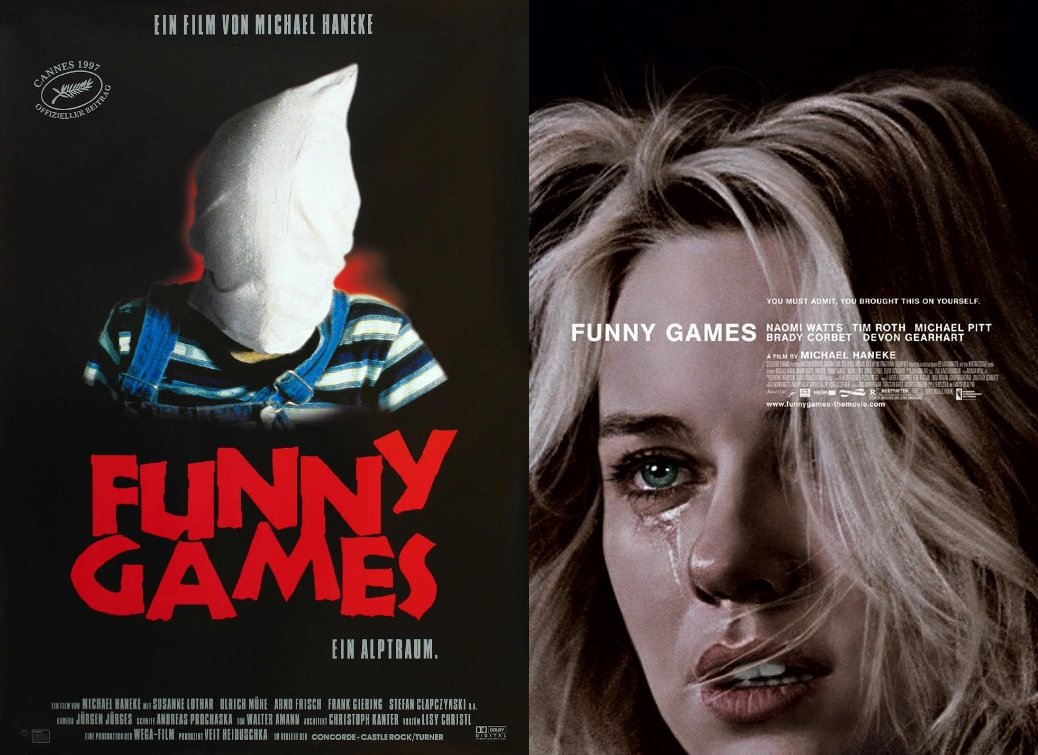
Very occasionally, directors will remake their own past films: Alfred Hitchcock remade his 1934 silent The Man who Knew Too Much with sound under the same title in 1956, and Michael Mann remade his 1989 TV film L.A. Takedown with substantially larger resources in 1995 as Heat. Curiously, Michael Haneke remade his 1997 German-language Funny Games 10 years afterwards in English with bigger-name Hollywood actors, in an almost shot-for-shot reproduction. Like all classic Haneke, the original is disturbing enough already, but one reels at the internal psychology of someone who feels the need to make it twice.
It can be ambiguous at times whether films are remakes or whether an adjacent term is more appropriate: “reimaginings”, “reboots”, “retcons” and similar all bear similar implications but varying fealty to the original, and different creative roles implied. St Trinian’s (2007) borrows heavily from the 1957 series originator; The Thing (2011) is a free riff on the 1982 film, which itself was a loose reworking of the 1951 B-movie The Thing from Another World; Evil Dead II is a comedic reframing of the first one, and The Mummy (1999) is a loose, campy, CGI-rich spin on the 1932 Universal classic. On some level, making an exact remake would be at best dull, and at worst utterly pointless: The paradox of the remake is thus exposed by the purest examples of the form.
Of additional concern are English-language remakes of non-English-language cinema. These are somehow especially offensive: we might retain the right to rework past material from within our own culture, but to reach across continental divides to correct the mistakes of a different civilisation is fraught with hubris and neo-colonialism. The argument that an English-language script opening up the film to a broader audience is not a strong one, given the option of subtitles, or even dubbing at a push. We should in general show extra respect across cultural boundaries given the likelihood of misunderstandings and absent contexts.
There is a counterpoint, which is calling out the fetishism of lesser-known titles at the expense of the more familiar: there is also a tendency to celebrate the obscure for its own sake, somewhat analogous to the toxic indier-than-thou dynamics found in music circles. John Waters’ Cecil B. Demented (2000) does an excellent job of parodying this phenomenon, with a group of underground terrorist filmmakers causing havoc in the mainstream Hollywood scene. The ribbing is affectionate, however, and the audience is to understand that the outlaw filmmakers have a legitimate grievance, even if their methods are taken to an absurd extreme.
The discourse seems to be begging for some kid of grounding: can these attitudes be measured in any sense? Can we resolve any of these questions in anything based in data or evidence? Well, there exist quantitative representations of films in the form of movie ratings. These are the summed opinions of the users of the rating services, and as such are not objective ratings of quality: they depend on the population of raters and their susceptibility to trends and prejudices. However, I trust some of the available sources better than others as measures of artistic quality, and will use letterboxd as my point of reference for this project. I will also probably lapse into pseudo-objective language of films being “better” or “worse” than one another according to these ratings: I do not really believe these claims in an absolute sense but may lean on them as convenient simplifications of my real position.
So what do letterboxd ratings tell us about film remakes? Well, we can turn to Wikipedia for their lists of films remakes, including a separate one containing English-language remakes of non-Anglophone films. These can be matched systematically against collections of letterboxd ratings, and a data set is thus created: matched pairs of originals and remakes including ratings, genres, languages, and other variables, for the two separate populations of English-to-English remakes and International-to-English remakes (henceforth E-to-E and I-to-E). The matching of Wikipedia to letterboxd was only partially complete, as not all of the films involved had letterboxd pages or could be easily identified with the information provided: this might not be completely at random, as more obscure films are likely to be missing, but I think that any bias introduced should be towards more recognisable and high-impact films.
The final study populations consisted 347 of E-to-E and 206 I-to-E original-remake pairs. Let’s take a look at the ratings of the films, separated by each population, and by original/remake. The rating system of letterboxd allows users to rate films on a scale from half a star to five stars, in increments of half stars.
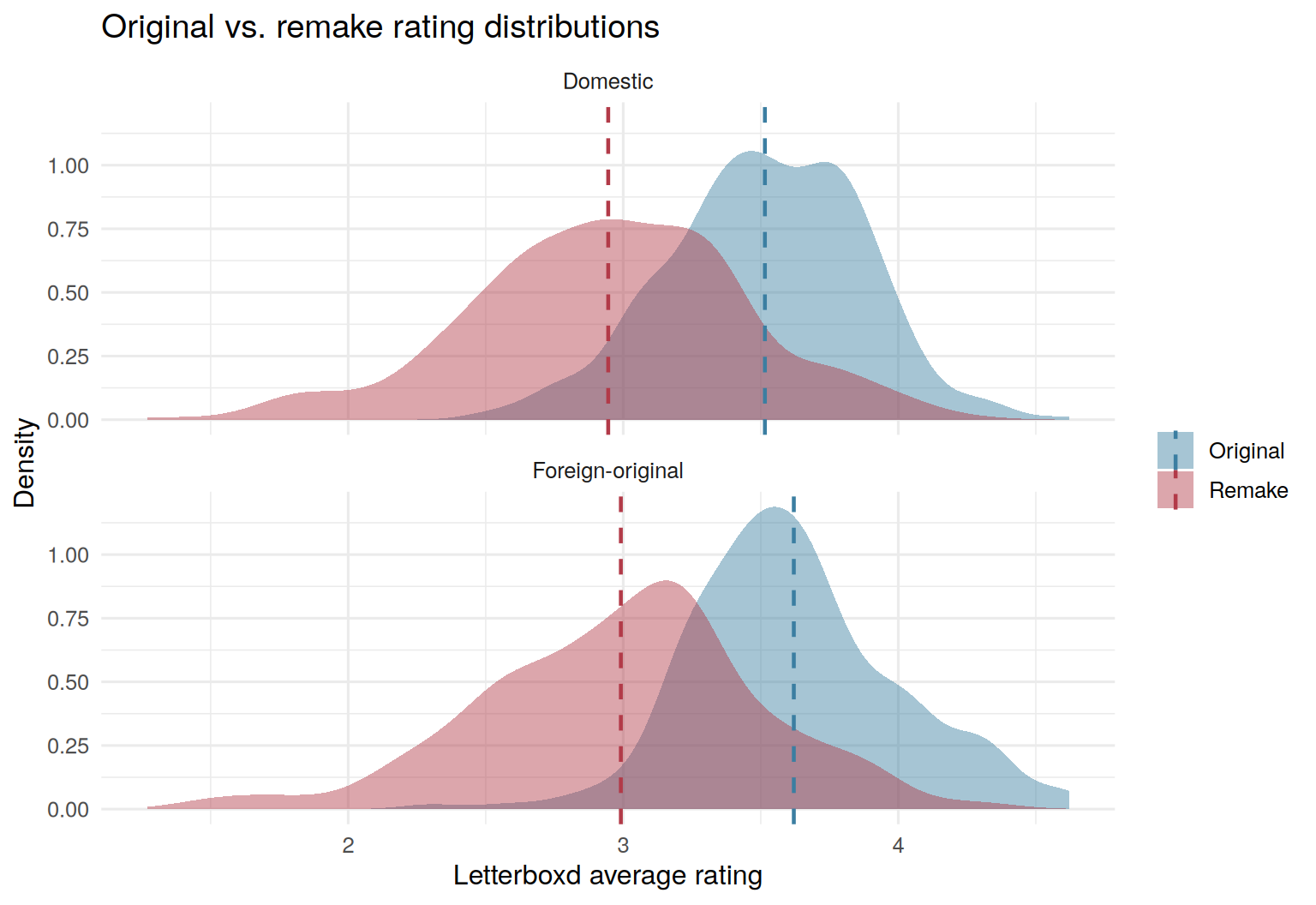
We see our initial suspicions confirmed: remakes are systematically worse than the originals, with the effect being stronger when remaking international films in English. These effects are both large in magnitude (0.57 and .63 ratings point differences, on average) and statistical confidence given the size of the data sets. With just these scores, there is another question that can be asked of the ratings: do better originals make better remakes? To be clear, we know that the remakes are systematically worse than the originals from the above, but if two original films A and B were remade into remakes C and D, would the difference in ratings between A and B be reflected in the difference in ratings between C and D? This can be approached with a simple correlation analysis on the two populations, with results below:
We see there is a weak positive correlation: better originals do generate better remakes, even if the remakes are worse than the originals themselves. The effect is slightly larger in I-to-E pairs than E-to-E pairs, with Pearson’s correlations of 0.298 and 0.168 respectively. This result is not a large enough effect size to be confirmed with the amount of data used here, but interesting to reflect on: do audiences judge remakes less harshly when they are unaware of the international original?
It might be instructive to look at the outliers of this cloud of points: are there any specific pairs of films representing the extremes of poor originals generating good remakes, or vice versa? These can be identified by plotting the Pareto frontier, shown below for the E-to-E data set.
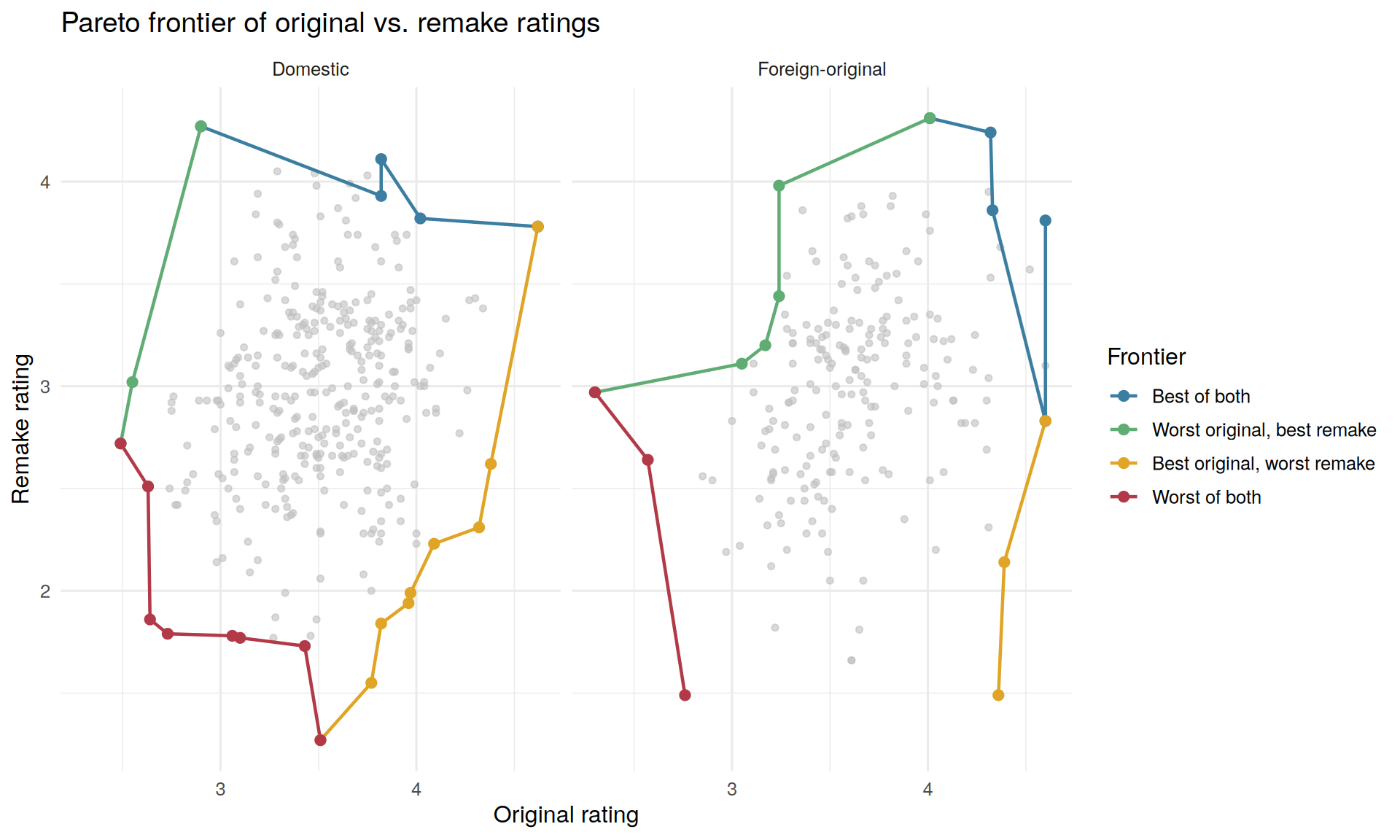
Some pairs jump out as being of interest in the E-to-E population. We have two unsuccessful Hitchcock updates: Rear Window (1954) and Psycho (1960) were both remade in 1998, the former as an leading-man opportunity for Christopher Reeve after his paralysis injury, and the latter perfectly shot-for-shot semmingly because Gus van Sant felt that the original needed colorising. Two recent Disney remakes also feature, in the form of the Mulan (2020) and Snow White (2025), although the worst remake in the population is Cats (2019): this is a debatable case as it is a remake of the 1998 direct-to-video version of the stage production, which might not be considered an original film in its own right. The rest of the lousy remakes are numerous instances of horror remakes: for some reason people keep making new versions of films like The Wicker Man, Black Christmas, Day of the Dead, Cabin Fever et al. with predictably negative results.
There are two outliers in being genuinely good remakes from domestic originals, curiously both from a similar era of crime films: Scarface (1932) rose from 3.82 to 4.11 stars when remade in 1983, but most strikingly Michael Mann’s aforementioned self-remade L.A. Takedown leapt from 2.90 to 4.27 as Heat: this is quite an extreme outlier in the bad-original-good-remake quadrant, and dominates any other film in that direction by some way.
The plot of the Pareto frontier for I-to-E pairs is shown above, with no conspicuous plucked-from-obscurity Heat success story. The largest improvement by some way is the Spanish-language The People Upstairs (2020) jumping 0.74 points as The Invite (2026), although this is probably heavily impacted by the positive recency bias of the remade film, and will settle to something less extreme with time. The second largest (and probably most robust) increase is the Hong Kong Infernal Affairs (2002) recast as The Departed (2006), which is famous as one of the few exceptions to the truism of Hollywood butchering foreign adaptations.
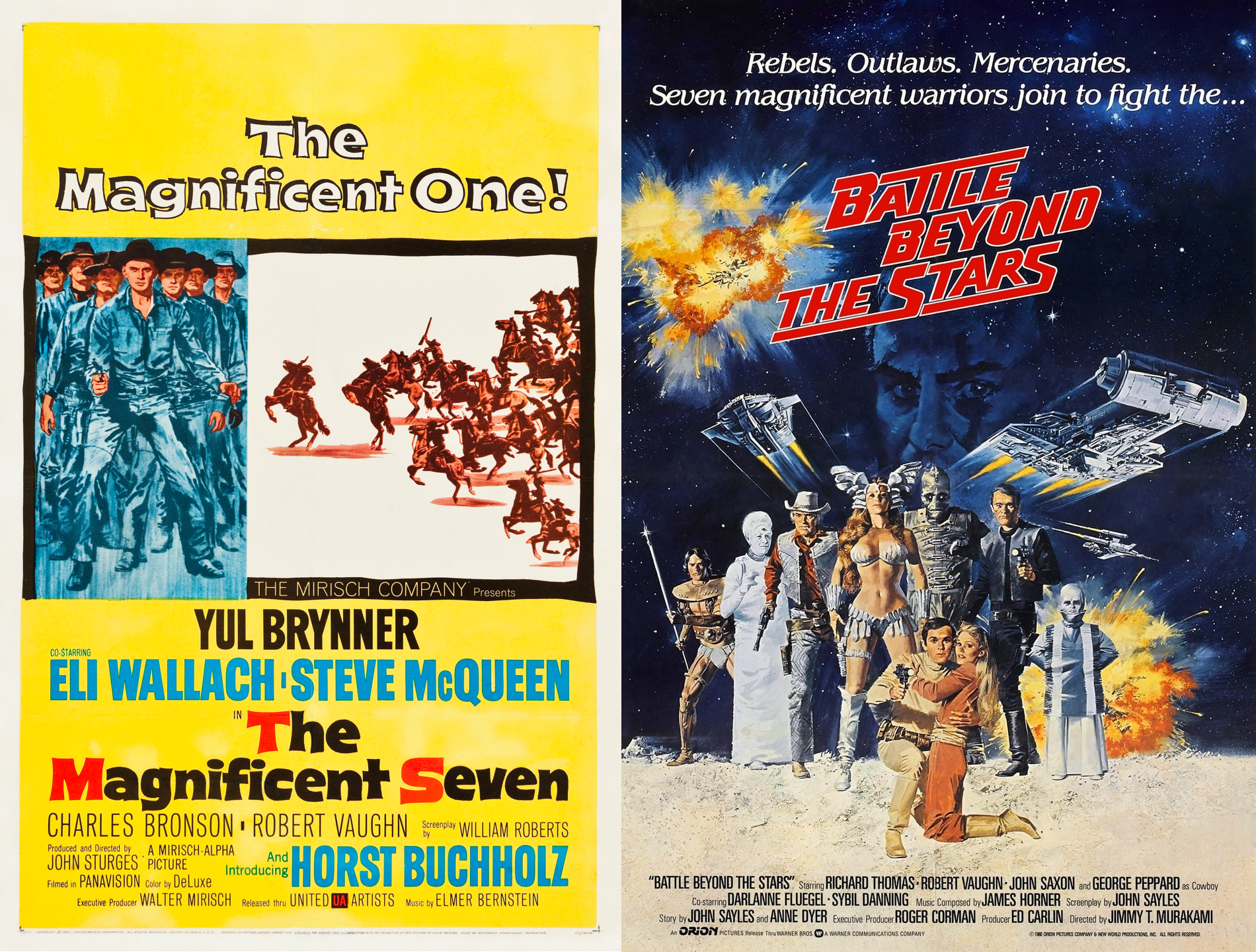
There are two other films that started high and remained worthwhile: the French still image science fiction featurette La Jetée (1962) that finally received the Hollywood blockbuster resources matching its ambition as Twelve Monkeys (1995), and the extraordinary French classic The Wages of Fear (1953) that sustained a very modest decline from 4.32 to 4.24 as the also widely respected Sorcerer (1977). Two films that make an interesting contrast are the duo of adaptations of Seven Samurai (1954), once as the classic Western The Magnificent Seven (1960), and once again as the misguided science fiction Battle Beyond the Stars (1980): it turns out that the genre transformation trick doesn’t always work the second time.
To complete with a final pair of adaptations, I can also offer two notorious failures drawing from East Asian cinema: the Korean classic Oldboy (2003) dropping from 4.39 to 2.14 stars in the hands of Spike Lee in 2013, and the 2006 Japanese film of Death Note (based on the beloved manga series) suffering the largest decline of all from 4.36 to 1.47 stars in the 2017 American version.
If you were curious, I present tables at the end of this post of all of the 47 E-to-E and 19 I-to-E remade films that are considered by letterboxd ratings to be an improvement on their original. Something that strikes me going through these lists is that the larger the improvement on the original rating, the less likely I am to have been aware that the original existed: The Children’s Hour? The Fly? CODA? Bugonia? Remakes all? It seems that, like a good cover song, it is possible to displace the cultural presence of the original if you can spot the right opportunity and are willing to roll the dice on a production. However, to dampen any enthusiasm, this happens only 13.5% of the time for E-to-E remakes and 9.2% of the time for I-to-E remakes. Those are not great odds at artistic success if you are invested in something as large-scale as a modern film production, but maybe remakes are considered lower-risk projects from a financial perspective.
As mentioned previously, there are some other variables included in the data that can be used to answer questions of interest. The three that struck me as being most interesting were the year of release of the remake, the nationality of the original film and the listed genre. These suggest two questions:
- What is the distribution of time between the original film and the remake?
- Are some foreign traditions especially fruitful when remade into English?
- Do some genres survive the remake process better than others?
The first question can be approached visually by plotting the densities of the difference in years between films for the domestic and foreign populations separately. They look as follows:
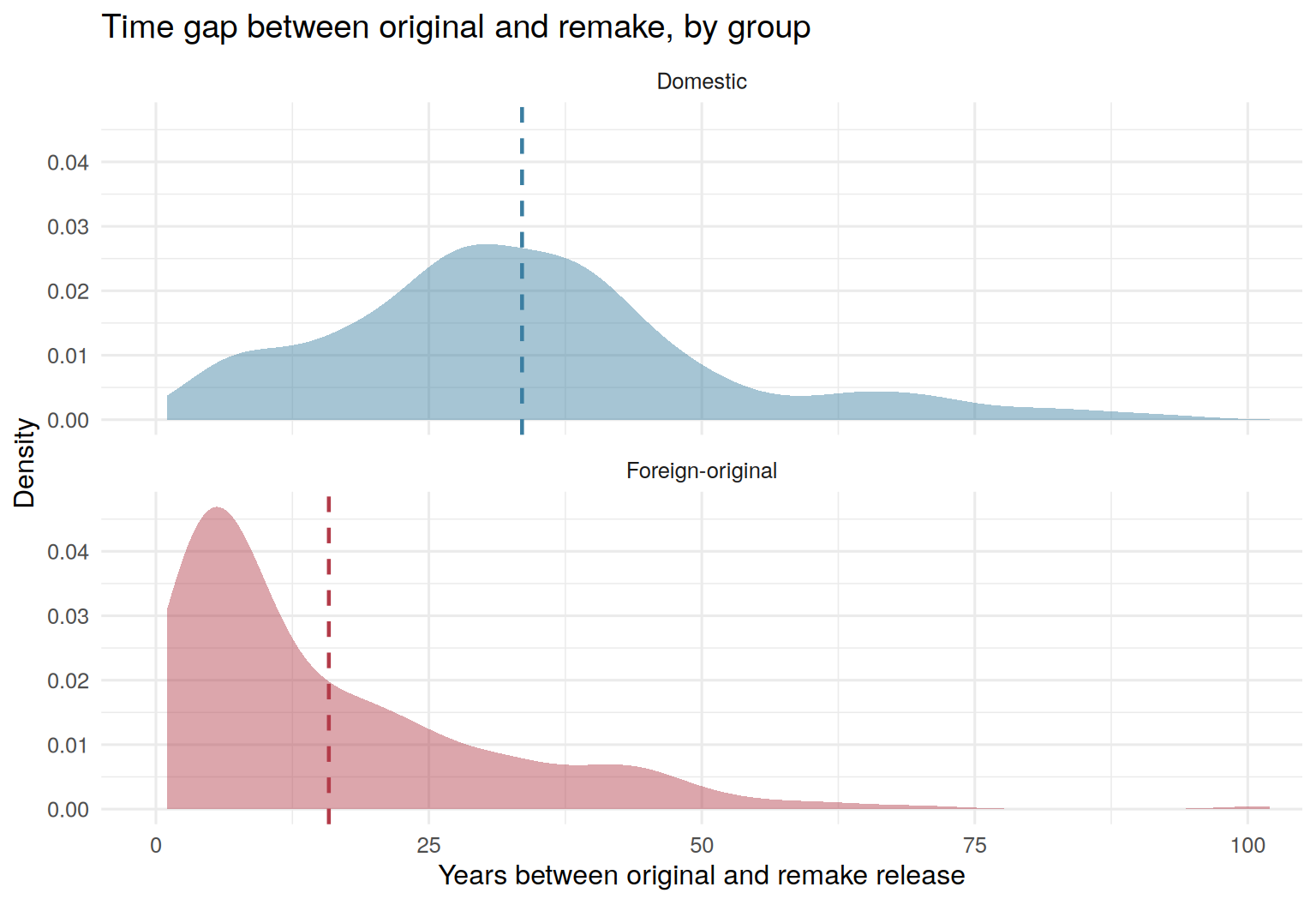
These are intriguingly different: the E-to-E remake time happens at a longer timeframe, averaging approximately 32 years before a remake is made. This is a reasonable timeframe, as you need approximately a generation to pass before the nostalgia effect kicks in around the original film, and the next crop of filmmakers to emerge with a fresh perspective on the source material. By contrast, I-to-E remakes tend to happen much faster, with a median of 9 years: if the original film is not known to domestic audiences, then there is no real need to wait for the original film to become stale: the international cultural difference provides the distance that time provided for the E-to-E remakes.
To answer the second question, we can build a regression model, predicting the remake rating using the original film nationality and the original rating. The model will consequently identify which nationalities beget higher-rated remakes, while accounting for systematic differences in ratings between the original film nationalities. I don’t really have a strong prior idea of what to expect here: the German, French, Italian, and Japanese traditions are probably the foreign-language traditions that Anglophone filmmakers consider highest-status, although specific directors from other traditions will draw the focus elsewhere (looking at you, Ingmar). We can take a look at the effects by nationality adjusted for original rating below, with USA originals as the reference category:
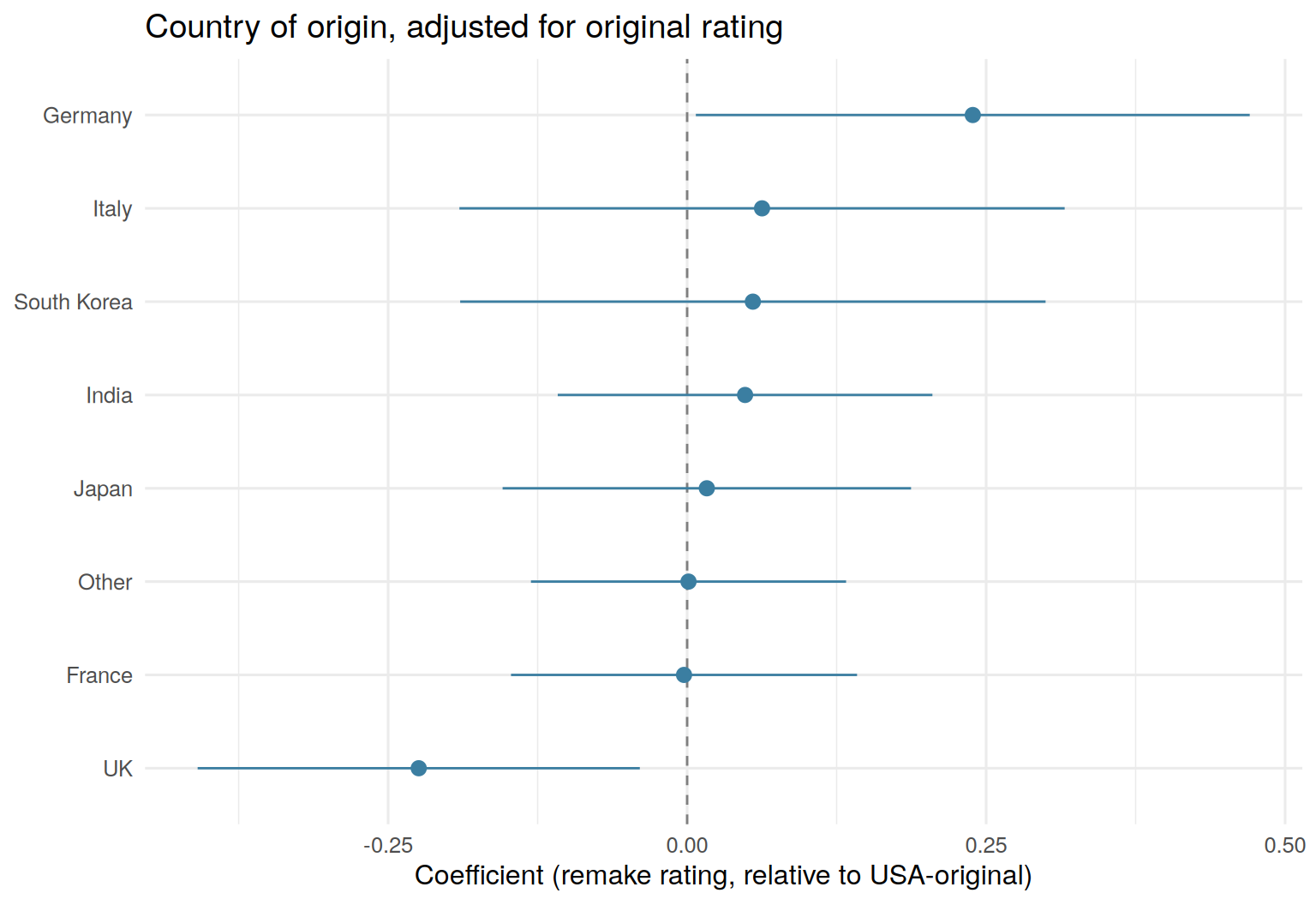
We see two outliers: German originals seem to perform better than expected given the rating, and UK films worse than expected. These are small effects among many possible ones and are close to significance boundaries, so should not be taken too seriously, however. To the former claim: It is possible that the influx of German filmmakers to Hollywood after the war led to a certain affinity for their home culture, and Hollywood consequently had a special talent for identifying and adapting films from the fatherlands. Concerning the UK, while there might be an immediate closeness between British and American Anglophone cultures, the absence of a substantial language barrier may lend the resulting transatlantic E-to-E remakes to feel especially pointless.
Similarly, let’s look at the third question as to whether the genre of the original film has an influence on the remake rating (in addition to the original film rating). Again, these are small effect sizes drawn out of a potential crowd of many so should not be taken too seriously, but might be of interest:
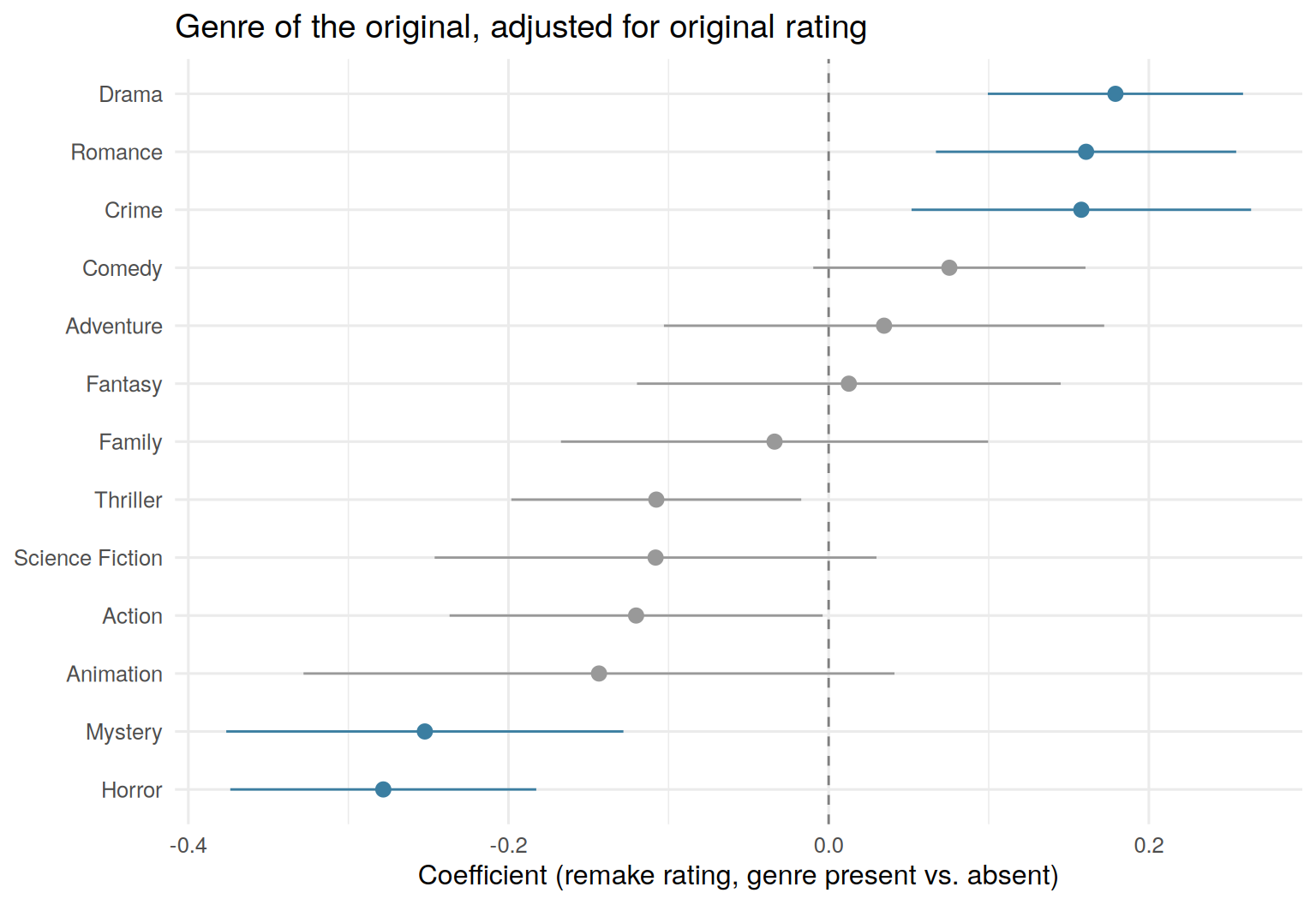
We see the top three most adaptable genres are Drama, Romance and Crime, and the three least adaptable are Horror, Mystery, and Animation. What strikes me about these contrasting genres are the latent counterintuitive presence of special effects and technology that might be used to “modernise” the original: it seems that genres that potentially lean hard on special effects are the hardest to remake, in contrast to genres that don’t need them so much. This is a curious contrary point to the prior suspicion that improved technology might be the best justification for remaking an older film.
It is worth pointing out that the previously mentioned Hitchcock Thriller/Mystery The Man who Knew Too Much that he himself updated for the sound era showed a modest increase from 3.38 to 3.72, but this doesn’t apparently reflect a broader trend. Funnily enough, the best musical analogue I can find of an artist successfully re-recording their prior work is Oslo’s own A-ha: their original 1984 song and video for Take on Me has a certain uncanny quality given the familiarity of the global hit the year after. You can always trust Norwegians with their disturbingly good Anglophonic abilities to nail an English-to-English remake like that.
Worthwhile English-to-English remakes:
| Pair | Original | Remake | Δ |
|---|---|---|---|
| L.A. Takedown (1989) → Heat (1995) | 2.90 | 4.27 | 1.37 |
| The Front Page (1931) → His Girl Friday (1940) | 3.29 | 4.05 | 0.76 |
| Holiday (1930) → Holiday (1938) | 3.19 | 3.94 | 0.75 |
| The Little Shop of Horrors (1960) → Little Shop of Horrors (1986) | 3.18 | 3.84 | 0.66 |
| These Three (1936) → The Children’s Hour (1961) | 3.48 | 4.04 | 0.56 |
| The Blob (1958) → The Blob (1988) | 3.07 | 3.61 | 0.54 |
| The Ten Commandments (1923) → The Ten Commandments (1956) | 3.29 | 3.80 | 0.51 |
| Anastasia (1956) → Anastasia (1997) | 3.30 | 3.79 | 0.49 |
| The Fly (1958) → The Fly (1986) | 3.49 | 3.98 | 0.49 |
| The Wasp Woman (1959) → The Wasp Woman (1995) | 2.55 | 3.02 | 0.47 |
| One Sunday Afternoon (1933) → The Strawberry Blonde (1941) | 3.19 | 3.63 | 0.44 |
| The Secret Life of Walter Mitty (1947) → The Secret Life of Walter Mitty (2013) | 3.37 | 3.74 | 0.37 |
| Bedtime Story (1964) → Dirty Rotten Scoundrels (1988) | 3.33 | 3.68 | 0.35 |
| The Man Who Knew Too Much (1934) → The Man Who Knew Too Much (1956) | 3.38 | 3.72 | 0.34 |
| Gaslight (1940) → Gaslight (1944) | 3.66 | 3.99 | 0.33 |
| Waterloo Bridge (1931) → Waterloo Bridge (1940) | 3.51 | 3.83 | 0.32 |
| The Parent Trap (1961) → The Parent Trap (1998) | 3.37 | 3.69 | 0.32 |
| Freaky Friday (1976) → Freaky Friday (2003) | 3.10 | 3.40 | 0.30 |
| Scarface (1932) → Scarface (1983) | 3.82 | 4.11 | 0.29 |
| Ben-Hur: A Tale of the Christ (1925) → Ben-Hur (1959) | 3.75 | 4.03 | 0.28 |
| The Front Page (1931) → The Front Page (1974) | 3.29 | 3.56 | 0.27 |
| A Star Is Born (1937) → A Star Is Born (1954) | 3.60 | 3.87 | 0.27 |
| Free and Easy (1930) → Abbott and Costello in Hollywood (1945) | 3.00 | 3.26 | 0.26 |
| The Mummy (1932) → The Mummy (1999) | 3.28 | 3.52 | 0.24 |
| Magnificent Obsession (1935) → Magnificent Obsession (1954) | 3.39 | 3.63 | 0.24 |
| Cat-Women of the Moon (1953) → Missile to the Moon (1958) | 2.49 | 2.72 | 0.23 |
| The Informer (1935) → Uptight (1968) | 3.69 | 3.92 | 0.23 |
| Mother’s Day (1980) → Mother’s Day (2010) | 2.76 | 2.95 | 0.19 |
| The Incredible Journey (1963) → Homeward Bound: The Incredible Journey (1993) | 3.24 | 3.43 | 0.19 |
| The Toolbox Murders (1978) → Toolbox Murders (2004) | 2.75 | 2.92 | 0.17 |
| True Grit (1969) → True Grit (2010) | 3.64 | 3.81 | 0.17 |
| Satan’s School for Girls (1973) → Satan’s School for Girls (2000) | 2.75 | 2.88 | 0.13 |
| Mystery of the Wax Museum (1933) → House of Wax (1953) | 3.38 | 3.49 | 0.11 |
| Invasion of the Body Snatchers (1956) → Invasion of the Body Snatchers (1978) | 3.82 | 3.93 | 0.11 |
| Love Affair (1939) → An Affair to Remember (1957) | 3.65 | 3.74 | 0.09 |
| My Sister Eileen (1942) → My Sister Eileen (1955) | 3.33 | 3.42 | 0.09 |
| Kismet (1944) → Kismet (1955) | 3.12 | 3.19 | 0.07 |
| Ice Castles (1978) → Ice Castles (2010) | 3.04 | 3.10 | 0.06 |
| The Roman Spring of Mrs. Stone (1961) → The Roman Spring of Mrs. Stone (2003) | 3.09 | 3.14 | 0.05 |
| The Bat (1926) → The Bat Whispers (1930) | 3.22 | 3.27 | 0.05 |
| South Pacific (1958) → South Pacific (2001) | 3.08 | 3.13 | 0.05 |
| The Computer Wore Tennis Shoes (1969) → The Computer Wore Tennis Shoes (1995) | 2.89 | 2.93 | 0.04 |
| High Sierra (1941) → Colorado Territory (1949) | 3.70 | 3.74 | 0.04 |
| Pete’s Dragon (1977) → Pete’s Dragon (2016) | 3.05 | 3.09 | 0.04 |
| Prancer (1989) → Prancer: A Christmas Tale (2022) | 3.07 | 3.11 | 0.04 |
| Little Miss Marker (1934) → Sorrowful Jones (1949) | 3.35 | 3.36 | 0.01 |
| A Star Is Born (1937) → A Star Is Born (2018) | 3.60 | 3.61 | 0.01 |
Worthwhile Foreign-to-English remakes:
| Pair | Original | Remake | Δ |
|---|---|---|---|
| The People Upstairs (2020) → The Invite (2026) | 3.24 | 3.98 | 0.74 |
| My Fault (2023) → My Fault: London (2025) | 2.30 | 2.97 | 0.67 |
| La Famille Bélier (2014) → CODA (2021) | 3.36 | 3.86 | 0.50 |
| Infernal Affairs (2002) → The Departed (2006) | 4.01 | 4.31 | 0.30 |
| Blind (2011) → The Witness (2015) | 3.28 | 3.54 | 0.26 |
| A Woman’s Face (1938) → A Woman’s Face (1941) | 3.41 | 3.66 | 0.25 |
| Victor and Victoria (1933) → Victor/Victoria (1982) | 3.59 | 3.82 | 0.23 |
| La Cage aux Folles (1978) → The Birdcage (1996) | 3.61 | 3.83 | 0.22 |
| Profumo di donna (1974) → Scent of a Woman (1992) | 3.66 | 3.88 | 0.22 |
| Hold-Up (1985) → Quick Change (1990) | 3.24 | 3.44 | 0.20 |
| Le Dernier Tournant (1939) → The Postman Always Rings Twice (1946) | 3.43 | 3.61 | 0.18 |
| Save the Green Planet! (2003) → Bugonia (2025) | 3.67 | 3.84 | 0.17 |
| La Chienne (1931) → Scarlet Street (1945) | 3.82 | 3.93 | 0.11 |
| Vincent Wants to Sea (2010) → The Road Within (2014) | 3.27 | 3.35 | 0.08 |
| 4x4 (2019) → Locked (2025) | 2.57 | 2.64 | 0.07 |
| Män som hatar kvinnor (2009) → The Girl with the Dragon Tattoo (2011) | 3.81 | 3.88 | 0.07 |
| The Valet (2006) → The Valet (2022) | 3.05 | 3.11 | 0.06 |
| The Hands of Orlac (1924) → Mad Love (1935) | 3.57 | 3.63 | 0.06 |
| Lemon Popsicle (1978) → The Last American Virgin (1982) | 3.17 | 3.20 | 0.03 |