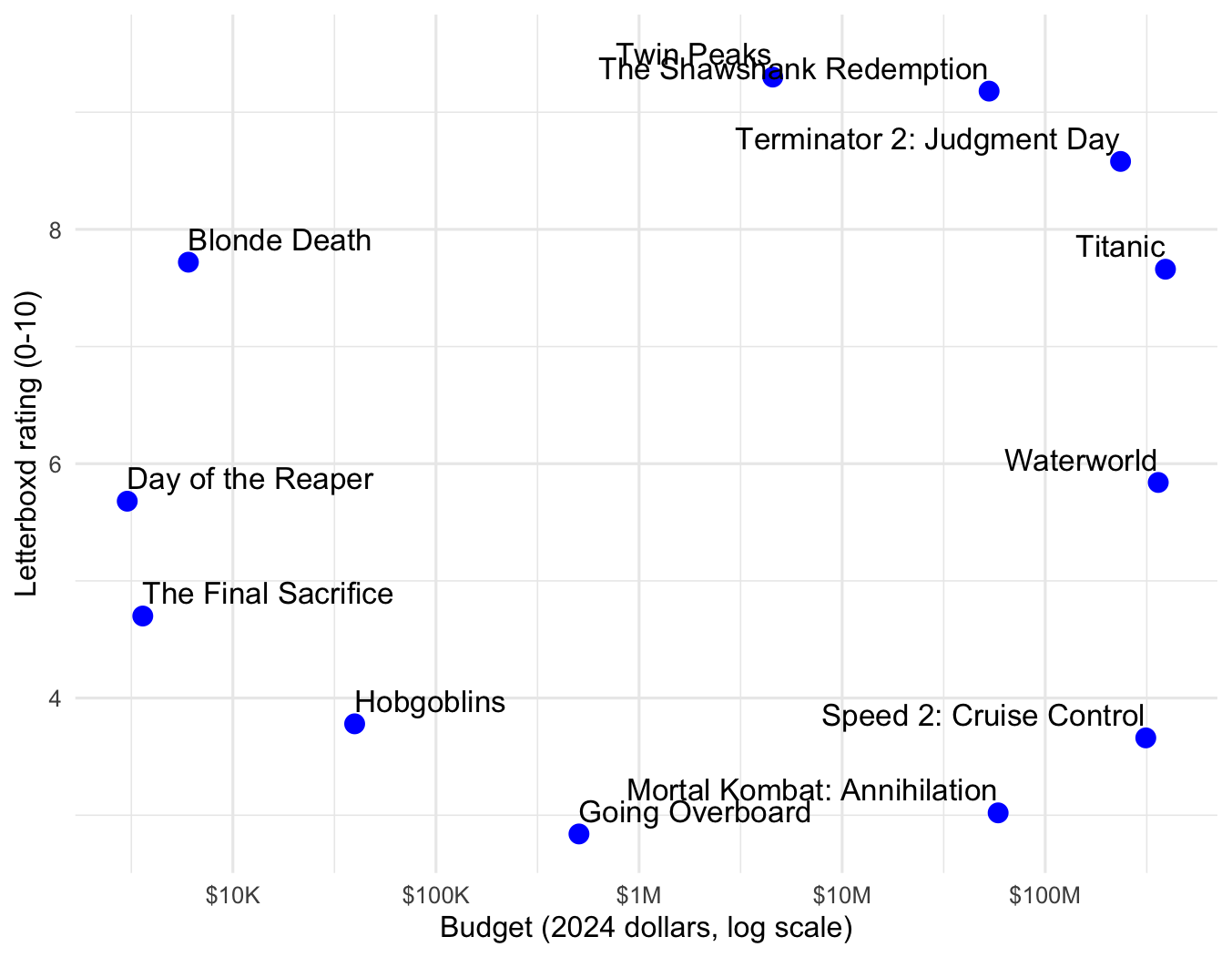
<?xml version="1.0" encoding="utf-8"?><feed xmlns="http://www.w3.org/2005/Atom" ><generator uri="https://jekyllrb.com/" version="3.10.0">Jekyll</generator><link href="https://owenthomas.no/feed.xml" rel="self" type="application/atom+xml" /><link href="https://owenthomas.no/" rel="alternate" type="text/html" /><updated>2026-10-17T10:00:26+00:00</updated><id>https://owenthomas.no/feed.xml</id><title type="html">The Oslo Dispatch</title><subtitle>Dispatches on statistics, literature, history, and culture.</subtitle><entry><title type="html">What Meeting a North Korean Defector Taught Me about Statistics</title><link href="https://owenthomas.no/theoslodispatch/2026/10/15/DMZ/" rel="alternate" type="text/html" title="What Meeting a North Korean Defector Taught Me about Statistics" /><published>2026-10-15T00:00:00+00:00</published><updated>2026-10-15T00:00:00+00:00</updated><id>https://owenthomas.no/theoslodispatch/2026/10/15/DMZ</id><content type="html" xml:base="https://owenthomas.no/theoslodispatch/2026/10/15/DMZ/"><![CDATA[<h4 id="what-is-the-literacy-rate-in-korea">What is the Literacy Rate in Korea?</h4>

<p>One of my favourite sensations is that of ambiguous sovereignty. Don’t get me wrong, I enjoy a well-functioning welfare state and judicious taxation to keep the public transport running on time, but it is also healthy to have the power structures that we live under be called into question every so often. Whose national narratives do we trust in these circumstances? To whom do we turn for authority concerning claims about social reality? These ambiguities can be explored in specific geographical regions of the world: border countries that have passed between nations like regifted scented candles, remote islands with limited loyalty with the mainland, or in the midst of large cities that identify more with the global cosmopolis than their subregional nearest neighbours.</p>

<p>Despite their relative social homogeneity, all of the mainland Nordic countries have their own examples. Norway has the international anti-Antarctic archipelago of Svalbard in the extreme North; Sweden has the neo-Medieval treasure of Gotland off its east coast; and Finland has the Swedish-speaking Åland islands muddling its national identity after receiving them in one of the only lasting decisions by the League of Nations. All three nations are stitched together across their northern extremities by the territory of the Sámi people, one of the few peoples of Europe routinely described as “indigenous”, and who routinely force the three nations to confront the unfamiliar emotion of post-colonial guilt. Central European Denmark has its own awkwardly ex-empire unresolved relationship with Greenland and the Faroes, stretching the bounds of their modern influence uncomfortably far across the north Atlantic. The United Kingdom, more than familiar with managing uneasy relationships with former possessions, has its own Celtic discontents closer to home along its Western fringe. More extensive recent immigration, contributing hugely to the thriving of the country, has also forced an accelerated reckoning of what it means to be a citizen of the former fulcrum of the world. </p>

<p>This summer, I had the pleasure of visiting the Demilitarised Zone (DMZ) between North and South Korea, possibly the most famous instance of awkward middle-grounds between rival political powers. While preparing for the day-trip from Seoul, I did some preliminary reading. Somewhat randomly, <em>Ender’s Game</em> (1985) by Orson Scott Card came to the top of my audiobook pile while waiting, but it made strangely appropriate reading in Seoul. For context: There were many young men in camo fatigues visible in the city, performing their involuntary military service, and privileges were explicitly shown to them. It was interesting that these young men clearly enjoy high social status, but the idealised K-pop male idols are conspicuously effeminate, wearing makeup, dressing fashionably and celebrated for singing and dancing well. It is possible that they offer a soft-edged antidote to the everyday militarism present in South Koreans’ lives. This has probably been discussed extensively in gender studies departments in Korea and I have simply not done the requisite reading, but it was striking to a lay-person such as myself.</p>

<figure>
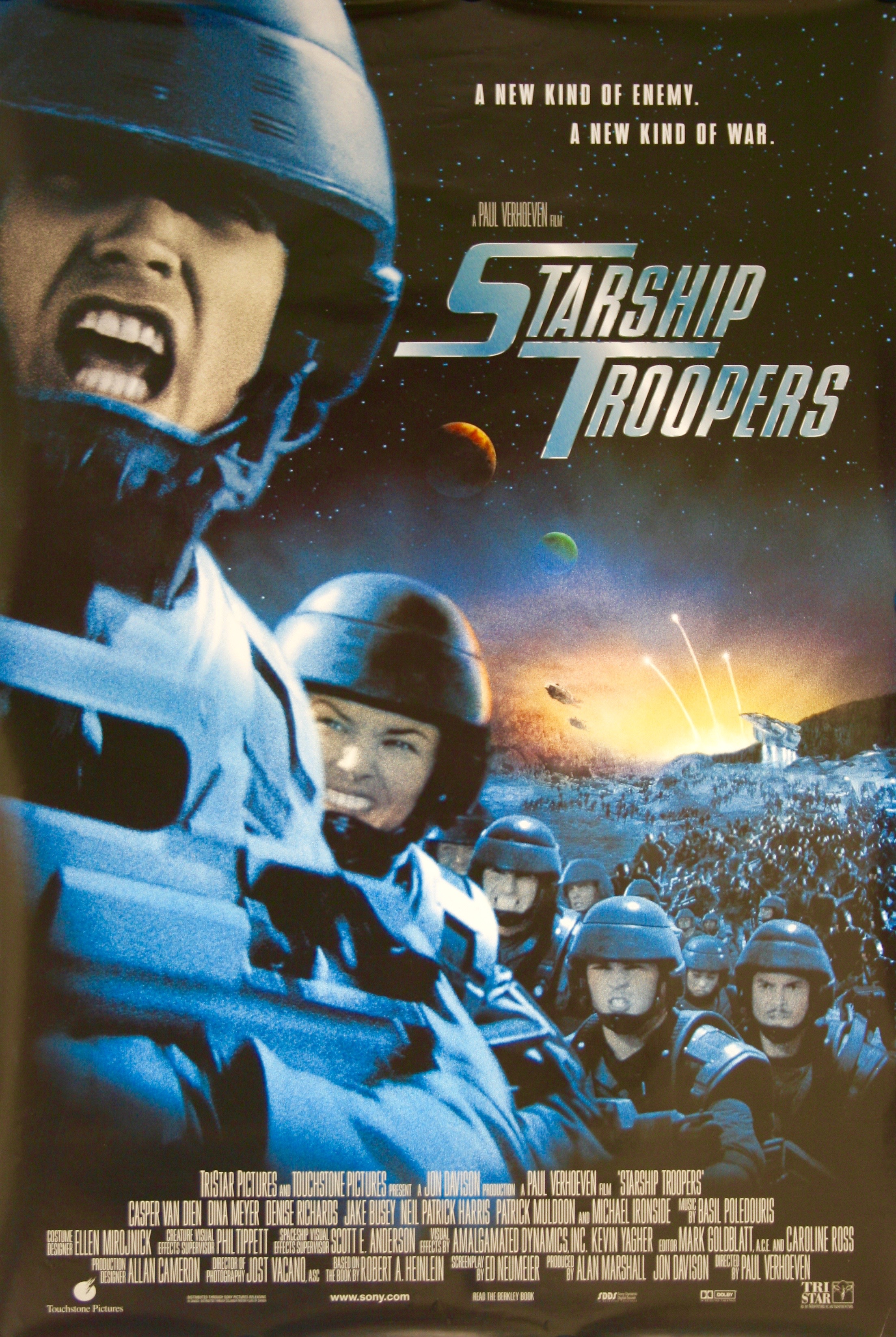
  <img src="/assets/images/2026-10-15-DMZ/starship_troopers.jpg" />
  <figcaption>Paul Verhoeven's 1997 satirical sci-fi masterpiece.</figcaption>
</figure>

<p>Meanwhile, the book was militaristic science fiction targeted directly at teenagers who (presciently enough for 1985) enjoy video games and internet message boards. I didn’t particularly enjoy it: All the adolescent narcissism of <em>Artemis Fowl</em> meets all the space fascism of <em>Starship Troopers</em>, without the campy subversive film adaptation to redeem it. At one point the term “ansible” is used to describe faster-than-light communication devices: this is lifted directly from Ursula K Le Guin, who first used it in her 1966 novel <em>Rocannon’s World</em>, referred to somewhat disrespectfully in Ender’s Game as “some old book”. Orson Scott Card has also supported laws criminalising same-sex sexual activity: I do not see it as a coincidence that the alien species that is eventually eradicated are known as the “buggers”.</p>

<p>Alongside the book, I was also drawn to some statistics coming out of North Korea, which make drily ridiculous reading to outside audiences: </p>

<ul>
  <li>Kim Jong-Il hitting eleven holes-in-one in his first ever round of golf. I know just enough about golf to realise that this would not be possible even with cosmological-scale beginner’s luck.</li>
  <li>Zero covid cases ever: one’s credence is initially tempted given the hermitic nature of the country, but the claim becomes more absurd considering the poor healthcare system and the presence of several thousand immigrants from China, which notoriously under-reported its own cases.</li>
  <li>A 100% literacy rate! For one reason or another, this was the one that stuck in my mind the most. Something about the unambiguous nobility of the claim, applied to the population as a whole rather than individual hagiographised leaders.</li>
</ul>

<p>Given the external narratives about the poverty and destitution of the locals, the 100% literacy claim seemed surprising: any claims of perfect records are immediately met with skepticism by statistically educated people, who are trained to recognise and interpret the variation and uncertainty present in our understanding of the world. That said, it is credible that North Korea might have a very high literacy rate: Sometimes communist countries do the basics more thoroughly than their capitalist competitors. Cuba famously used to have a lower infant mortality rate than the USA despite its vastly more limited resources. </p>

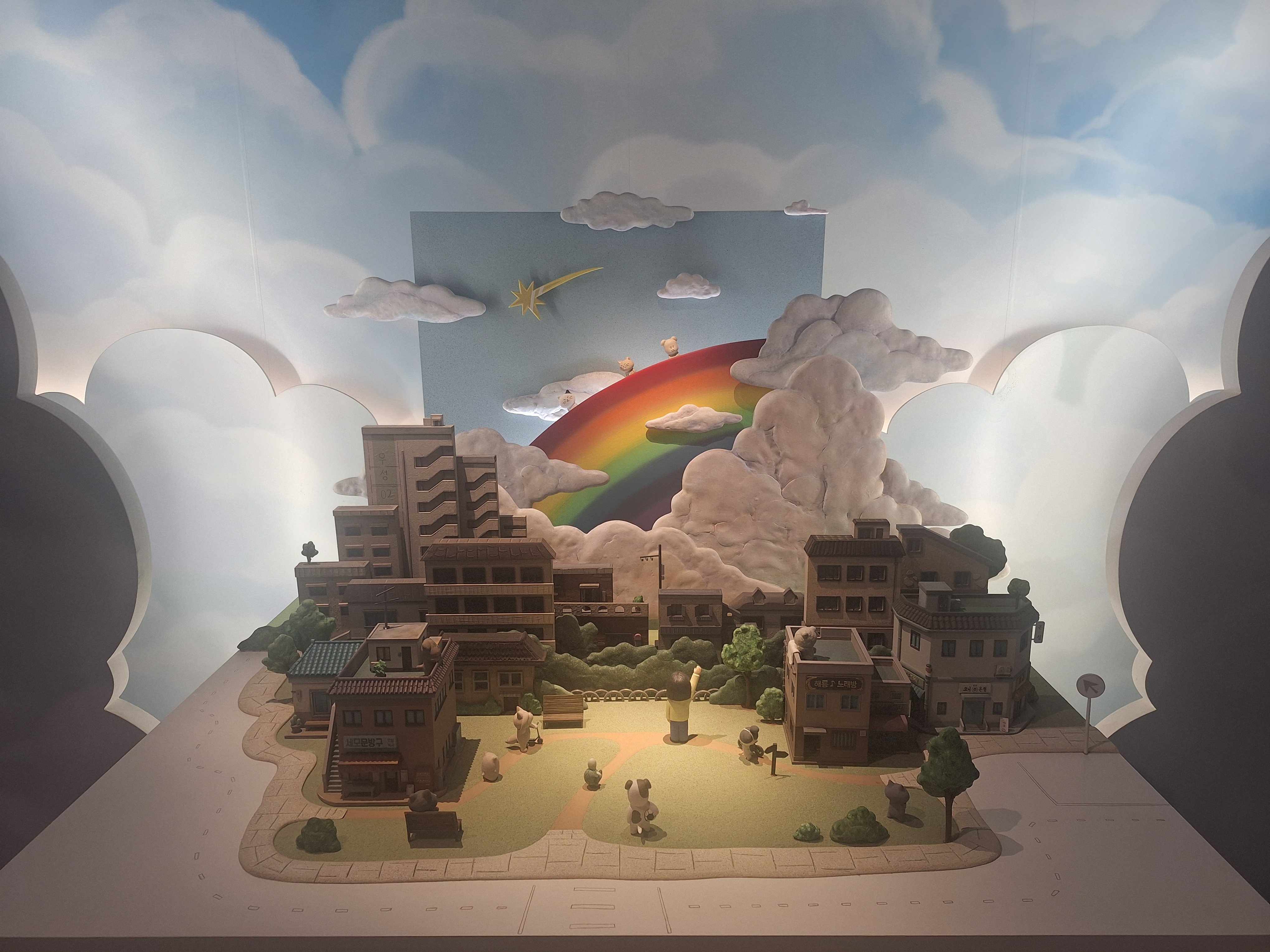
<p>By comparison, South Korean literacy rate is generally estimated at around 98%, with the 2% deviation from perfection having several possible causes: Firstly, the enormous green flag of greater honesty and transparency in the reporting process. Secondly, deep inequality in access to education: anyone who has seen <em>Parasite</em> (2019) would understand the profound variation in qualities of life between rich and poor in South Korea. Thirdly, the heavy technological-dependence of society may turn locals away from traditional forms of reading. Younger generations process information primarily through short-form video and social media: if we think of literacy beyond basic reading skills, South Koreans might be considered to have a literacy issue with a reduced focus on more challenging long-form writing. That being said, Seoul is the only city I know which has a library as the centrepiece of its principal shopping centre, and recent Nobel prize winner Han Kang is clearly popular and successful. The online illustrator Keykney hosted a well-attended and text-heavy exhibition of their webcomics, which was a fascinating multi-media fusion of internet culture, traditional visual art, and extensive walls of text to be read.</p>

<figure>
  <img src="/assets/images/2026-10-15-DMZ/Keykney.jpg" />
  <figcaption>The animal afterlife according to Keykney. The exhibition was probably the most committed and effective work of art I have encountered describing the experience of the death of a pet.</figcaption>
</figure>

<p>At last, the day of the DMZ visit arrived. On the bus on the way north, partly inspired by the literacy rate claims, I read Darrell Huff’s 1954 non-fiction book <em>How to Lie with Statistics</em>. I was not quite sure what to expect, as skepticism concerning statistics can take many forms: </p>

<ul>
  <li>The underlying anxiety that many people feel around mathematical topics, leading to insecure negative reactions.</li>
  <li>The suspicion that this is just some tedious bookwork necessary to enable the real fun of the phenomenon being studied.</li>
  <li>The cynicism that fails to believe that these abstract numbers are based in reality and not fabricated on the spot.</li>
  <li>The “Lies, Damned Lies, and Statistics” solipsistic appeal to not have a principled position influenced by something as prosaic as data.  </li>
</ul>

<figure>
  <img src="/assets/images/2026-10-15-DMZ/never-tell-me-the-odds-star.gif" />
</figure>

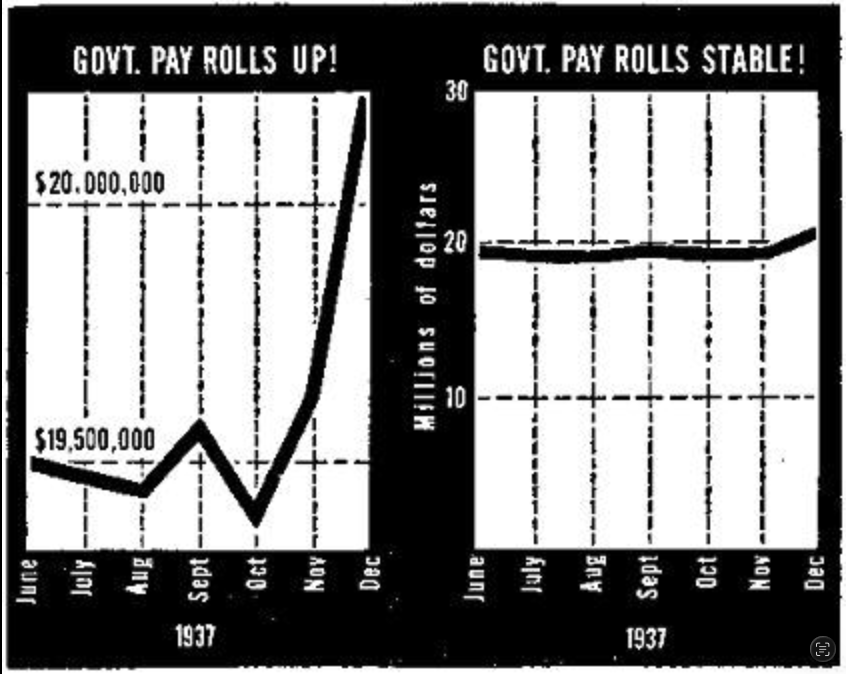
<p>Instead of these, I found something sympathetically specific: case studies in which statistics had been constructed that are technically true but misrepresent reality in the service of the agenda of the analyst. Think of reporting median instead of the mean salary in a company when wanting to hide the out-of-proportion income of the CEO, or the legion of visualisation methods that provide misplaced intuition while still maintaining the illusion of objectivity:</p>

<blockquote>
  <p>[A misleading graph] is vastly more effective, however, because it contains no adjectives or adverbs to spoil the illusion of objectivity, there’s nothing anyone can pin on you.</p>
</blockquote>

<p>There was not so much in the way of modern statistical inference tricks that might be used to, for example, nudge a p-value below a significance boundary (someone should write that book!). Still, it was quite interesting in its own somewhat superficial way.</p>

<figure>
  <img src="/assets/images/2026-10-15-DMZ/misleading_graph.png" />
  <figcaption>Does pay go up or stay stable? Ask the y-axis.</figcaption>
</figure>

<p>This book led me to reflect on the experience of my totalitarian statistician counterparts, and what kind of pressure they are under to generate pseudo-objective numbers to support the regime. I was dwelling on a couple of issues in particular:</p>

<ol>
  <li>Are the statistics coming out of North Korea were entirely made-up, or of the technically-true-but-carefufully-selected variety? I found a <a href="https://www.nknews.org/2019/06/the-historical-roots-of-north-koreas-notoriously-unreliable-statistics/">Blog post</a> that suggested that some decades ago, they tended to “fudge” the numbers rather than outright fabricate them, but that was quite some time ago.</li>
  <li>What is the real literacy rate, if not the unbelievable 100% reported by the regime?</li>
</ol>

<p>With these two questions in mind, I entered the DMZ.</p>

<p>The DMZ itself was manifestly beautiful: decades of enforced depopulation has led to its flourishing as an informal nature reserve. The experience of spending time in the pseudo-organic landscape was a welcome antidote to the psychological stress of finding myself in the immediate vicinity of an ongoing conflict with nuclear weapons on the table. The weather was warm and clear: we were herded to an observation post with powerful binoculars to look over the border to ogle the wretchedness of the DPRK. I felt absurd visually skipping through the luscious greenery trying to pick out the much smaller, shabby sentry tower facing us from the other side. The Potemkin village of Kijong-dong stood clearly devoid of people, but with facsimile buildings that were convincing enough at a distance: the contrast with the thriving natural environment was made all the more more tantalising by the strict ban on photography.</p>

<figure>
  <img src="/assets/images/2026-10-15-DMZ/Bridge_DMZ.jpg" />
  <figcaption>The surprisingly verdant DMZ landscape.</figcaption>
</figure>

<p>The Q&amp;A session with a North Korean defector followed. It was unclear what format this would take, and how tightly controlled the parameters of the interaction would be. We were shepherded into a room with about a hundred chairs arranged in narrow rows facing a small stage. We were shown an introductory video that was about ten minutes long, showing poverty-stricken Northerners delivering coal by horse and cart, and reconstructions of attempted border-crossings. It was not clear if this was intended to encourage us to show sympathy for the defector’s plight, or as a warm-up to the narrative of senseless suffering that was about to become flesh in front of us. </p>

<p>The defector was brought on stage with an interpreter: she was perhaps in her 50s, dressed conservatively in a Western style. A few introductory explanations came that she had defected in 2019, and the audience was asked to provide questions in a somewhat haphazard way. I was sat near in front so was able to ask one quite early: “What is the literacy rate in North Korea? How many people know how to read?” After a couple of attempts the interpreter understood my English, and passed the question onto the defector. Her eyes widened at the question, and looked at me with a sense of shock. Given the primitive representation of life in the North shown in the video, this didn’t seem like an unreasonable question, but from her response I would think that she had never been asked this before. She explained quite matter-of-factly that everyone could read, then immediately followed up that this was the one thing that the government did well. Furthermore, she explained that thorough selective education is necessary to ensure that everyone could consume state propaganda direct from the source, and not through the potentially diluting influence of word-of-mouth.</p>

<p>A couple of other questions followed, describing in detail her defection process through China and ultimately via Mongolia. There was a slight lull in momentum, so I took the opportunity to ask my second question, motivated by <em>How to Lie With Statistics</em>: “Of all of the narratives and statistics that we hear from North Korea, do they have any basis in reality, or are they totally fabricated?” The defector took no time to answer this time, stating definitively that they were all lies and not to be believed. What I really meant was whether the lies told by the regime were of the outright fabrication type, or of the Darrell Hoff-style accurate but bad-faith misrepresentations. I wanted to clarify with a follow-up question “Yes but what <em>kind</em> of lies?”, but a third question felt selfish at that point. My second question might have seemed stupid to everyone else, but I was angling for a degree of nuance that wasn’t really possible in the format provided.</p>

<figure>
  <img src="/assets/images/2026-10-15-DMZ/Soy_DMZ.jpg" />
  <figcaption>Enjoying a soy-bean ice-cream after the interview.</figcaption>
</figure>

<p>The day trip gave me much to reflect on, and I eventually came to a better understanding of what had happened in the Q&amp;A. My questions were almost those that a DPRK-sympathiser would have posed, but I did mean them in good faith given the research that I had done. I doubt that that my overly regime-sympathetic questions have got me put on a list: I successfully made it through the airport on the way out, at least. In retrospect, I also realised the absurdity of my line of inquiry: to anyone with a lived experience of the consequences, the difference between a technically-true-lie-with-fudged-statistics and a straight-up fabrication is immaterial. The latter is immediately ethically offensive, but the former is more insidious for the same reason, since it can be said with a straight face and with sources to cite. Masters of the craft like the DPRK propagandists blend the two effortlessly. My attempted quizzing of a regime survivor on her experience the difference was exposed as pretentious, academic quibbling.</p>

<p>So what have I learned? To my first question: bad-faith selective statistics are at least as useless as fictitious ones, and we should pride ourselves on treating both with disdain. To my second question: what is the literacy rate in Korea? Well, literacy is not a black-and-white issue, as the South Korean authorities seem willing to acknowledge, with their approach featuring laudable degrees of openness and nuance. It does appear that the rate in North Korea is high, but perhaps government pressure, limited analysis resources, and some crude rounding up, leads to suspiciously perfect figures. Whether you are able to read, however, is not the final word, and each region has its own additional issues: the North is limited in what they are allowed to read, and the South is struggling to find the will to read more challenging works when short-form video is omnipresent. And in the gloriously ambiguously sovereign DMZ? Bereft of permanent residents, we have the ultimate statistical ambiguity when normalising with respect to a population of zero: Undefined!</p>]]></content><author><name></name></author><summary type="html"><![CDATA[What is the Literacy Rate in Korea?]]></summary></entry><entry><title type="html">Foucault’s Pendulum in Nidaros</title><link href="https://owenthomas.no/theoslodispatch/2026/10/01/FPN/" rel="alternate" type="text/html" title="Foucault’s Pendulum in Nidaros" /><published>2026-10-01T00:00:00+00:00</published><updated>2026-10-01T00:00:00+00:00</updated><id>https://owenthomas.no/theoslodispatch/2026/10/01/FPN</id><content type="html" xml:base="https://owenthomas.no/theoslodispatch/2026/10/01/FPN/"><![CDATA[<h4 id="ancient-numerology-meets-contemporary-compositions-in-the-ideal-context-of-trondheim">Ancient numerology meets contemporary compositions in the ideal context of Trondheim</h4>

<p>This summer I performed at Olavsfest, a music festival in Trondheim, Norway. The city is located about halfway up the country, at the chokepoint where the rounded rhomboid mass of southern Norway narrows into its slim, sparsely-peopled quiff in the Arctic. Trondheim is today dominated by three presences: firstly, the near-millenium-old Nidaros Cathedral, whose spires rise from the middle of the water-ringed old town;  secondly, NTNU, the modern science and technology university that towers over the city from the top of nearby Gløshaugen plateau; and thirdly, more elevated and ancient than them all, the ever-changing weather.</p>

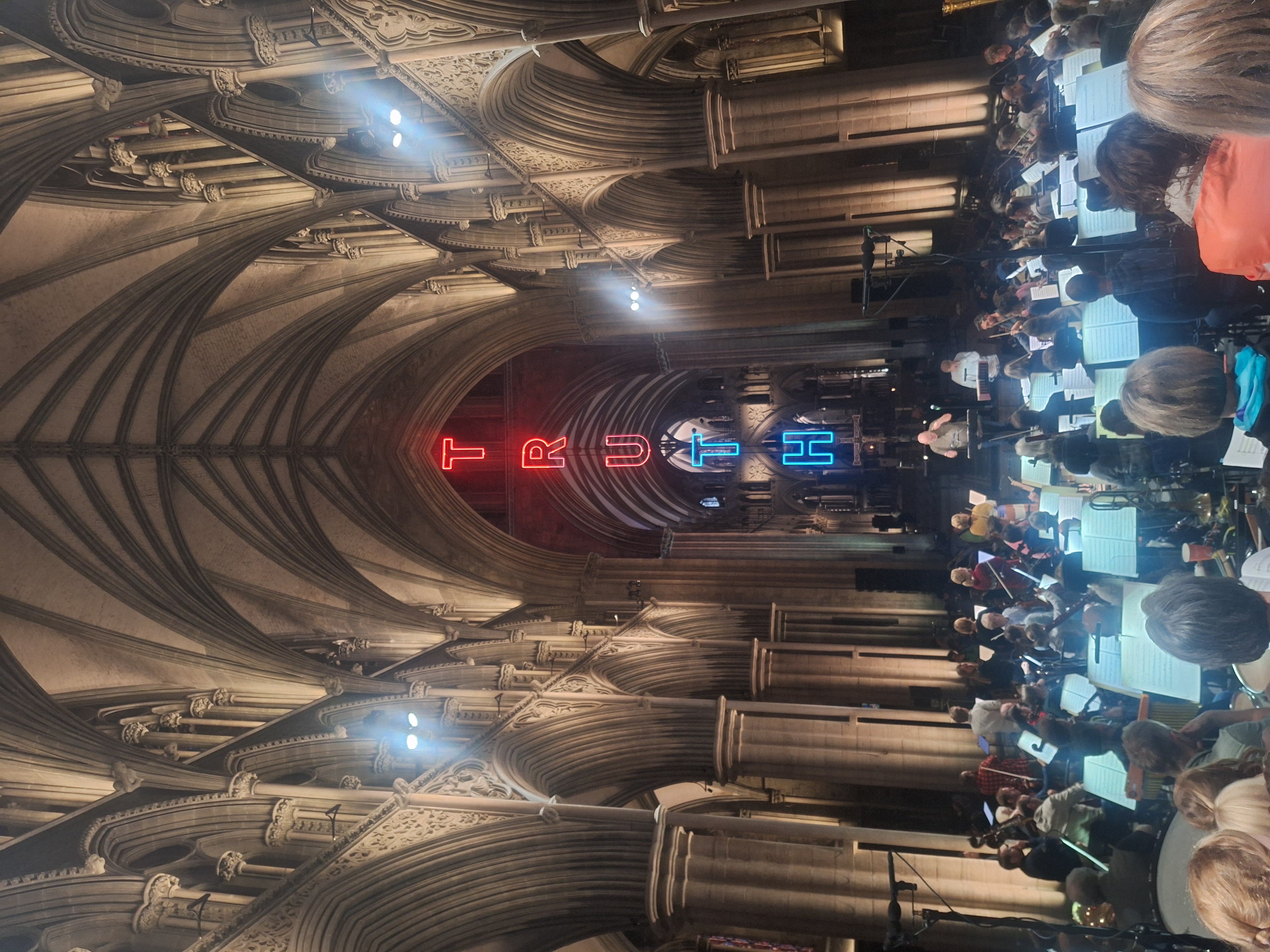
<p>The cathedral is Norway’s only example of the large-scale Medieval gothic church architecture with which the UK is so abundant. The dimensions of the building are of a genuinely breathtaking scale, to an extent that feels somehow un-Norwegian: churches here are either the ancient, gloomy, timber-scented and dragon-encrusted stave churches left to us by the latter-day Christianised vikings, or more modern austere affairs reflecting the minimal and self-denying tendencies of Nordic Lutheranism. Of course, Nidaros cathedral is as Norwegian as they come, with the national patron saint’s bones enshrined in the crypt and the crown jewels in the museum across the square.</p>

<figure>
  <img src="/assets/images/2026-10-01-FPN/Nidarosdomen.jpg" />
  <figcaption>Nidaros cathedral mid-rehearsal.</figcaption>
</figure>

<p>NTNU has a much more recent history, initially as a technical college in 1870 and only taking its present name after a reorganisation in 1996. It positions itself as Norway’s answer to MIT or Imperial College London: a specialist school in science and engineering, it generates some excellent researchers, including Edvard and May Britt Moser, who in 2014 became the nation’s first science Nobel winners in decades. Considering the intertwined history of the origins of our present day academic system from the tradition of monasteries, the two institutions have surprisingly little to do with one another: especially so since NTNU shut down its church music degree programme two years ago.</p>

<figure>
  <img src="/assets/images/2026-10-01-FPN/NTNUfront.jpg" />
  <figcaption>NTNU campus with approximately average Trondheim sky colour.</figcaption>
</figure>

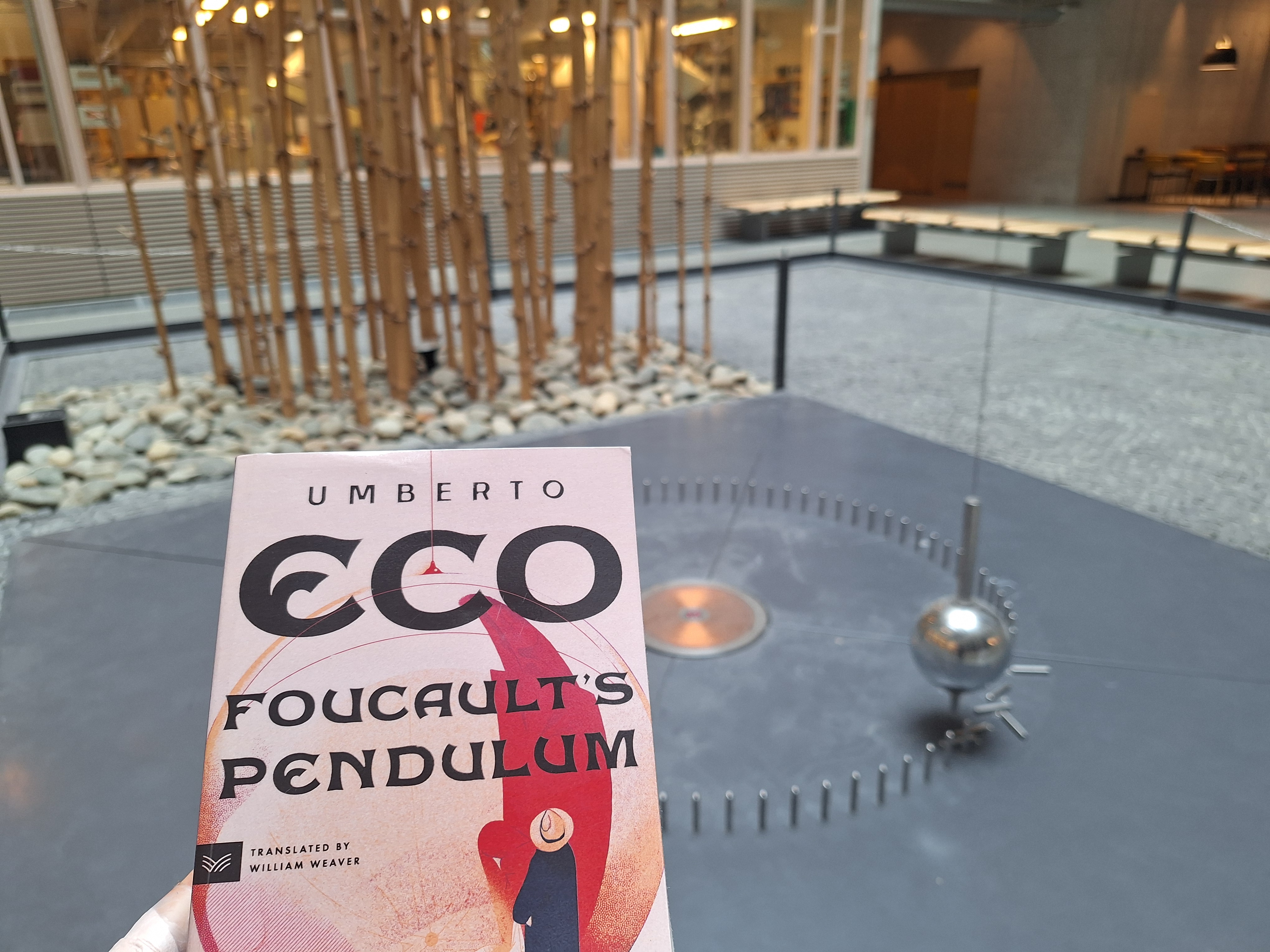
<p>By some coincidence, I was reading a book during the trip that captured the multiple natures of the city quite effectively: Foucault’s Pendulum by Umberto Eco. The book is a long, dense, interweaving of scientific riddles with obscure Medieval conspiracy theories, all structured reflecting the Kabbalistic tradition of Jewish mysticism<sup id="fnref:1" role="doc-noteref"><a href="#fn:1" class="footnote" rel="footnote">1</a></sup>. It felt so pleasing to be able to read the book during rehearsal downtime in the cathedral, with the text of the book in dialogue with the centuries of pilgrims’ inscriptions on the walls, themselves represented in the commissioned Mass of Graffiti that we were performing.</p>

<p>Similarly, the scientific bent of the book felt at home at NTNU. According to Eco, the book’s title has nothing to do with philosopher Michel Foucault, although that is precisely the kind of playful literary misdirection that he would engage in to amuse himself. Instead, the physicist Léon Foucault designed a physics experiment in 1851 demonstrating the rotation of the Earth from a stationary perspective: a pendulum that is left to swing freely under its own mass at the Earth’s surface will appear to rotate its plane of oscillation over the course of a full day.</p>

<p>The mechanism can be best understood through imagining one located at one of the poles: the earth will rotate on its axis directly underneath the constant swing of the pendulum, which will trace out a perfect hyper-petalled floral design on the snow beneath. The effect is most clearly observed at the poles and does not exist at the equator: this is pleasingly reflected in the map of the global distribution of those mentioned on wikipedia:</p>

<iframe src="https://osm4wiki.toolforge.org/cgi-bin/wiki/wiki-osm.pl?project=en&amp;article=List_of_Foucault_pendulums" width="100%" height="600" style="border: none;" loading="lazy">
</iframe>

<p>Some medium other than snow is often used to track the precession of the pendulum, more often sand or small sticks that can be knocked over. Of course, owing to air resistance and the capture medium, the pendulum will gradually lose energy, so modern installations often use an electromagnet to compensate, without interfering with the mechanism of interest or demanding human intervention. There is an attractive installation of one on the NTNU campus, where I naturally took a photo:</p>

<figure>
  <img src="/assets/images/2026-10-01-FPN/NTNUpendulum.jpg" />
  <figcaption>Foreground: Foucault's Pendulum. Background: Foucault's Pendulum.</figcaption>
</figure>

<p>The book itself was enjoyable, and surprisingly varying in tone, with the scientific themes implied by the title only breaking through explicitly in a handful of places. The pendulum itself crops up as a plot device towards the end as the guide to finding the location of the <em>Umbilicus Telluris</em>, the “Navel of the World”: this is the crucial missing piece in a fabricated conspiracy theory developed by one of the characters, which attracts a particularly intense groups of devotees known as the Diabolicals. Their plan to attain this knowledge is eventually executed at the fabricator’s expense in a particularly gruesome fashion.</p>

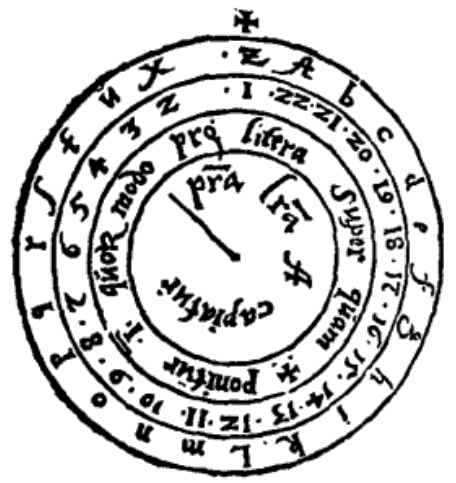
<p>Other mathematically inclined moments include an extended sequence concerning plot-driven codebreaking, including the physical machinery of Cipher disks: these were invented by Leon Battista Alberti in 1471 to encrypt (or decrypt) passages of text much more quickly than using lengthy lookup tables. Some nice diagrams are featured representing them, and fairly practical instructions as to have they would have worked in practice.</p>

<figure>
  <img src="/assets/images/2026-10-01-FPN/cipherdisk1.png" />
  <figcaption>A cipher disk from the novel.</figcaption>
</figure>

<p>The characters end up facing the task of reconstructing a map to locate the <em>Umbilicus Telluris</em>, with an approach that takes a surprisingly computational turn:</p>

<blockquote>
  <p>Meanwhile, they recorded events, gathered information, and put it all—where? In Abulafia, Belbo joked. But Diotallevi, who had been gathering information himself, said it was no joke. Surely the Jesuits were constructing an immense, tremendously powerful computer that would draw a conclusion from this patiently accumulated, age-old brew of truth and falsehood.</p>
</blockquote>

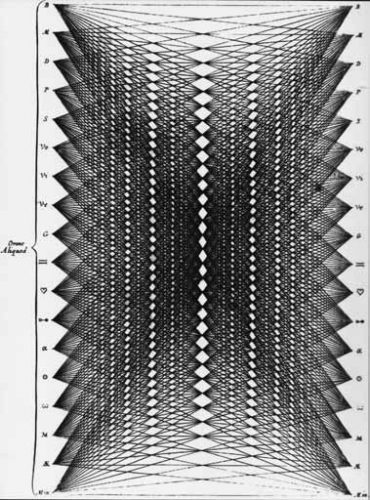
<figure>
  <img src="/assets/images/2026-10-01-FPN/crochetpattern.png" />
  <figcaption>The combinatoric "crochet pattern".</figcaption>
</figure>

<blockquote>
  <p>“The Jesuits,” Diotallevi said, “understood what neither the poor old Templars of Provins nor the Baconian camp had yet realized, namely, that the reconstruction of the map could be accomplished by ars combinatoria; in other words, with a method that foreshadowed our modern electronic brains. The Jesuits were the first to invent Abulafia! Father Kircher reread all the treatises on the combinatorial art, from Lullus on, and you see what he published in his Ars Magna Sciendi…”“It looks like a crochet pattern to me,” Belbo said.“No, gentlemen, these arc all the possible combinations. Factor analysis, that of the Sefer Yesirah. Calculation of permutations, the very essence of the temurah!”This was certainly so. It was one thing to conceive Fludd’s vague project of identifying the map by beginning with a polar projection; it was quite another to figure out how many trials would be required in order to arrive at the correct solution. And, again, it was one thing to create an abstract model of all the possible combinations, and another to invent a machine able to carry them out. So both Kircher and his disciple Schott built mechanical devices, mechanisms with perforated cards, computers ante litteram. Binary calculators. Cabala applied to modern technology. IBM: lesus Babbage Mundi, lesum Binarium Magnificamur. AMDG: Ad Maiorem Dei Gloriam? Not on your life! Ars Magna, Digitale Gaudium! IHS: lesus Hardware &amp; Software!”</p>
</blockquote>

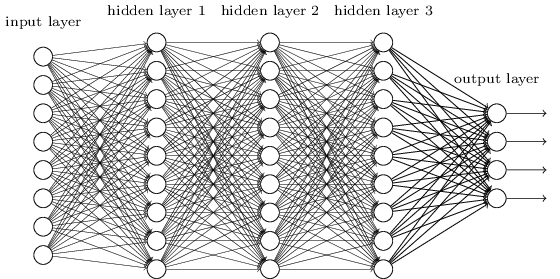
<p>That “crochet pattern” diagram will immediately trigger the visual memories of anyone who has read up on the methodology behind the AI models that presently sweeping the world: the densely-connected edges between two layers of nodes mimic the exact structure of a single-layer neural network, and it is iterating these single layers that generates powerful “deep learning” models. One example diagram is here:</p>

<figure>
  <img src="/assets/images/2026-10-01-FPN/deepneuralnetwork.png" />
  <figcaption>A basic deep neural network, with suspiciously crochet-pattern vibes.</figcaption>
</figure>

<p>The references to “Binary calculators” and punning on IBM are too direct for Eco to have not been aware of the technological implications: neural networks as a topic were undergoing a revival at the time of writing, including the reissuing of Minsky and Paper’s <em>Perceptrons</em> book in 1988, and Rumelhart and McClelland’s <em>Parallel Distributed Processing</em> in 1986. The analogy between “Cabala applied to modern technology”, limited only by the computational power available in 1988 feels extremely prescient: with 2026’s acres of data centres we can train LLMs that vast amounts of the population are willing to credit with near-divine insight.</p>

<p>Earlier in the book there is a moment in which a character needs to guess a computer password to gain access to the Abulafia, the computer holding the digital repository of collected knowledge. They consider the possibility of exploring the space of all possible strings systematically, again reflecting the combinatoric reasoning that reoccurs later.</p>

<p>Given the religious nature of the book, the character suspects that the password might be a permutation of the Tetragrammaton, or the four letters of the name of God. Never spoken aloud by observant Jews, the four Hebrew letters transliterated into English are <strong>YHWH</strong>, and are most commonly rendered as a full word in English as Jehovah. The character then goes on to construct a computer program in BASIC to permute these four letters, which is pleasingly discordant in an otherwise prose-heavy novel:</p>

<blockquote>
  <p>“The problem is to find all the permutations of the name of God, isn’t it? Well, this manual has a neat little program in Basic for listing all possible sequences of four letters. It seems tailor-made for YHVH. Should I give it a whirl?”</p>

  <p>10  REM anagrams
20  INPUT L$(1), L$(2), L$(3), L$(4)
30  PRINT
40  FOR I1 = 1 TO 4
50  FOR I2 = 1 TO 4
60  IF I2 = I1 THEN 130
70  FOR I3 = 1 TO 4
80  IF I3 = I1 THEN 120
90  IF I3 = I1 THEN 120
100 LET I4 = 10-(I1+I2+I3)
110 LPRINT L$(I1);L$(I2);L$(I3);L$(I4)
120 NEXT I3
130 NEXT I2
140 NEXT I1
150 END”</p>

  <p>“Try it yourself. When it asks for input, type in Y, H, V, H, and press the ENTER key. But you may be disappointed. There are only twenty-four possible permutations.”</p>
</blockquote>

<p>Why 24? Well, it is a strict function of the number of letters used as input: any four-letter string should have 24 permutations, since you can start with any of the four letters, then proceed with any of the remaining three, then choose one of the two left, and then be forced to choose the final one. This gives you 4x3x2x1 =4!=24 possibilities<sup id="fnref:2" role="doc-noteref"><a href="#fn:2" class="footnote" rel="footnote">2</a></sup>. This naive analysis, however, contains an error. the string <strong>YHVH</strong> contains a repeated letter, in this case <strong>H</strong>: this reduces the total number of unique permutations to 12, since solutions in which the two <strong>H</strong> letters are exchanged will be indistinguishable.</p>

<p>However, the problem specification quickly increases in the book: it is asked what would happen if the name of God were lengthened? Well, the number of possible permutations unsurprisingly increases. The potential length is expanded up to 27 letters, owing to the 27 letters of the Hebrew alphabet. There is something pleasing to the idea that the name of God would justly and universally include each letter exactly once, resulting in 27! possibilities. However, it is then asserted that without a given string to permute, “the name of God could be aleph repeated twenty-seven times”, so we have to move from factorials to exponentials: 21! becomes 27<sup>27</sup>, which grows substantially faster: instead of multiplying 27 by all 26 integers smaller than it, we multiply 27 by itself 27 times<sup id="fnref:3" role="doc-noteref"><a href="#fn:3" class="footnote" rel="footnote">3</a></sup>. Some indulgence is taken in the text with cosmic scale of the numbers produced: real joy appears to be experienced in the utter intractability of the problem of enumerating them all with a computer, something akin to the rapture of the true believer in surrendering themselves to the unknowability of the divine.</p>

<p>In the midst of enjoying himself, while referencing the exploding factorial functions, Eco introduces a misleading pun:</p>

<blockquote>
  <p>You know what this is called today? Factor analysis.</p>
</blockquote>

<p>One could reasonably describe the analysis of factorials as “factor analysis”, but unfortunately that specific pairs of words was already in widespread use by 1988 to refer to something else: statistical models used to decompose observed data into a smaller number of latent factors,  somewhat similar to the single-layer neural networks shown in Figure REF. Given his apparently familiarity with the latter, one assumes that he is making this joke out of mischief rather than ignorance.</p>

<p>Of course, the problem is then escalated one last time, with the assertion:</p>

<blockquote>
  <p>The real and true name of God, the secret name, is as long as the entire Torah.</p>
</blockquote>

<p>At this point, the narrative shifts to pure mysticism and drops the quantitative approach, but just to amuse myself I will pick up the numerical thread myself. Confusingly, the Torah has differing numbers of letters depending on whether one is speaking concretely or figuratively. although it is not so unusual to represent a large, precise number by a more rhetorically convenient, larger, rounder number: consider Gustav Mahler’s “Symphony of a Thousand” featuring a mere three to five hundred musicians. Speaking literally, every copy of the Torah has an identical total of 304,805 characters, but idiomatically it is said to have 600,000. A factor of two would be quite meaningful for the scribes tasked with copying them, but the possibly permutations of strings of either of those lengths is so vast that it would be hard to communicate a meaningful intuition of the difference between the two.</p>

<p>27<sup>304,805</sup> and 27<sup>600,000</sup> are easy to express concisely as exponents, but are inconceivably vast numbers, both larger than any number used to describe anything tangible in the natural sciences, including e.g. the number of atoms in the universe. However, these types of numbers do emerge in statistics through similar reasoning as sizes of state-spaces that one might want to perform inference over. For example, if you were looking to assign data points to 27 exclusive clusters, and had a dataset of 600,000 individuals (conceivable in our post-“Big Data” era), this is is the precise number of possible solutions that you would need to find some way of choosing between in a principled manner.</p>

<p>It is kind of fun to attempt to expand one’s perception to try to gain any conscious traction on what numbers of this scale might mean. This, I think, is the analogy that Eco is trying to communicate with theology: for religious people, the true name or nature of the divine is inherently unknowable and inaccessible, but it is the effort of conscious exploration of the vast possible state-space that is supposed to enlighten us.</p>

<p>Of course, the password in the novel is eventually guessed, not through a misguided brute-force combinatoric search, but instead with some ironic second-order Gödelian logic:</p>

<blockquote>
  <p>“Do you have the password?” I typed: NO.</p>
</blockquote>

<p>There is another specifically Jewish mystical numerological tradition mentioned in Foucault’s Pendulum: “gematria, which seeks sublime affinities between words and their numeric values”. This is a different approach, in which different Hebrew letters are assigned unique numbers. The numbers of the letters in a word are added to give each word a representative number, and then the numbers associated with words are compared to give supposed insight into the relationships between their meaning. This might be considered spiritual-mathematical gold dust, flashy quantitative rhetoric, or numerological nonsense depending on your personal taste.</p>

<figure>
  <img src="/assets/images/2026-10-01-FPN/thechosen.jpg" />
  <figcaption>Chaim Potok's The Chosen.</figcaption>
</figure>

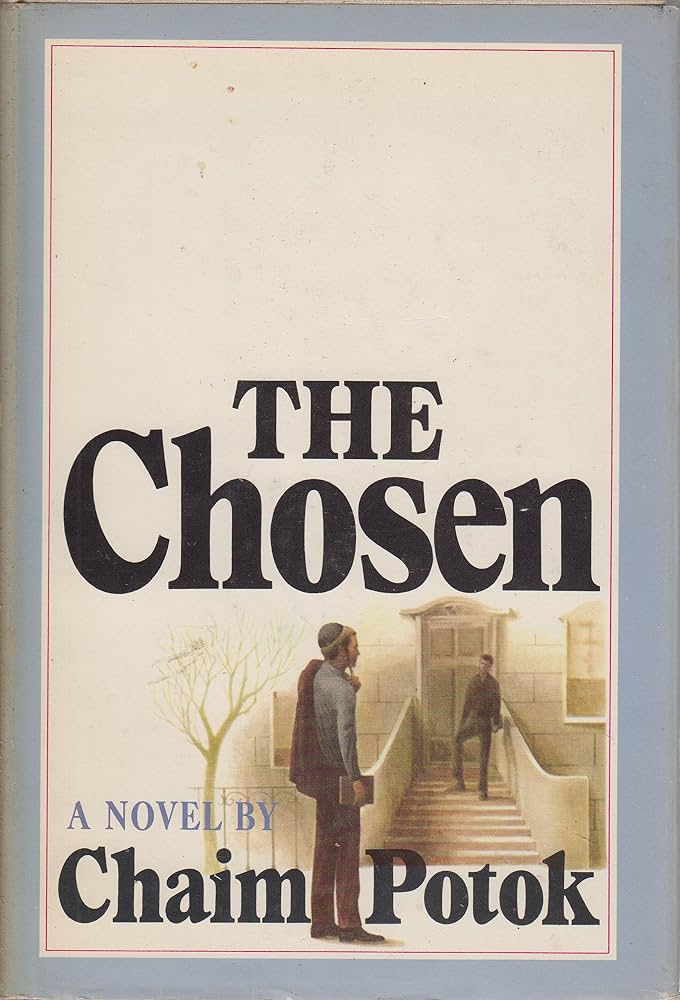
<p>I first encountered gematria in Chaim Potok’s <em>The Chosen</em>, a beautiful novel about the adolescence of Reuven Malter, a boy coming of age in a strict Orthodox community in 1940s Williamsburg. The gematria features in a virtuosic preaching performance from the respected Rabbi Reb Saunders:</p>

<blockquote>
  <p>In gematriya, the letters of the word ‘traklin,’ hall, the hall that refers to the world-to-come, come out three hundred ninety-nine, and ‘prozdor,’ the vestibule, the vestibule that is this world, comes out five hundred thirteen. Take ‘traklin’ from ‘prozdor,’ and we have one hundred fourteen. Now listen to me. A righteous man, we said, is two hundred four. A righteous man lives by Torah. Torah is mayim, water; the great and holy rabbis always compare Torah to water. The word ‘mayim’ in gematriya is ninety. Take ‘mayim’ from ‘tzaddik’ and we also have one hundred fourteen. From this we learn that the righteous man who removes himself from Torah also removes himself from the world-to-come!</p>
</blockquote>

<p>You get the idea. Of course, it emerges that that Reb Saunders has left a trap for the mathematically-inclined protagonist by deliberately erring in the calculation of on the the word-scores: the student is precocious enough to correct Reb Saunders in front of a crowd, to the congregation’s shock and the Rabbi’s delight. Reuven’s father, however, does not share the Rabbi’s enthusiasm</p>

<blockquote>
  <p>I saw him grimace when I began to go over the gematriyot. My father did not particularly care for gematriya. He had once referred to it as nonsense numerology and had said that anything could be proved that way, all that had to be done was to shift letters around adroitly so as to make the values come out any way you wanted.</p>
</blockquote>

<p>Well, beauty is where you find it. We should not confuse the quantitative nature of gematria with logical rigour, and we are not proving anything in a rational sense. However, I think it is admirable that numbers are used in this tradition to attempt to do something creative or even sublime, transcending the mere tedious bookkeeping with which we might ordinarily associate them. There is no inherent trade-off between how useful something can be and how much fun we can have it, and we have perhaps erred in proposing mathematic as being the sensible, practical and dull education necessary to pursue no-one’s childhood dream career as an actuary. Imagine how magical numbers would be to us if we weren’t taught them in school! As Eco and Potok and have demonstrated above, we should instead be open to the use of mathematics in our leisure time, and we should pursue it out of giddy, hedonistic fun.</p>

<div class="footnotes" role="doc-endnotes">
  <ol>
    <li id="fn:1" role="doc-endnote">
      <p>I should clarify ahead of time that I have a deep and enduring respect and interest in Jewish culture and its intellectual tradition, but am not myself of the community so apologise in advance if I get anything wrong. Indeed, the saying goes that a Jew should not study Kabbalah until they are 40 years old, married, and have children, and even then, to do so can be dangerous. Well, I am unmarried, childless and have been Jewish for precisely zero years of my life, so wish me luck. <a href="#fnref:1" class="reversefootnote" role="doc-backlink">&#8617;</a></p>
    </li>
    <li id="fn:2" role="doc-endnote">
      <p>The exclamation point ! is representing the factorial function, by which a number is multiplied by every integer smaller than itself. <a href="#fnref:2" class="reversefootnote" role="doc-backlink">&#8617;</a></p>
    </li>
    <li id="fn:3" role="doc-endnote">
      <p>Stirling’s approximation would suggest that n! is approximately e<sup>n</sup> smaller than n<sup>n</sup> for large n. <a href="#fnref:3" class="reversefootnote" role="doc-backlink">&#8617;</a></p>
    </li>
  </ol>
</div>]]></content><author><name></name></author><summary type="html"><![CDATA[Ancient numerology meets contemporary compositions in the ideal context of Trondheim]]></summary></entry><entry><title type="html">When Books and Films Collide</title><link href="https://owenthomas.no/theoslodispatch/2026/09/17/STB/" rel="alternate" type="text/html" title="When Books and Films Collide" /><published>2026-09-17T00:00:00+00:00</published><updated>2026-09-17T00:00:00+00:00</updated><id>https://owenthomas.no/theoslodispatch/2026/09/17/STB</id><content type="html" xml:base="https://owenthomas.no/theoslodispatch/2026/09/17/STB/"><![CDATA[<h4 id="do-good-books-make-good-film-adaptations-i-statistically-compare-ratings-between-goodreads-and-letterboxd-to-find-out">Do good books make good film adaptations? I statistically compare ratings between Goodreads and Letterboxd to find out.</h4>

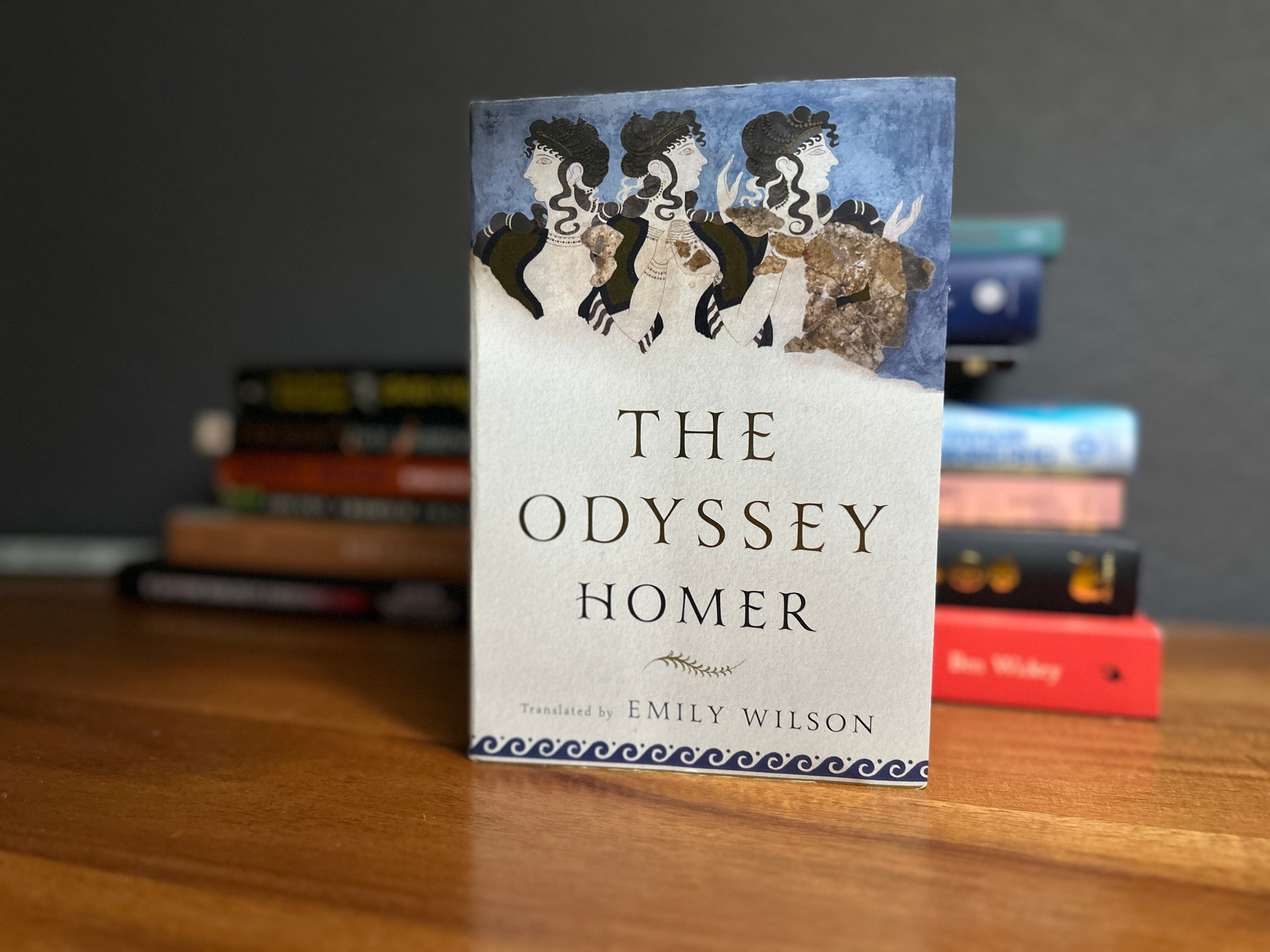
<p>There was a frisson of excitement to be felt when old-school literary feuding collided with the machinations of modern Hollywood in August this year, when Emily Wilson definitively severed ties with Christopher Nolan’s 2026 film adaptation of Homer’s Odyssey. She had achieved public fame some years previously as the first woman to have a professionally published translation of the Odyssey into English, somehow as late as 2017: her translation received widespread acclaim, and Nolan had spoken in interviews about the inspiration that he had drawn from her version in particular. One imagines that her comments would have stung, but given his power and fame, he will probably not struggle to shrug them off.</p>

<figure>
  <img src="/assets/images/2026-09-17-STB/Emily_Wilson_Odyssey.png" />
  <figcaption>Emily Wilson's widely respected translation of the Odyssey.</figcaption>
</figure>

<p>Much of the response to the debate feeds on the tension between literature and cinema as media: we relate to these art forms differently, and bring distinct expectations and modes of judgement to them. Considered apart, we have developed mature techniques of criticism and analysis to compare good films with bad films, or indeed good books with bad books. But books and films judged side-by-side presents an immediate conflict of expectations and values that add fuel to the confusion and drama.</p>

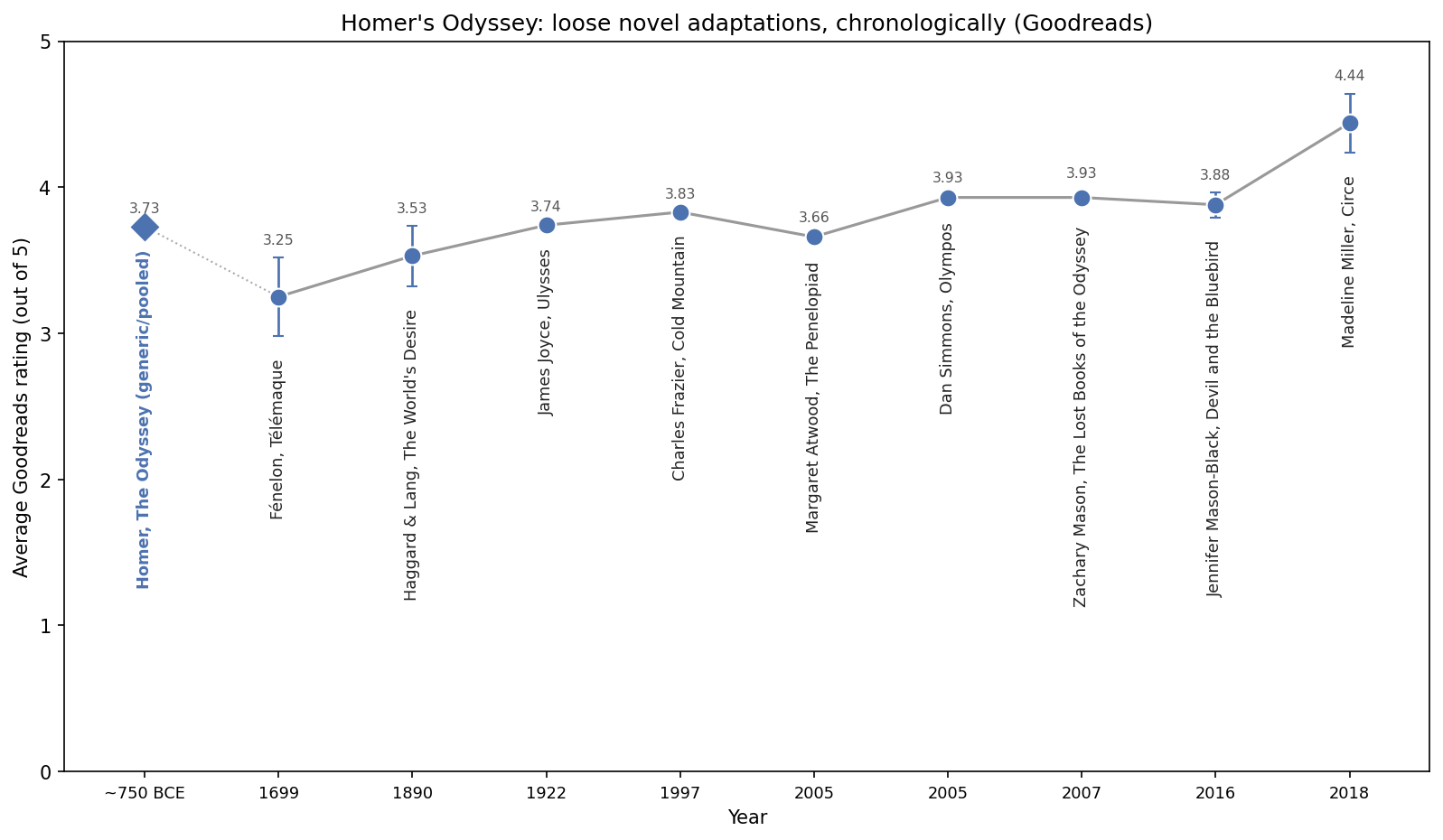
<p>Online ratings websites provide a treasure-trove of data for the numerically-inclined among us, and it is tempting to turn to these as an empirical solution the confusion. Let’s take a look at the average goodreads rating of all literary works derived from the Odyssey here:</p>

<figure>
  <img src="/assets/images/2026-09-17-STB/odyssey_books_figure 1.png" />
  <figcaption>Goodreads ratings of literary adaptations of the Odyssey.</figcaption>
</figure>

<p>Unfortunately, goodreads does not record ratings for different translations of the same work, so all of the English versions of Homer’s Odyssey get rolled into a middling 3.73/5. This is curiously very close to the score for its most famous literary reworking, James Joyce’s <em>Ulysses</em>: one assumes that this is a coincidence rather than user confusion. There is what looks like a gentle increase in ratings with time (although note the unscaled x-axis), culminating with a clear leader of the pack in the form of Madeline Miller’s <em>Circe</em>.</p>

<p>We should be careful interpreting these numbers as anything other than what they are, however: average ratings from the general public at specific point in time, with all of the fickleness and social biases that may entail. Notably, we have a quite explicit example here of recency bias, in which raters prefer works that they have seen most recently: this would explain the seeming positive trend, and also the high score for <em>Circe</em>. This dataset was extracted and frozen in late 2017, so <em>Circe</em>’s relatively few 77 reviews, presumably from advance copies, would be riding the honeymoon wave awaiting a highly-anticipated work from a well-respected writer. In 2026, <em>Circe</em>’s score has since stabilised to a still-leading but less extreme 4.22.</p>

<p>One other curious phenomenon that emerges in goodreads data can be surprisingly low average ratings for established “classics”. I think this phenomenon comes chiefly from obligatory reading in school leading to large numbers of people giving low ratings to “important” books that they struggled through involuntarily. I cannot find a good way of removing this kind of review systematically, and it is not totally clear to me that I should if I could: these are real people with real opinions, and if <em>Gulliver’s Travels</em> seemingly doesn’t speak to the interests of today’s teenagers, then that tells us something meaningful about how it is being taught to modern high-schoolers. The polarisation manifest in the ratings represents a genuine divide in the minds of the reading public, and what more could you ask for in a dataset? Goodreads remains the most inclusive, and therefore more comprehensive data set for book ratings online: any attempt to find a collection of ratings from a more classics-enthusiastic crowd would come with the trade-off of a much smaller dataset, with fewer ratings per book and smaller coverage of more obscure works.</p>

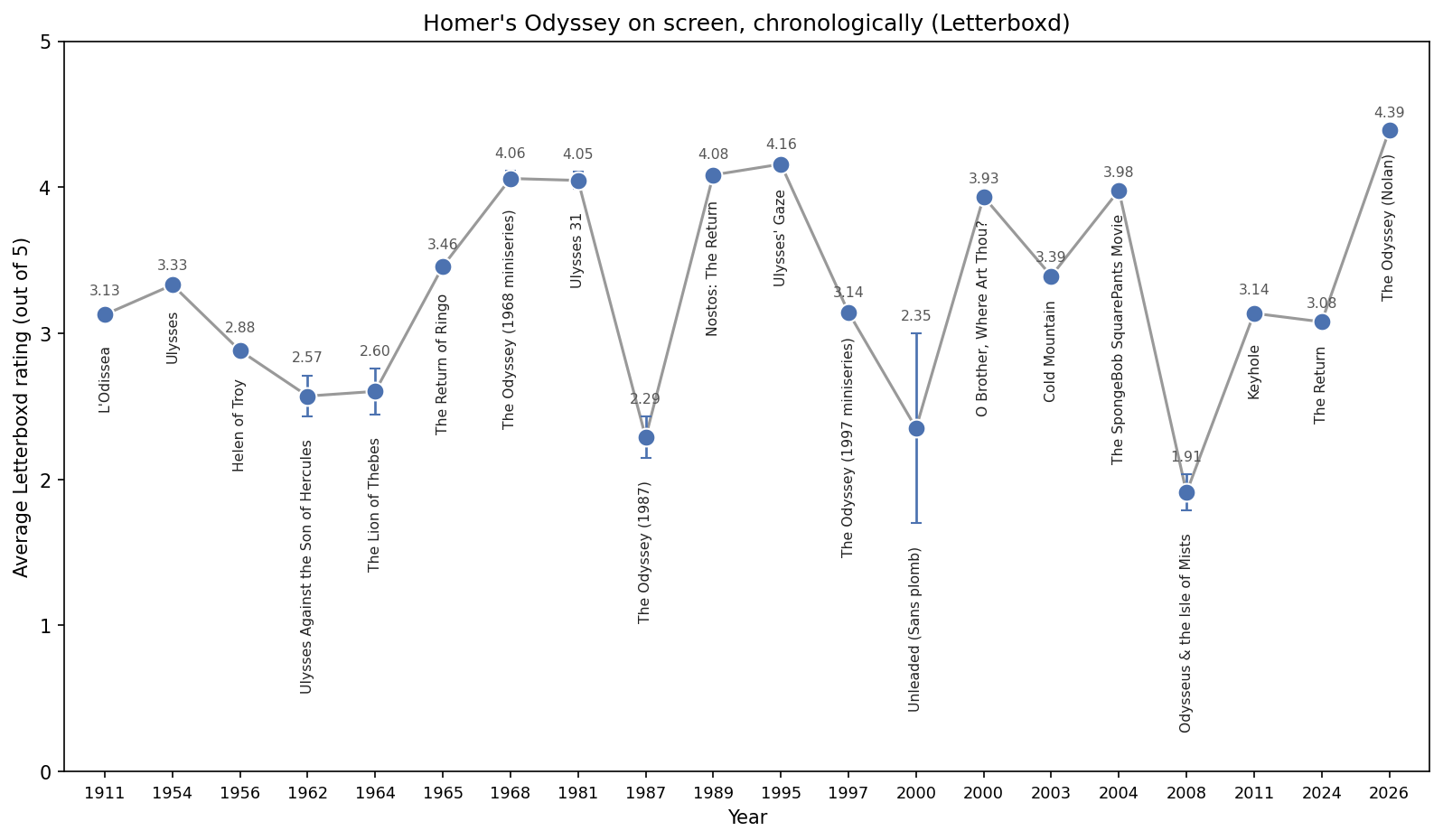
<p>Let us consider the same methods to letterboxd ratings of films inspired by the Odyssey, with a generous interpretation of “inspired”:</p>

<figure>
  <img src="/assets/images/2026-09-17-STB/odyssey_films_figure 1.png" />
  <figcaption>Letterboxd ratings of film adaptations of the Odyssey.</figcaption>
</figure>

<p>We again see 2026’s The Odyssey riding high on recency bias, now with no future data to indicate where it might stabilise. There are also more film adaptations than book adaptations: this is perhaps surprisingly considering the costs involved and long swathes of literate human history before film-making came into being. It is possible a literary adaptation might have been considered redundant considering the dominance of the original literary text, whereas making a definitive cinematic version has remained an open challenge for the history of film.</p>

<p>The effect of classic films receiving mass low-ratings seems to be less pronounced in film data than book data. This is presumably because students are not forced to consume films as systematically as they are books, with fewer resultant embittered reviews. That said, social pressure to watch and enjoy “classic” films certainly exists, through schools, parents, cinephile friends, and others, so this effect may still be present. We should perhaps be grateful for the limited cinema education in the education system, preserving films as something fun to be appreciated in one’s spare time and not worthy ways to enlighten oneself culturally (even if they are).</p>

<p>As with the goodreads ratings, it is important to not confuse the seeming objectivity of quantitative methods with an objective interpretation of their conclusions: ratings data will often say as much about a work’s positioning in social consciousness, more than any absolute measure of artistic quality. Socially contingent data will beget socially contingent analysis results, and no amount of number crunching will allow us to bootstrap<sup id="fnref:1" role="doc-noteref"><a href="#fn:1" class="footnote" rel="footnote">1</a></sup> our way out of the quagmire.</p>

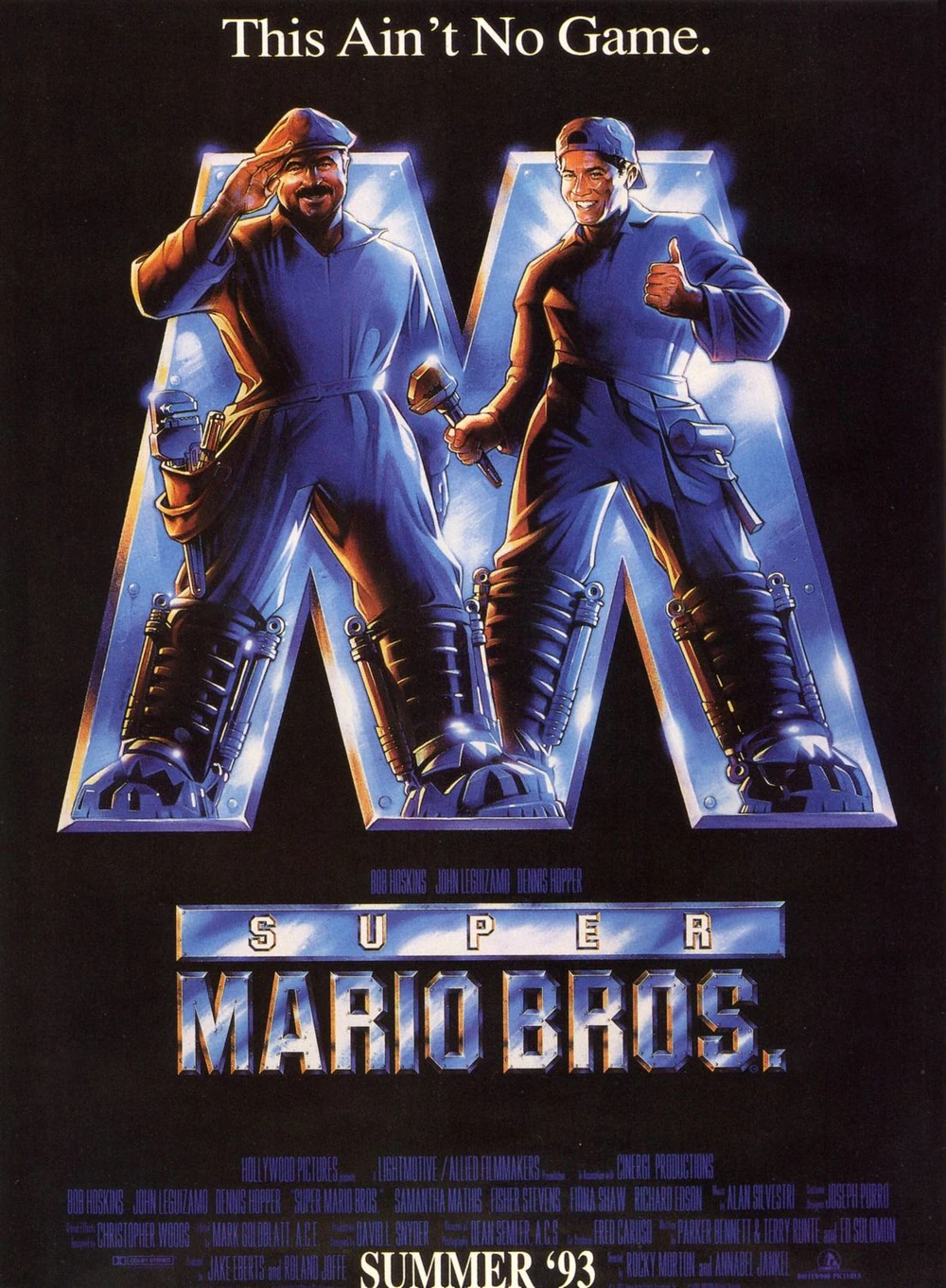
<p>The question lingers in the air as to whether it is possible to compare across forms of media in a meaningful way: when can a book be said to be better than a film, or vice versa? Would it be controversial to suggest that, in the grand scheme of things, <em>Mrs Dalloway</em> is a greater work of art than the 1993 <em>Super Mario Bros.</em> film? Well, maybe, if you particularly despise reading, or are unduly fond of Bob Hoskins.</p>

<figure>
  <img src="/assets/images/2026-09-17-STB/SUPERMARIOBROS.png" />
  <figcaption>SUPER MARIO BROS (1993).</figcaption>
</figure>

<p>There are several effects to acknowledge here: there is an implicit historic cultural hierarchy that would place literature above film as a medium. Literature has a longer presence in society, arguably dating back to the birth of language itself, with millennia to embed itself into power structures and develop a dense history of criticism and cross-referencing across society. By contrast, film is a relative upstart on the cultural scene, emerging at a quite distinct point in history enabled by specific post-industrial technological developments. There is no inherent limitation of cinema’s capability of representing the human experience compared to writing, but it still has much momentum to gain before cultural snobbery can be overcome.</p>

<p>That said, many people in the modern day really would prefer to settle down with a streaming service rather than a book: a childhood friend of mine even delayed reading <em>the Lord of the Rings</em> so as not to spoil the films. That does also raise another issue: if the goal is to absorb the narrative as quickly as possible, then films will almost always be the more time-efficient mode of consumption. Some exceptions, notably by their scarcity, include short stories adapted into feature films (<em>Brokeback Mountain</em>, <em>The Curious Case of Benjamin Button</em>), and some particularly indulgent adaptations of relatively short novels (the masterfully slow <em>Sátántangó</em>, and the bloated <em>Hobbit</em> trilogy). I personally would question the wisdom of prioritising time-efficiency of cultural consumption above all else, as the end-point seems to be actively minimising the amount of time spent engaging with great works of art. That is not a reasonable way to live your life.</p>

<p>One way to approach the question would be to standardise the ratings that we have available from goodreads and letterboxd, and then directly compare film adaptations of books for which we have paired data available. The standardisation would help address differences in calibration between the scales used for each medium: this can be done through computing “z-scores”, which linearly transform the populations to have zero mean and unit variance.</p>

<p>How do we find lists of films based on books? Wikipedia has some extensive <a href="https://en.wikipedia.org/wiki/Lists_of_works_of_fiction_made_into_feature_films">lists of films based on books</a>. There is some notable systematic missingness here, chiefly of older films less popular among Wikipedia editors, and films that did not received a full theatrical release, e.g. the 1980 PBS TV film version of Ursula K. Le Guin’s <em>The Lathe of Heaven</em>. To maintain focus and tractability, I focused on fiction and poetry, excluding non-fiction, religious works, non-literary mythology or folklore, comic books, and theatre. Theatre is a particular loss considering it contains easily the most adapted author of all time in the form of Shakespeare, but including him would mean he would dominate so thoroughly to make the inference unstable. He may also be the definitive example of the pathology described earlier of obligatory reading generating low ratings.</p>

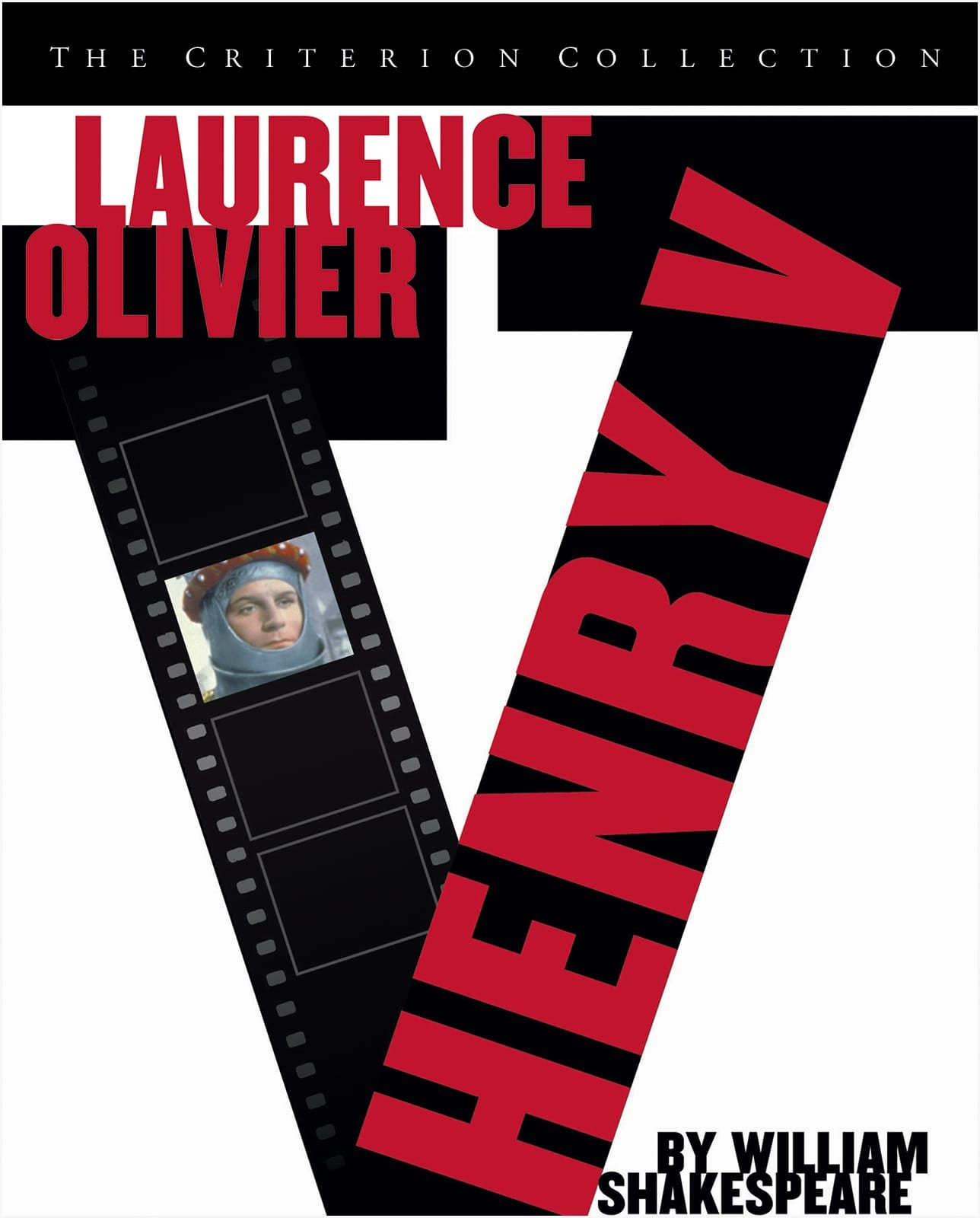
<p>There is another reason for excluding plays, which is that a faithful film adaptation of a play is a direct experience of the play itself, in a way that isn’t true of novels or poems. For example, I have never read or seen <em>Henry V</em> on stage, but I have watched the 1944 Laurence Olivier film, which was loyal enough for me to feel comfortable reviewing the play itself on goodreads. My rating of the book will be coloured by my experience of watching the film, which establishes a reverse causation effect that I would like to avoid. By contrast, simply given the nature of the mediums involved, I don’t think anyone would elide watching a film with reading a novel or poem: even watching the &gt;7 hour Sergei Bondarchuk version of <em>War and Peace</em> doesn’t substitute sitting down with the &gt;1,200 page book.</p>

<figure>
  <img src="/assets/images/2026-09-17-STB/HENRYV.png" />
  <figcaption>Henry V (1944).</figcaption>
</figure>
<p>You might make the case that  epic poems like the Odyssey were also originally experienced as live recital performances, but no one has yet made the implied monologue film adaptation. However, I would be happy to include goodreads ratings based on audiobook versions: this might be the closest modern technology has allowed us to reconverge to our ancient roots.</p>

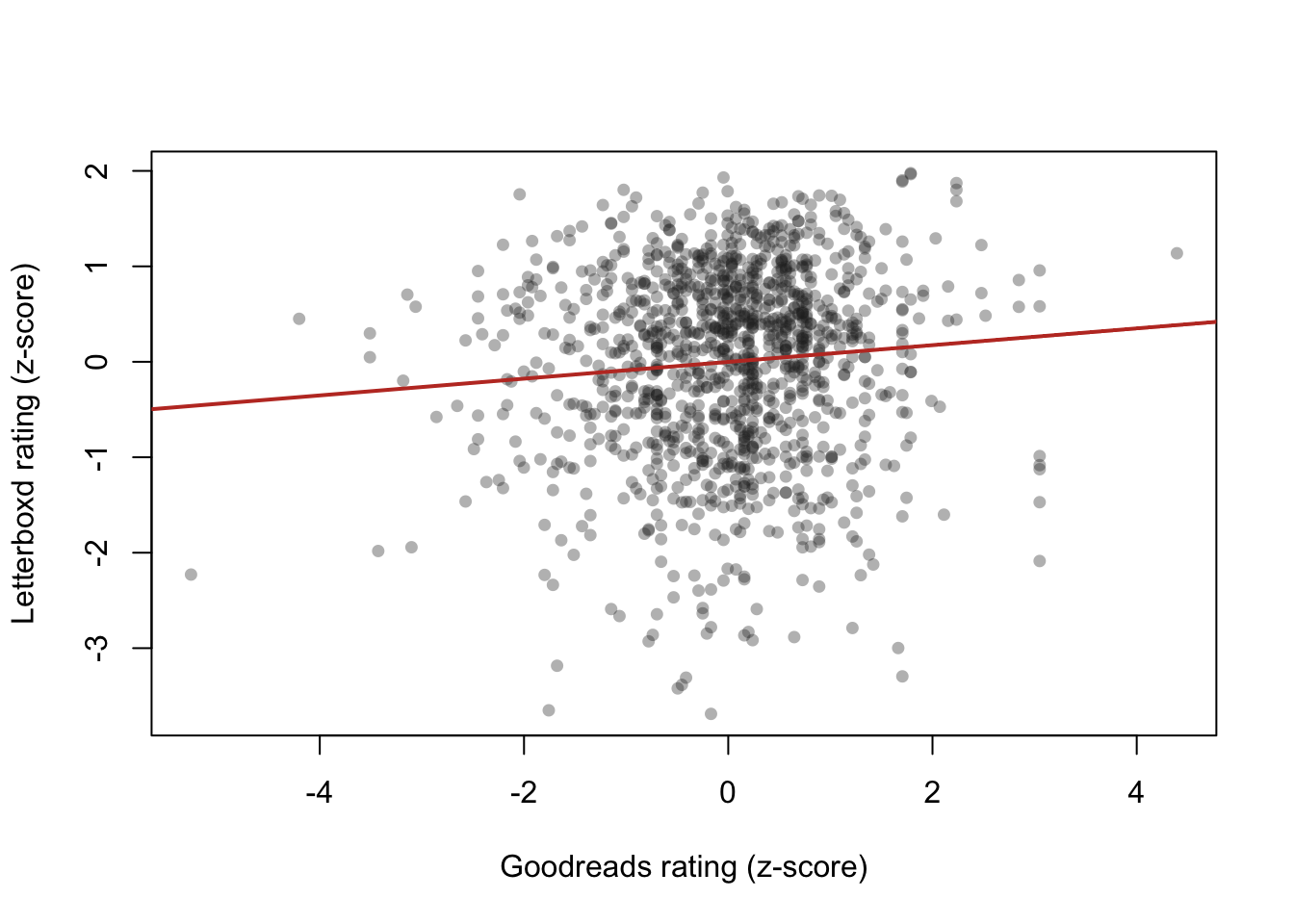
<p>Using these lists as a basis, and with some amount of fuzzy matching for the book titles between wikipedia and goodreads, we end up with a final population of 853 books adapted into 1178 films, and 1192 distinct book-film pairs. Books are sometimes made into multiple films, and films are (less frequently) based on multiple books: consider 2004’s <em>Van Helsing</em> drawing on <em>Dracula</em> and <em>Frankenstein</em>, and other novels.</p>

<figure>
  <img src="/assets/images/2026-09-17-STB/GoodreadsLetterboxScatter.png" />
  <figcaption>Goodreads z-scores plotted against Letterboxd z-scores.</figcaption>
</figure>
<p>The entire data set is plotted above with a trendline: we see a modest, but highly significant correlation of r = 0.096. Better books tend to beget better films! Not a great shock, but reassuring to see in reality. Two implicit queries underlie this statement:</p>

<ol>
  <li>Are books that get adapted higher rated than those that don’t?</li>
  <li>Are films based on books higher rated than those that aren’t?</li>
</ol>

<p>To the first question, a very small positive effect of 0.0254 is observed with borderline significance. To the second, a tiny effect size of no statistical significance. So the population of book-film pairs is broadly representative of the wider populations. This might be considered surprising, but studios may be choosing books that are marketable rather than particularly respected, and similarly will produce films motivated by financial rather than artistic urges.</p>

<p>One potential association to investigate is the role of budget: of course good books results in good films because studios are willing to throw more money at well-respected books, resulting in better films. Perhaps if this budget effect were removed then the correlation observed above would disappear?</p>

<p>Well, this question can be answered through the use of a mediation analysis: a regression model predicting the letterboxd rating, conditioning on the goodreads ratings, budget, and year. We can then observe the relationship of book score with film score separately to that of budget or year. Mediation analysis can be controversial since it invites a causal interpretation, while being itself vulnerable to confounding: for example, what if big-name directors get assigned larger budgets and also independently make higher-rated films? For that reason, the following should be interpreted with some caution.</p>

<table>
  <thead>
    <tr>
      <th>variable</th>
      <th>effect size</th>
      <th>95% c.i.</th>
    </tr>
  </thead>
  <tbody>
    <tr>
      <td>goodreads</td>
      <td>0.1796</td>
      <td>[0.1204, 0.2388]</td>
    </tr>
    <tr>
      <td>budget</td>
      <td>-0.1015</td>
      <td>[-0.1640, -0.0389]</td>
    </tr>
    <tr>
      <td>year</td>
      <td>-0.3730</td>
      <td>[-0.4402, -0.3059]</td>
    </tr>
    <tr>
      <td>budget×year</td>
      <td>-0.0538</td>
      <td>[-0.1109, 0.0033]</td>
    </tr>
  </tbody>
</table>

<p>We see that the positive influence of goodreads score remains, even after adjusting for budget and year. There is an extremely clear negative influence of year on letterboxd score, and even more surprisingly a possible negative relationship between budget and film rating score. This would seem to contradict <a href="https://owenthomas.no/theoslodispatch/2026/08/06/DFW/">one of my previous posts on the subject</a>, but these are distinct populations of films chosen according to different principles.</p>

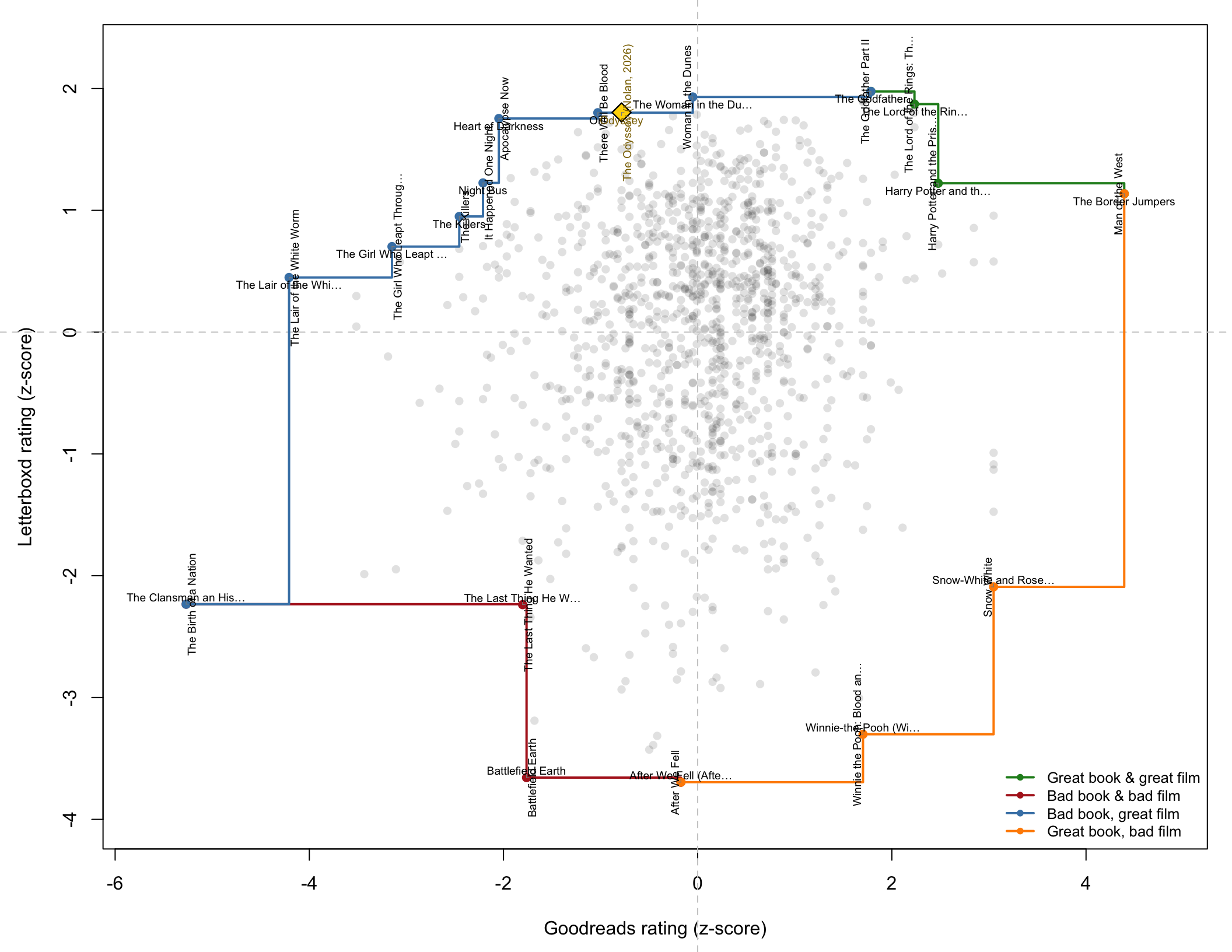
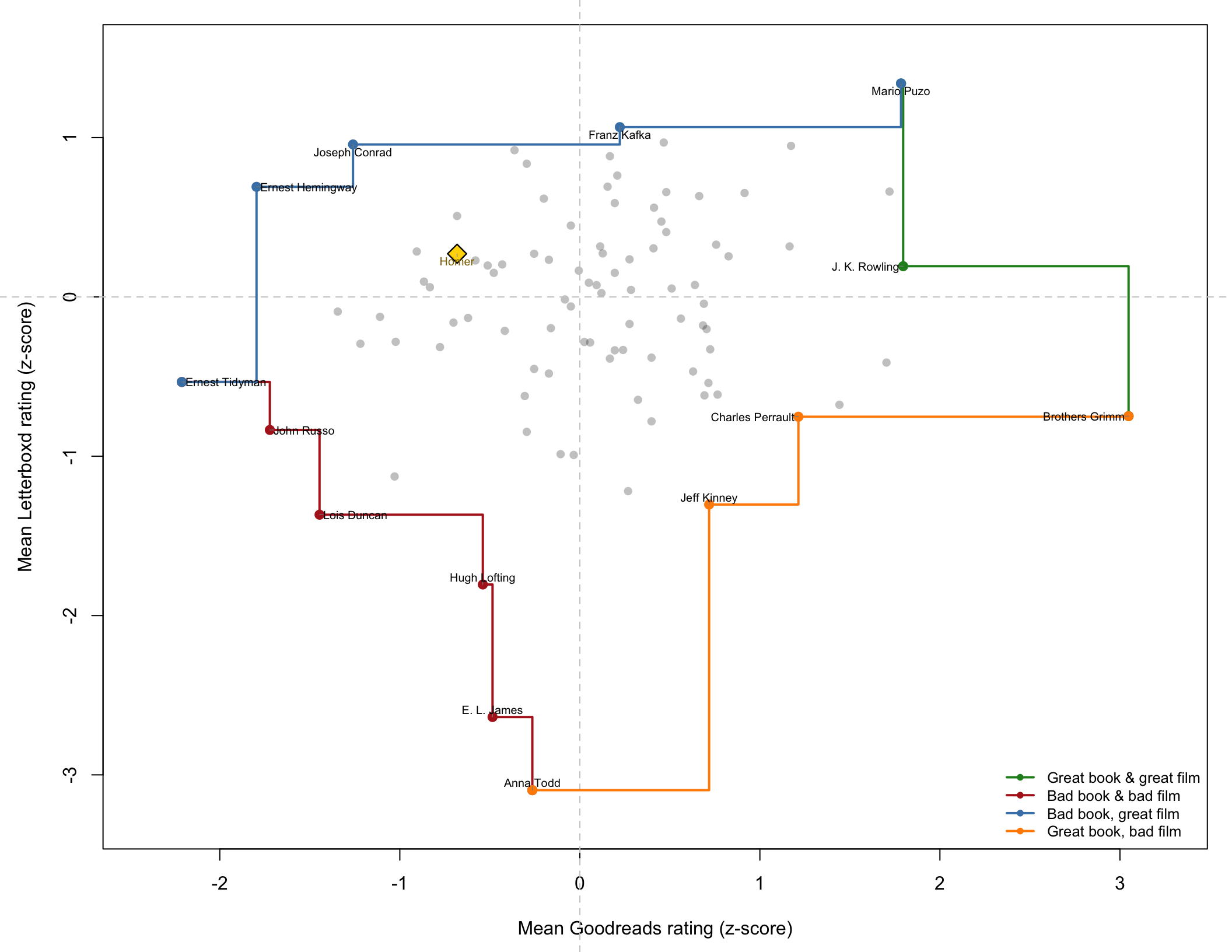
<p>Counterintuitively, sometimes looking at the extremes can tell us about the features of the bulk population. With that in mind, let’s look at the outlying values of the book/film ratings, through the mechanism of Pareto-optimality. Pareto-optimality is a way of thinking about outliers when thinking about multiple dimensions at once, as we are doing with goodreads and letterboxd ratings. Consider the top right corner: any work that isn’t “dominated” by another work with both higher goodreads and letterboxd scores, is said to be Pareto-optimal. This logic extends to other directions too: points with no worse film rating but no better goodreads rating would be extremes in the bottom-right, for example.</p>
<figure>
  <img src="/assets/images/2026-09-17-STB/BookFilmPareto.png" />
  <figcaption>Pareto Frontier of Goodreads z-scores plotted against Letterboxd z-scores.</figcaption>
</figure>

<p>Data points that are Pareto-optimal in each direction are plotted above. We see some curious commonalities in the extremes: books that readers choose to read when they are younger (e.g. <em>The Lord of the Rings</em>, <em>Harry Potter</em>, <em>Snow White</em>, <em>Winnie the Pooh</em>) tend to be highly rated, in contrast to “classics” that they are obliged to read in school (e.g. <em>Heart of Darkness</em>). Some of these youth-oriented books get developed into films with mainstream success (<em>LotR</em>, <em>Harry Potter</em>), and some get unflattering adaptations: it should be pointed out here that the bottom-right low-rated films are the unloved 2015 <em>Snow White</em> film, and the 2023 deliberately poor-taste-joke-rushed-to-meet-a-copyright-expiration-date <em>Winnie the Pooh: Blood and Honey</em>.</p>

<p>In the lower bad-film extremes of the figure we also encounter the tepid romantic drama <em>After We Fell</em> (the lowest-rated novel adaptation on letterboxd), the Scientology propaganda of <em>Battlefield Earth</em>, and the unsuccessful film of the novel <em>The Last Thing He Wanted</em>, by the otherwise well-respected Joan Didion. In the extreme left, we have the toxic pairing of the book <em>The Clansman: A Historical Romance of the Ku Klux Klan</em>, made into the film <em>The Birth of the Nation</em>: the book is an explicitly racist representation of American history and race relations. The film carries this forward without transcending them, but is remembered in cinematic history for its then-unprecedented cinematic scale and technical innovation. It is a regrettable chapter in film history, unfortunately echoed in Hollywood’s first famous talkie film being the blackface-heavy <em>The Jazz Singer</em>.</p>

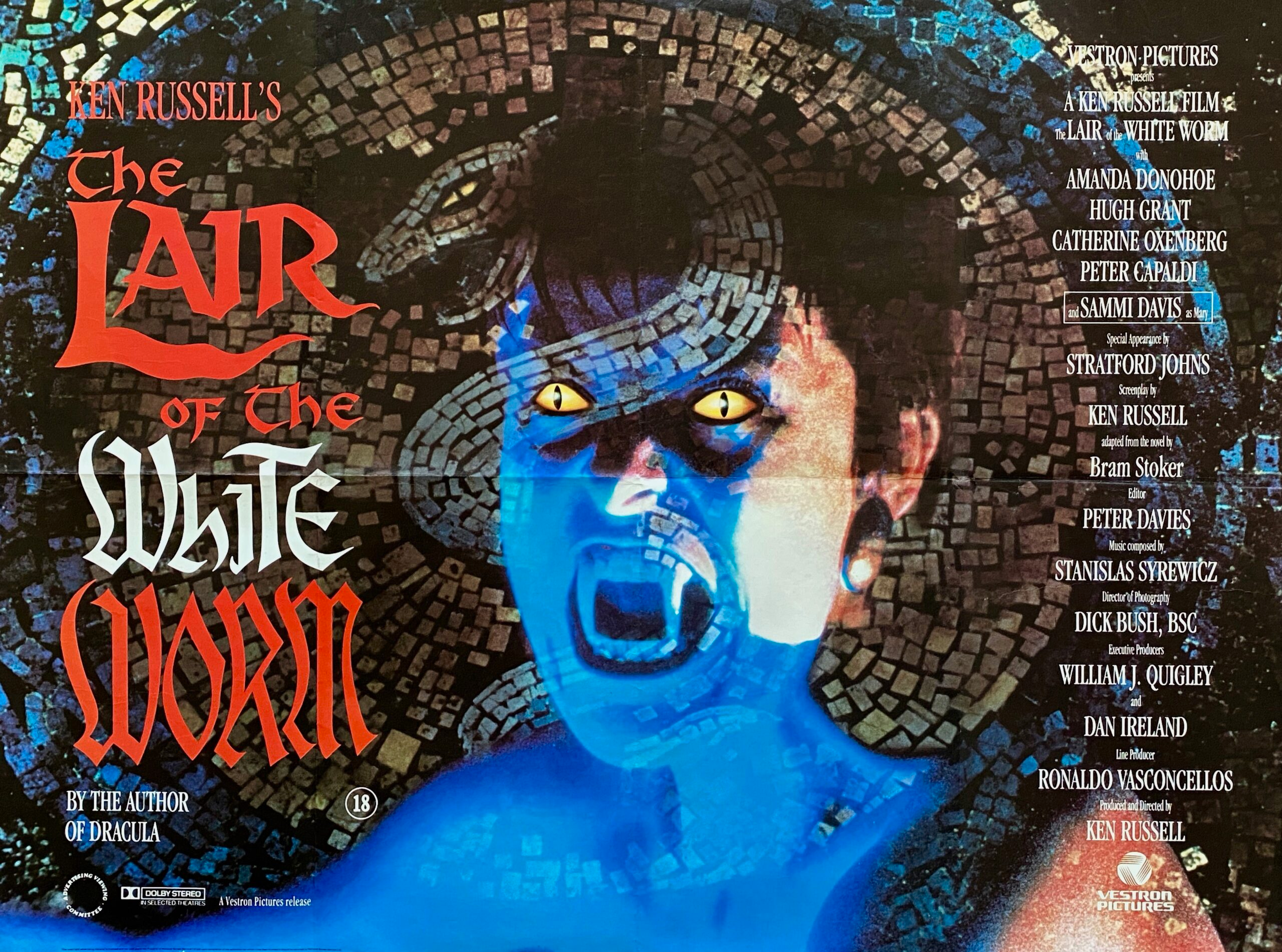
<p>Some interesting points appear in the good-film bad-book top-left corner: Bram Stoker’s ill-remembered <em>The Lair of the White Worm</em> was made into a enjoyably camp phallocentric horror-comedy film: other minor literary works made into surprisingly successfully films abound in this corner.</p>
<figure>
  <img src="/assets/images/2026-09-17-STB/LairoftheWhiteWorm.png" />
  <figcaption>The Lair of the White Worm (1988).</figcaption>
</figure>
<p>Towards the top of the graph we encounter films rated among the best of all time: they would approach Pareto-optimality regardless of the book ratings: <em>Apocalypse Now</em>, <em>There Will be Blood, The Godfather Part II</em>, and Hiroshi Teshigahara’s 1964 <em>The Woman in the Dunes</em> (the highest rated novel adaptation on letterboxd). <em>Heart of Darkness</em> is probably unfairly penalised by its presence on high school reading lists, while the other source material is represented as neutral-to-positive in quality. We also see Christopher Nolan’s The Odyssey marked in a golden diamond, just shy of the upper Pareto boundary.</p>

<p>The final point is in the extreme right, and apparently the best book in the data set: the Western novel <em>The Border Jumpers</em>, adapted into the 1958 film <em>Man of the West</em>. I won’t pretend to be familiar with either of them: I suspect that they are of reasonable quality but the extreme high rating of the book is based on only four ratings, so its position would most likely stabilise away from the edge with more thorough coverage.</p>

<p>We can also look at statistics per book:</p>

<ul>
  <li>The top 5 books with most film adaptations are <em>Dracula</em> (24), <em>Frankenstein</em> (19), <em>Peter Pan</em> (12), <em>Planet of the Apes</em> (10) and <em>Winnie the Pooh</em> (9).</li>
  <li>Of books with multiple film adaptations, the 5 highest average letterboxd ratings go to <em>The Lord of the Rings</em>, <em>The Wages of Fear</em>, <em>Do Androids Dream of Electric Sheep</em>, <em>The Godfather</em>, and <em>The Trial</em>.</li>
  <li>Of novels with multiple film adaptations, the 5 lowest average letterboxd ratings go to <em>Doctor Dolittle</em>, <em>Stuart Little</em>, <em>I Know What You Did Last Summer</em>, <em>Firestarter</em> and <em>Pet Sematary</em>.</li>
</ul>

<p>We can also extend the reasoning to the writer level: averaged over goodreads and letterboxd ratings, which authors are most adapted, and best/worst adapted?</p>

<ul>
  <li>The top 5 writers with the most film adaptations are Stephen King (40 films from 24 books), Bram Stoker (25 film from 2 books), Ian Fleming (22 films from 17 books), Mary Shelley (19 films from 1 book), and Charles Dickens (15 films from 4 books).</li>
  <li>Of writers with at least three film adaptations, the 5 highest average letterboxd ratings go to Mario Puzo, Franz Kafka, John Steinbeck, Joseph Conrad, and Michael Bond.</li>
  <li>Of writers with at least three film adaptations, the 5 lowest average letterboxd ratings go to Anna Todd, E. L. James, Hugh Lofting, Lois Duncan, and Jeff Kinney.</li>
</ul>

<p>The numbers above reveal the limitations of the wikipedia lists used, considering <a href="https://www.slate.com/blogs/browbeat/2011/03/23/the_most_adapted_authors_revised_and_expanded_edition_infographic.html">results reported elsewhere from probing IMDB</a>. Consequently, these results should be considered as representative of the source data and the inherited biases: towards more English-language, theatrically released, modern films.</p>

<p>We repeat the Pareto efficiency analysis on ratings aggregated across authors (with more than three film adaptations) and find the following pattern emerges:</p>

<figure>
  <img src="/assets/images/2026-09-17-STB/ParetoAuthorFilmBook.png" />
  <figcaption>Pareto Frontier of average author Goodreads z-scores plotted against Letterboxd z-scores.</figcaption>
</figure>

<p>Patterns analogous to the film-level data remain:</p>
<ul>
  <li>Fairly tale fabulists Charles Perrault and the Brothers Grimm make good books with unflattering films</li>
  <li>Anna Todd (of <em>After We Fell</em> et al.) appears at that bottom</li>
  <li>E. L. James of <em>50 Shades</em> is not so far away</li>
  <li>Ernest Tidyman of the <em>Shaft</em> series of novels is at the extreme left</li>
  <li>High school staples of Ernest Hemingway and Joseph Conrad populate the top left. Homer is in that direction too, but not so near the Pareto edge.</li>
  <li>Franz Kafka and Mario Puzo make the highest-rated film source material out there.</li>
</ul>

<p>All of interest, but so what? Have we determined when to save time and watch the film over the book? Or, indeed, indulge oneself and luxuriate in the lengthy novel instead of the film? Well, there appear to be some compelling examples in a few cases, but I reiterate the previous point that these ratings will reveal more about widespread social biases than about the inherent quality of the works themselves. I will not, therefore, claim to have found a conclusive resolution to the tension between the literary and cinematic traditions I mentioned earlier. I do, however, offer some observations:</p>

<ul>
  <li>Good books beget good films, but adapted books are not much better than average, neither are book adaptations inherently good films.</li>
  <li>People often remember the books of their childhood fondly, the books less so.</li>
  <li>The books we recall grudgingly from our school days often make well-respected films.</li>
  <li>If Bram Stoker’s <em>The Lair of the White Worm</em> was worth gambling on, then maybe Mary Shelley is owed an adaptation of <em>The Last Man</em>. It’s certainly very prescient in our era of pandemics and climate anxiety.</li>
</ul>

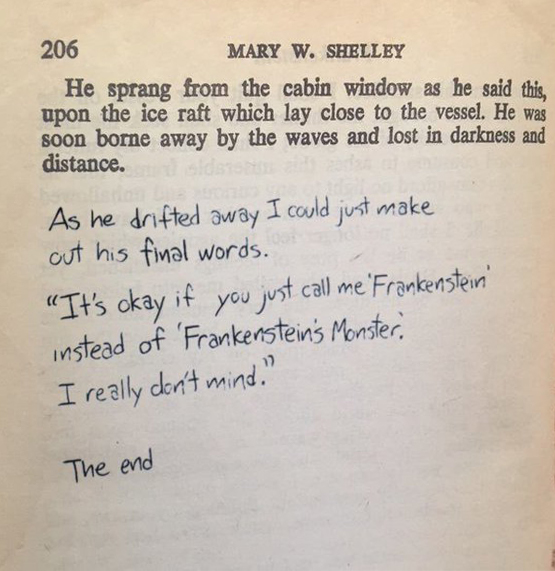
<p>Unfortunately we were not able to read Mary Shelley’s hot take on Guillermo del Toro’s 2025 <em>Frankenstein</em>, although given her fascination with science and technology, one might assume she would approve of film as a medium. One would also imagine that she would dislike the choice of a closing quotation by Lord Byron, the most famous male author in her social circle, and someone from whom she worked hard to maintain a distinct literary career.</p>

<p>It’s really all the more offensive considering that we already know the perfect fan edit of the ending of Frankenstein, which could so easily have made it on screen:</p>
<figure>
  <img src="/assets/images/2026-09-17-STB/FrankensteinMonster.png" />
  <figcaption>Finally, the author makes their position clear.</figcaption>
</figure>

<div class="footnotes" role="doc-endnotes">
  <ol>
    <li id="fn:1" role="doc-endnote">
      <p>hehehe <a href="#fnref:1" class="reversefootnote" role="doc-backlink">&#8617;</a></p>
    </li>
  </ol>
</div>]]></content><author><name></name></author><summary type="html"><![CDATA[Do good books make good film adaptations? I statistically compare ratings between Goodreads and Letterboxd to find out.]]></summary></entry><entry><title type="html">Hiroshima, mon Anniversaire</title><link href="https://owenthomas.no/theoslodispatch/2026/09/03/HMA/" rel="alternate" type="text/html" title="Hiroshima, mon Anniversaire" /><published>2026-09-03T00:00:00+00:00</published><updated>2026-09-03T00:00:00+00:00</updated><id>https://owenthomas.no/theoslodispatch/2026/09/03/HMA</id><content type="html" xml:base="https://owenthomas.no/theoslodispatch/2026/09/03/HMA/"><![CDATA[<h4 id="what-can-cultural-responses-to-nuclear-warfare-tell-us-about-how-to-handle-upcoming-climate-and-ai-crises">What can cultural responses to nuclear warfare tell us about how to handle upcoming climate and AI crises?</h4>

<p>This year, I was lucky enough to celebrate my birthday in Hiroshima. The highlight of the day was a live baseball game, with the Hiroshima Toyo Carp hosting the Tokyo Yakult Swallows. This was the coincidentally the reverse fixture of that at which Haruki Murakami felt the distinct calling to abandon jazz cafe management and become a novelist:</p>

<blockquote>
  <p>It was the season opener, and they were taking on the Hiroshima Carp at home. I remember that Yasuda was pitching for the Swallows. He was a short, stocky sort of pitcher with a wicked curve. He easily retired the side in the top of the first inning, and in the bottom of the inning the leadoff batter for the Swallows was Dave Hilton, a young American player new to the team. Hilton got a hit down the left field line. The crack of bat meeting ball right on the sweet spot echoed through the stadium. Hilton easily rounded first and pulled up to second. And it was at that exact moment that a thought struck me: You know what? I could try writing a novel. I still can remember the wide open sky, the feel of the new grass, the satisfying crack of the bat. Something flew down from the sky at that instant, and whatever it was, I accepted it. - Haruki Murakami, <em>What I Talk About When I Talk About Running</em> (2007)</p>
</blockquote>

<p>I won’t claim to have received quite such clear cosmic direction, but the game did provide appropriate narrative satisfaction. Having gone down 0-3 early on, the home side eventually won with a home run in the bottom of the ninth: this is analogous to winning it with a six off the final ball, or a particularly spectacular golden goal in that curious decade-long window of FIFA experimentation with extra-time brinksmanship. Real anime finale stuff, in other words. </p>

<p>Even more striking than the players’ performance was the engagement of the crowd. The Mazda stadium was near-full of locals, with communal chants known universally by heart and crowd participation so well-organised that I felt like an unbeliever who had dropped into a Catholic mass without knowing the liturgical choreography. It reminded me of one of those cities whose collective civic peace of mind hinges directly on the thriving of their local sports team. I have experienced similar public devotion only in post-Thatcherite industrial cities in the UK whose only sources of pride are their local football team, some local variety of baked good, and the lost industry that they used to have.</p>

<figure>
  <img src="/assets/images/2026-09-03-HMA/carpboy.png" />
  <figcaption>In 2023, Hiroshima redesigned its Carp Boy.</figcaption>
</figure>

<p>Of course, Hiroshima has lost more than anywhere else. Having studied physics up to Master’s level, I have always harboured a guilty fascination for the city and the destruction that was wreaked upon it. What might there be to see in a city that was so thoroughly destroyed? How does one rebuild a physical and social environment from nothing? Founded in 1949, the baseball team came to represent the triumph of the city’s post-war recovery, providing something for the traumatised surviving population to collectively cheer. It suggests something quite positive about the human capacity for forgiveness that America’s Pastime could become so close to the hearts of this community, although it might also simply indicate the true power of the USA’s hegemony: if your own heritage has been physically obliterated, what else do you have available than the culture of your occupiers?</p>

<p>What other responses are possible when starting from something so horrifying? One thinks of Adorno’s “To write poetry after Auschwitz is barbaric”: our existing cultural tools feel offensively inadequate in reply to unprecedented atrocities. And yet, people tried.</p>

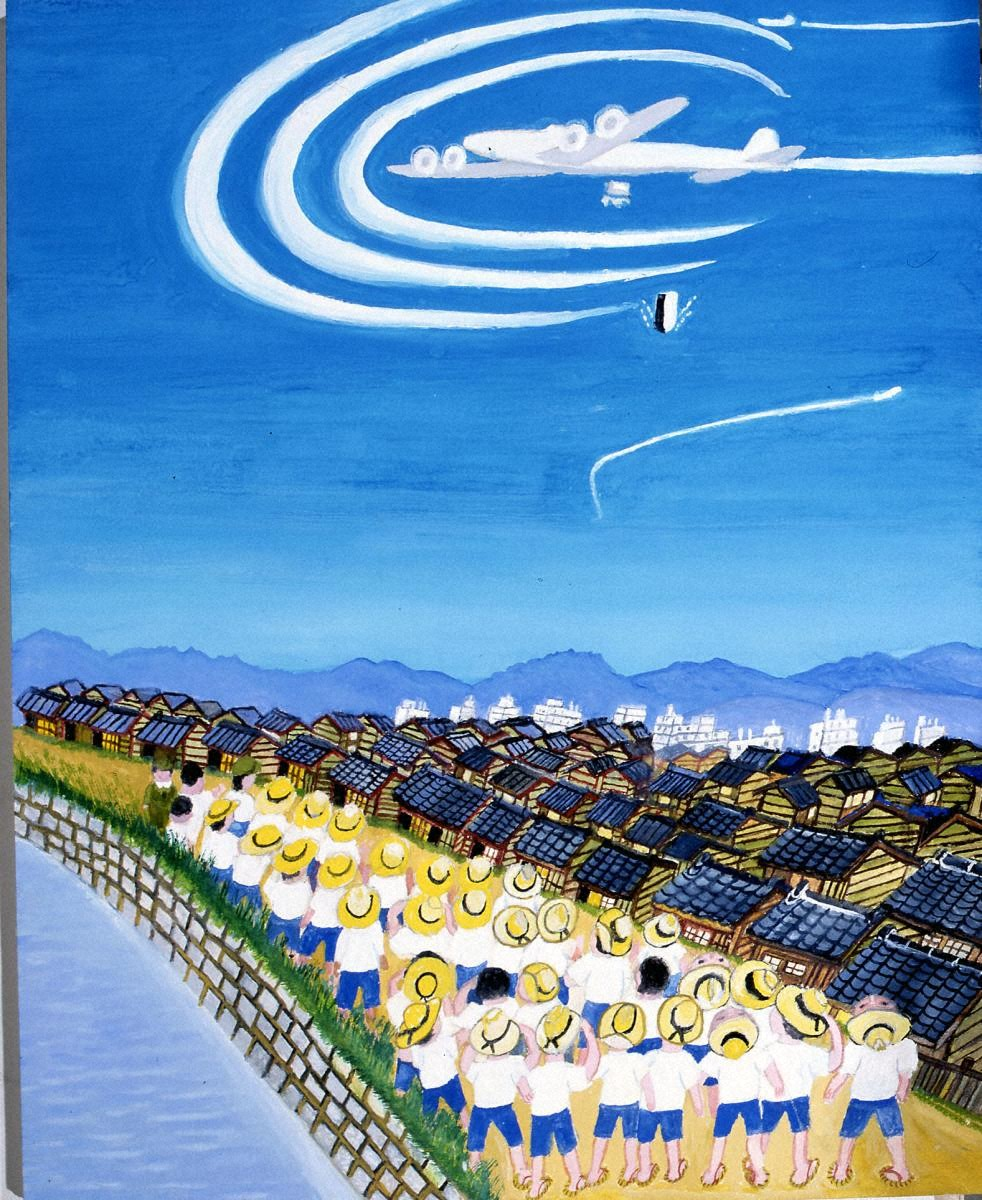
<p>Artistic reactions came from across different media as people tried to process the trauma in diverse ways. The rawest of them all are the “A-bomb Drawings by Survivors”, visible at the Hiroshima Peace Memorial Museum. Their emotional impact is heightened by the crude amateurism of so many of them: these are not cultivated artistic responses to the trauma, but a demonstration that the eyewitnesses were an arbitrary subsample of the general untrained population. More professional visual media would follow later, starting in 1973 with the <em>Barefoot Gen</em> series by Keiji Nakazawa, a Hiroshima survivor and professional manga artist who captured his experiences on paper.</p>

<figure>
  <img src="/assets/images/2026-09-03-HMA/abombdrawing.png" />
  <figcaption>KIMURA Hideo. Tokaichi, Nakahiro areas, Hiroshima. Little Boy is dropped from the Enola Gay B-29 bomber while school children are walking to school.</figcaption>
</figure>

<p>The world of cinema was relatively fast to respond: The first <em>Godzilla</em> film was released in 1954, in which a monster directly conceived from nuclear testing fallout terrorises the citizenry of Japan. The metaphor for the haunting presence of atomic weapons and their consequences is not subtle, but with time and the further development of the franchise and film CGI, modern viewers would consider the earliest film to be verging on kitsch. It is staggeringly difficult to imagine the impact this film would have on audiences, partly because of the then-pioneering special effects and also the timeliness of the material for the still-fresh memories of the audience. Further <em>kaiju</em> series would follow, but <em>Godzilla</em> remains the dominant example: the others were fun movie spectacle but lacked the historic gravitas of the genre originator.</p>

<p>The most famous musical response by some way is Penderecki’s 1961 <em>Threnody to the Victims of Hiroshima</em>, one of the few post-war avant-garde works to make it into the standard classical repertoire. It is a challenging work for string instruments, relying heavily on dissonance and jarring extended technique, but anything more sonorous might well be considered inappropriate to commemorate an event so violent. Intriguingly, the composer only had the idea for its dedication and title after hearing it performed: it is fascinating to think that he would conceive and fully compose a work so disturbingly perfect for its title without having had it in mind from the start. One wonders if he was carrying the association subconsciously while composing, or perhaps using his own experience of the war in Poland that he was not willing to reference directly.</p>

<p>There is another work that sets the European and Asian traumas of the war side-by-side. <em>Hiroshima mon amour</em> directed by Alain Resnais, based on a script by Marguerite Duras, is a seminal 1959 work of French New Wave cinema. The opening sequence features a compilation of shots of tourism sites in Hiroshima, including the Peace Memorial Museum that I myself visited. The soundtrack is a dialogue between a French woman and a local man, in which she haltingly recounts her memories of her visit: “The photographs, the reconstructions, for lack of anything else, the explanations for lack of anything else.” The man consistently responds: “You saw nothing in Hiroshima”.</p>

<p>It is uncomfortable viewing, partly because of the difficult subject matter and partly because it feels like he is quite flagrantly gaslighting her with repeated denials of her experience. In a way, he is also reminding her that his experience as survivor takes primacy, and there really is nothing left to see there but reconstructions. The film goes on to represent the woman’s own trauma from the war in Nevers, France: It is gradually revealed that she fell in love with an occupying German soldier who was shot upon the city’s liberation, leading further to her social ostracism and eventual expulsion. The pain of each of their traumas is coupled to their fear of forgetting that which they have lost.</p>

<figure>
  <img src="/assets/images/2026-09-03-HMA/hiroshimamonamour.png" />
  <figcaption>Film poster for Hiroshima Mon Amour.</figcaption>
</figure>

<p>The film closes with a strikingly didactic stance on then-present politics:</p>

<blockquote>
  <p>How much do the 40,000 A-bombs and H-bombs currently stockpiled in the world equal? They are a tribute to man’s scientific genius, but unfortunately man’s political intelligence is 100 times less developed than his scientific intelligence, and for that reason he forfeits our respect.</p>
</blockquote>

<p>The narrative thus looks forward in time to the incoming cold war era of nuclear paranoia, which itself would inspire cultural works, not directly referencing Hiroshima but the threat of potential violence kept fresh in the refrigerator of the Cold War. </p>

<p>Perhaps the most famous film on the subject is Stanley Kubrick’s 1964 <em>Dr Strangelove</em>: it is interesting that the subject of impending nuclear annihilation was what tempted Kubrick to make the only out-and-out comedy of his career. Perhaps he had followed the advice of atomic physicist Niels Bohr’s witticism that “Some subjects are so serious that one can only joke about them.” A similarly, seemingly light-hearted atomic-age artefact is Nena’s 1983 synthpop classic <em>99 Luftballons</em>: as West Berliners, they would have been acutely aware of the gravity of the situation, but it seems like some predicaments are so precarious that all one can do is dance.</p>

<p>Artistic representations of prospective impending nuclear destruction fall firmly within the well-established apocalyptic genre, which is as old as literature itself: the 4000-year-old <em>Epic of Gilgamesh</em> represents humanity being wiped out in floods sent by vengeful deities. When a work is considered to have been an influence <em>on</em> Homer and the Hebrew bible, then we know we are dealing with a rare vintage. The (post-)apocalyptic genre has ever since been prone to a certain religiosity, with Western works mostly drawing on Judeo-Christian end-times eschatology. Perhaps even a secular apocalypse comes with an implicit moral reckoning that leads the authors to revert to their inherited sense of a judgement yet to come.</p>

<p><em>A Canticle for Leibowitz</em>, written by Walter M. Miller Jr. in 1959, leans into this tendency head-on, with a caste of monks hiding in the wasteland of the Rocky Mountains after nuclear war: their relics are the engineering diagrams sourced from raiding abandoned fallout shelters while dodging gangs of marauding mutants. They labour, slowly and in the scholarly dark, to reconstruct the past from the random assemblage of surviving technical information serving as their academic illumination.</p>

<figure>
  <img src="/assets/images/2026-09-03-HMA/whenthewindblows.png" />
  <figcaption>Film poster for When the Wind Blows.</figcaption>
</figure>

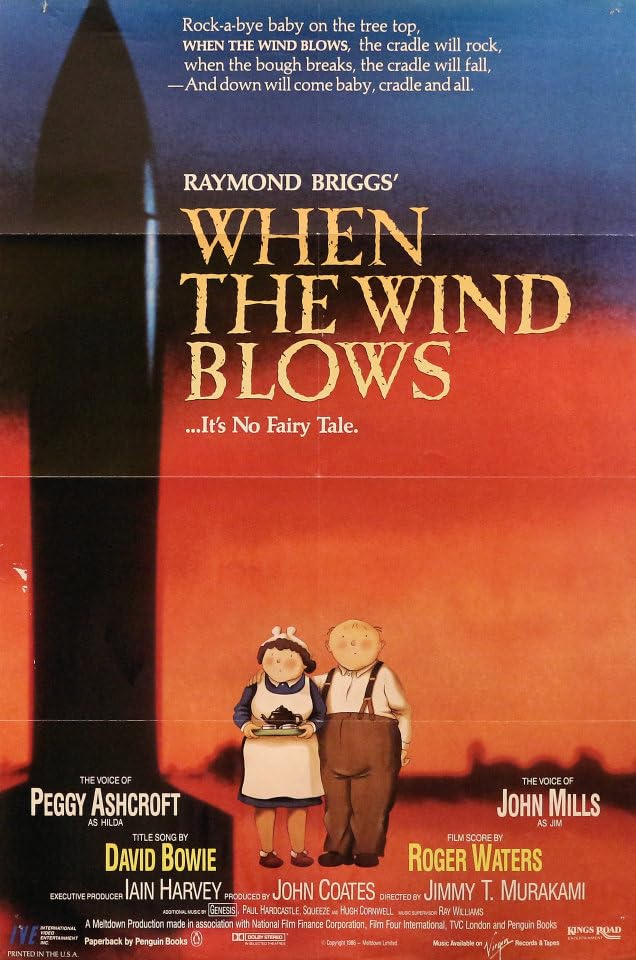
<p>Others lean into the grit of the reality of the simple question of “What if a nuclear attack were to happen over here rather than over there?” The 1984 TV film <em>Threads</em> traumatised a nation of BBC viewers with its credible representation of atomic war and descent into nuclear winter seen from Sheffield. Likewise, the 1986 animated film <em>When the Wind Blows</em> shows a similar narrative from the perspective of an older couple in rural Sussex, made all the more disturbing by the cozily familiar animation style of Raymond Briggs, more famous to UK audiences for his Christmas classic <em>The Snowman</em>. Nevile Shute’s 1957 novel <em>On the Beach</em> and film adaptation two years later asked the same of idyllic Melbourne: the bitter irony exploited that Australia, ever the global afterthought, is yet again left out of the international conversation and warhead exchange, and has been left to slowly (and unscientifically) die of the gradual southward drift of the resulting radiation. Reading and watching these, wondering how someone could conceive of something so heinous happening so close to home, one thinks of British playwright Sarah Kane’s response to questions about her notorious 1995 play <em>Blasted</em>: “my imagination isn’t that fucking sick…I just read the newspapers.” Her creative crime had been simply to transplant the ongoing atrocities happening in Bosnia to a hotel room in Leeds.</p>

<p>The work that best unifies the religiously sublime and disturbingly familiar for me is Russell Hoban’s 1980 novel <em>Riddley Walker</em>. Set not so far from where I grew up in Southeast London, the book follows the adolescence of the title character, who comes of age in the physically and culturally devastated ruins of the region surrounding the former English religious capital of Canterbury, Kent. Living in the shadow of a nuclear war centuries past, the populace have reconstructed a system that fuses political power and religious belief, justified by the scarce, salvaged artefacts of times gone by: these include a medieval wall painting of Saint Eustace recovered from Canterbury cathedral, and a Punch-and-Judy puppet show<sup id="fnref:1" role="doc-noteref"><a href="#fn:1" class="footnote" rel="footnote">1</a></sup>. The surviving population leads a ragged existence within early-Medieval-style palisaded settlements, the fences existing to protect them from the bands of mutant wild dogs roaming the countryside. Nervous journeys between settlements armed with low-tech spears and arrows are performed when necessary to share resources or information, often through the parodic medium of puppet shows for an illiterate audience. The authorities are aware of a historic devastating war brought about by explosions, and are trying to reconstruct the atomic age weaponry using the middle-ages technology they have available: they are stumbling towards a basic chemical explosive, akin to a rudimentary dynamite, and are not in a position to understand the conceptual leap needed to recreate the nuclear weapons whose deafening echoes they still inhabit. Life is cheap, lives are brief, abuse of all kinds is rampant within the community still carrying the traumas of the conflict from eons before.</p>

<p>What sets the book apart experientially to the reader is the futuristic dialect that the whole book is narrated in: the English language has transformed into something more raw, phonetic, and horrifyingly beautiful. Riddley’s sub-Sunday-school received understanding of religious terminology is rendered through the horror of his existence into phrases of disturbing elegance: “sovereign galaxies and flaming nebulae” becomes “sarvering gallack seas and flaming nebyul eye”, the biblical “Adam” is punned with the nuclear “atom”, the “Littl Shining Man” refers ambiguously to the split nucleus and the pierced body of Christ. Riddley turns to mantra-like comfort phrases: “Eusas head is dreaming us”, “Your tern now my tern later”, and the hollow, sarcastic solace of “Trubba not”. Limited in his understanding of our world of philosophy and learning, Riddley is clearly possessed of his own personal spirituality, with some passages breaking into a beautifully clumsy lyricism when he expresses it<sup id="fnref:2" role="doc-noteref"><a href="#fn:2" class="footnote" rel="footnote">2</a></sup>:</p>

<blockquote>
  <p>Its some kynd of thing it aint us but yet its in us. Its looking out thru our eye hoals. May be you dont take no noatis of it only some times. Say you get woak up suddn in the middl of the nite. 1 minim youre a sleap and the nex youre on your feet with a spear in your han. Wel it werent you put that spear in your han it wer that other thing whats looking out thru your eye hoals. It aint you nor it dont even know your name. Its in us lorn and loan and sheltering how it can.</p>
</blockquote>

<p>The book is a beautiful and darkly funny insight into the mind of the title character: what human parts of us will remain when our world is upended and our way of life is destroyed? What response is possible after the apocalypse when all we have is what we can salvage from the ruins and the dust?</p>

<figure>
  <img src="/assets/images/2026-09-03-HMA/walkermap.png" />
  <figcaption>Map from Riddley Walker with future-authentic place names. Decoding them is left as an exercise to the reader.</figcaption>
</figure>

<p>Since the Cold War ended, the threat of nuclear war is no longer as immediate as it once was. Concern about nuclear war seems old-fashioned now, even though the world itself is as well-armed and conflict-plagued as ever. Are you worried about the still realistic risk of instantaneous radioactive obliteration? How quaint. I count myself lucky to have spent my childhood years in the 1990s without any apparent existential threat to my well-being. The public narrative changed with 9/11 and the War on Terror, and today we are facing the dual and related threats of a climate crisis and potential AI singularity.</p>

<p>There is something to be learned about these two impending (and dependent) crises from our previous brushes with nuclear annihilation. The initial motivation to develop atomic weaponry to counter the reported German bomb program and the horrors of Nazim would have felt well-justified, but if the goal of the Manhattan project were to build the A-bomb in time to prevent the Holocaust then it must be considered a failure. After the fall of Germany, all of the physicists, with the notable exception of Joseph Rotblat, continued to work on the technological puzzle that they had sunk their teeth into without any evidence that the Japanese had their own parallel program. One cannot help but draw an analogy to AI researchers insisting that they must develop their potentially dangerous projects, all in the name of keeping up with their Chinese analogues: I am quite confident that they would continue their efforts with enthusiasm even after the collapse of their international rivals.</p>

<p>What can the cultural responses to the nuclear violence discussed above tell us about how to handle impending crises? What can we say about how we might handle these future challenges, and what can we expect to survive of our humanity afterwards? </p>

<p><em>Hiroshima mon amour</em> helps us to specify what we really fear in these crises. The French woman was as equally disturbed by the trauma of losing her lover as by her own increasing inability to remember him. Which day will be more tragic: the day when the last glacier melts or the day when the last person to have seen a glacier dies? The “enlightened anthropocentric” perspective would hold that environmental campaigning is done in the interests of humanity and our own expected suffering, and we should not pretend to be acting out of benign concern for the planet that will continue without us. It is hard to say whether we are mourning the death of our planet or the loss of our ability to live here in good conscience, but increasing precision about the sources of our fears will go a long way towards alleviating them.</p>

<p>Similarly, <em>Riddley Walker</em> specifically demonstrates one path by which new technology can destroy not only itself, but also centuries of previous technology, and our ability to rebuild it from the ruins. This is relevant to the climate crisis, as Margaret Atwood lays out in her climate-fiction dystopia Oryx and Crake:</p>

<blockquote>
  <p>“Because all the available surface metals have already been mined,” said Crake. “Without which, no iron age, no bronze age, no age of steel, and all the rest of it. There’s metals farther down, but the advanced technology we need for extracting those would have been obliterated.”</p>
</blockquote>

<p>Analogously with the rise of AI, we are delegating to LLMs increasingly complex “human” skills that we used to take pride in. After a couple of generations of this behaviour, who will bother or even remember how to implement a basic statistical inference algorithm on a computer? If the AI systems we grow to trust turn either hostile or themselves off, how could we possibly reimplement either them or their labour? We do not need to perform all of the tasks that we delegate so easily now, but we must remember <em>how</em> to do them, which we will struggle to do without practice.</p>

<p>Perhaps this is all too pessimistic: <em>Riddley Walker</em>’s internal monologue sustains a comforting gallows humor through his bleak existence, and the protagonists of <em>Hiroshima mon Amour</em> find intimacy in a consummated love affair, in spite of the traumas they bear. The human ability to not merely survive but thrive after unimaginable horrors cannot be universally assumed but also should not be underestimated. Perhaps we will find our own ways of finding joy after the incoming climate or AI crises: in the future, we will find new ways to hit home runs in Hiroshima again.</p>

<figure>
  <img src="/assets/images/2026-09-03-HMA/mazda.png" />
  <figcaption>Happy birthday to me at the Mazda stadium!</figcaption>
</figure>

<p>**</p>

<div class="footnotes" role="doc-endnotes">
  <ol>
    <li id="fn:1" role="doc-endnote">
      <p>For international readers, “Punch and Judy” shows are a staple of the traditional British family summer: beachside puppet shows featuring the dysfunctional relationship between the title characters, the ever-imminent threat of a hungry crocodile, prop strings of sausages, and often genuinely disturbing amounts of would-be-comedic domestic violence. See Harrison Birtwistle’s 1968 opera of the same name for an alternative artistic reinterpretation. <a href="#fnref:1" class="reversefootnote" role="doc-backlink">&#8617;</a></p>
    </li>
    <li id="fn:2" role="doc-endnote">
      <p>Best read aloud for the confused reader. <a href="#fnref:2" class="reversefootnote" role="doc-backlink">&#8617;</a></p>
    </li>
  </ol>
</div>]]></content><author><name></name></author><summary type="html"><![CDATA[What can cultural responses to nuclear warfare tell us about how to handle upcoming climate and AI crises?]]></summary></entry><entry><title type="html">Multiple Texting with Mathematics</title><link href="https://owenthomas.no/theoslodispatch/2026/08/20/MTM/" rel="alternate" type="text/html" title="Multiple Texting with Mathematics" /><published>2026-08-20T00:00:00+00:00</published><updated>2026-08-20T00:00:00+00:00</updated><id>https://owenthomas.no/theoslodispatch/2026/08/20/MTM</id><content type="html" xml:base="https://owenthomas.no/theoslodispatch/2026/08/20/MTM/"><![CDATA[<h4 id="what-is-the-probability-of-finding-a-short-text-randomly-embedded-within-a-longer-one">What is the probability of finding a short text randomly embedded within a longer one?</h4>

<p>The following treated tweet has emerged on social media.</p>

<figure>
  <img src="/assets/images/2026-08-20-MTM/Pelican.jpg" />
  <figcaption>Figure 1: The sensitive subtext to <a href="https://x.com/realdonaldtrump/status/757573051215147008">Trump’s original tweet</a>.</figcaption>
</figure>

<p>I am not completely sure why I found it so engaging: it suggests that a positive mindset and a little creativity can find a micro-instance of serene nature poetry, even within the narcissistic and self-pitying sea of political discourse that floods our lives. Alternatively, it suggests that Trump has a secretive sensitive side that is forced to hide poetic works in plain sight amid his usual grandiose bluster.</p>

<p>It kindles the question of how unusual the presence of this hidden message is: how many of the texts we engage with on a regular basis are hiding little moments of beauty? Surely any sufficiently long text should contain any sufficiently short other text, letter-by-letter, assuming both are drawn from overlapping letter distributions?</p>

<p>Well, it is relatively easy to brute-force such a question with a little pythonic string-handling. A search will confirm the presence of Gerald Manley Hopkins’ <a href="https://www.poetryfoundation.org/poems/44402/the-windhover">The Windhover</a> in the <a href="https://drive.google.com/file/d/1yBIFJigIeNqgTn-SgKbOzFDQRAtACV2u/view?usp=sharing">first seven pages of Trump’s state of the union</a> address, adding further credibility to the theory of Trump as a secret poet.</p>

<p>A little further exploration reveals some more pleasingly embedded works: consider Adrian Mitchell’s pleasingly smutty miniature <a href="https://www.poeticous.com/adrian-mitchell/celia-celia">“Celia Celia”</a> scattered among the Song of Solomon found <a href="https://drive.google.com/file/d/1MXAm3gQH8CutdiNvKKSS_gVir1s_QTe5/view?usp=sharing">here</a>, Spike Milligan’s “There are holes in the sky” amidst the script to film Bee Movie found <a href="https://drive.google.com/file/d/1DutPY2x-NZck-ZvJtV6sndSdC9ghN3ly/view?usp=sharing">here</a>, or even Bernadette Meyer’s poem “Turning prose into poetry” found aptly within an instruction manual for a microwave oven available <a href="https://drive.google.com/file/d/1MT-xWR8O71sBDG4N1Zont2YtM7PBbAS4/view?usp=sharing">here</a>.</p>

<p>However, perhaps we can resolve some doubt through the use of statistics: several questions involved are relatively well-formed probability problems, susceptible to existing analytical methods.</p>

<p>First, a couple of assumptions. Let’s say we have a shorter text of length $N_s$ and a longer text of length $N_b$. Let’s assume that letters in each text are drawn independently from the same distribution of letters of the alphabet: further, that the $i$-th letter of the alphabet is drawn with known probability $p_i$. Such an assumption of independence is not completely watertight: some pairs of letters are more likely to be drawn together (TH, QU and so on in English), but the results of this assumption can be expected to be second order in magnitude.</p>

<p>Letter frequencies in English and other languages are quite well-studied, and to some degree have entered into broader culture: ETAOIN SHRDLU was a mechanical-typesetting-era printing artefact and historic meme, which can also be used as a challenging mnemonic for the order of the most commonly used letters in English.</p>

<figure>
  <img src="/assets/images/2026-08-20-MTM/shitposting.png" />
  <figcaption>Figure 2: Shitposting à la 1916.</figcaption>
</figure>

<p>So the different probabilities are available to us for our analysis: the question remains what to do with them. We can answer this by imagining the process of finding the smaller text within the larger one: for each letter in the shorter text, we progress sequentially through the longer text until we find the corresponding letter, then restart the process with the next letter.</p>

<h3 id="here-be-mathematics"><strong>HERE BE MATHEMATICS</strong></h3>

<h5 id="feel-free-to-skip-ahead-if-thats-not-your-thing">(Feel free to skip ahead if that’s not your thing)</h5>

<p>We can frame the whole question in terms of characterising the distribution of a variable called <em>f</em>: the point in the longer text at which the final letter of the shorter text is located. What can we say about the likely properties of the distribution of <em>f</em>?</p>

<p>The process of repeatedly testing for an event with a known probability <em>p</em> until we find a success suggests a geometric distribution. The sum of many geometric distributions with different <em>p</em> parameters does not result in a standard distribution (a negative multinomial is nearly there, but does not guarantee the ordering of the relevant letters from the shorter text).</p>

<p>Still, since the resulting distribution is a sum of familiar distribution, we can characterise its mean and variance through the sum of the means and variances of the component distributions.</p>

<p>Let’s do this via a tractable example.</p>

<p>Consider the word “QUITE”: its component letters have normalised frequencies of $[0.00978, 0.02758, 0.06966, 0.09056, 0.12702]$, respectively. For each of these, with a geometric distribution assumption, we would expect a number equal to the inverse of each probability before each of the letters are encountered, in this case $[102.25, 36.26, 14.36, 11.04, 7.87]$, giving a total of 171.78 letters expected before we find the word in a larger text. To put this as an equation:</p>

<p>\(E(f) = \sum_i^{N_s} E(f_i) = \sum_i^{N_s} 1/p_i\)
where $p_i$ is the probability associated with the letter in the $i$-th position in the shorter text, and $f_i$ is the length of longer text necessary to find said letter. We can calculate the variance on the estimate, again given the known properties of the geometric distribution:</p>

<p>\(V(f) = \sum_i^{N_s} V(f_i) = \sum_i^{N_s} (1-p_i)/p_i^2\)
in this case equal to 11,987,83, corresponding to a standard deviation of 109.49. Also, since the final variable we are targeting is known to be the sum of those associated with each individual letter, we can cite a central limit theorem and claim that the distribution will be Gaussian for a shorter text of any substantial length. This is probably not entirely secure in the case of the five-letter “quite”, but should hold for anything long enough to be interesting, and as such we will not consider any higher order moments of $f$.</p>

<p>The analysis becomes more elegant if we consider unspecified shorter texts: given an unknown shorter text of length $N_s$ drawn from a standard letter distribution, what is the probability of finding it in a longer text of length $N_b$? We would effectively be averaging over the easiest problem of finding a string of very common letters (e.g. “eeeee”) and very rare ones e.g. (“zzzzz”) and every string in between.</p>

<p>We have a similar approach of characterising the means and variances, but with each component of the sum itself being an average across possible letters, weighted by their probability of occurring, i.e:</p>

<p>\(E(f) = \sum_i^{N_s} E(f_i) = \sum_i^{N_s} \sum_j^{N_a} p_j E(f_i) = \sum_i^{N_s} \sum_j^{N_a} p_j/p_j = N_s N_a\)
where $p_j$ is now the probability of occurrence associated with the $j$-th letter in the alphabet, and assuming an alphabet of length $N_a$. So, pleasingly, the explicit distribution of letters disappear, and we can reasonably claim that for a shorter English text of non-trivial size $N_s$, we would expect to find it within a longer text after scanning through $26N_s$ letters.</p>

<p>The variance result is slightly less elegant</p>

<p>\(V(f) = \sum_i^{N_s} V(f_i) = \sum_i^{N_s} \sum_j^{N_a} p_j V(f_i) = N_s (\sum_j^{N_a} 1/p_j - N_a)\)
So the variance depends on the distribution $p_j$ across letters, but is at least constant for each language. The format suggest that a language with a relatively uniform distribution of letter frequencies would return small variances, and languages with a large discrepancy between largest and smallest frequencies would return a high standard deviation. In English, the value of the standard deviation happens to be 67.24 empirically.</p>

<p>Further, if we run with the Gaussianity property implied by the c.l.t., we have now characterised the entire distribution of $f$, and as such can generate a closed form result for the probability of finding an unspecified shorter text of length $N_s$ in a longer text of length $N_b$ with the standard normal cumulative distribution function Φ:
\(\int_0^{N_b} p(f) df = \Phi\big((N_b - 26N_s)/67.24\big)\)
Hooray!</p>

<h3 id="mathematics-over-the-villagers-rejoice"><strong>MATHEMATICS OVER. THE VILLAGERS REJOICE.</strong></h3>

<p>It’s curious to think how the result depends on the properties of the alphabet of the language in question. In terms of alphabet length, we would expect a Norwegian text drawn from an alphabet of length 29 (<a href="https://www.youtube.com/watch?v=f488uJAQgmw">don’t forget that æøå</a>) to take more time to find in a longer text, whereas a language such as Hawaiian with a short alphabet of length 13 would make it easy to find a microtext within a macrotext. The most extreme example I could find was the alphabet of the Khmer language with 74 letters, so it would take nearly three times as much time to perform the search as in English. However, languages with shorter alphabets often need longer texts to make the same point, so it is possible that their values of $N_s$ will be larger to represent an interesting subtext.</p>

<p>The variance result is also interesting: a language with a heavily non-uniform distribution of letters incurs a large uncertainty when performing the search task, whereas a language in which each letter is used with the same frequency would result in the least possible uncertainty on how long the search task demands.</p>

<p>It is clearly possible to generate adversarial examples that violate the assumptions involved in generating these results: submitting George Perec’s <a href="https://en.wikipedia.org/wiki/A_Void">“A Void”</a> as a longer novel within which to search would make it impossible to find any shorter text containing the letter “e”, for example. In these examples, the assumption that the texts are drawn from the same distribution of letters has been violated.</p>

<p>It is also interesting to consider languages which do not strictly have letters: Chinese characters are not generally considered an alphabet: there are said to be about 20,000 in general use, and they fall within a middle ground between letters, words, syllables and concepts. Performing the same analysis given a choice of characters rather than letters would presumably lead to a much more daunting search task.</p>

<p>This train of thought leads to the question of how a word-based version of this problem would work: can we find a shorter text word-for-word within a longer one? Previous derived results would still be valid, but with the number of letters in the alphabet being replaced with number of words in the dictionary: general estimates of which vary up to 228,132 total words in English, suggesting that this is a much less likely search problem to succeed. The presence of very rarely used words in language also vastly increases the variance associated with any estimate.</p>

<p>I was determined to find at least one example: starting with the short poem “Risk”, often attributed to Anaïs Nin:</p>

<blockquote>
  <p>And the day came when the risk to remain tight in a bud was more painful than the risk it took to blossom.</p>
</blockquote>

<p>I failed to find this sequentially word-for-word in some classic lengthy texts, so I took the adversarial approach and consulted some friends who are better-read than me to suggest some appropriate works, eventually prompting the discovery of the text within the apparently flower-heavy “Mayor of Casterbridge”. So a success, but a definitely non-random one.</p>

<p>There is also a curious word-level analogue to the original Trump tweet in the form of Tom Phillips’ “A Humument: A Treated Victorian Novel”. The artist involved found a forgotten Victorian novel named “A Human Document”, and proceeded to creatively paint over the vast majority of the text, leaving a second discovered text left exposed: in the words of one of the pages, “I have to hide to reveal”:</p>

<figure>
  <img src="/assets/images/2026-08-20-MTM/a_humument.jpg" />
  <figcaption>Figure 3: The cover page of Tom Phillips' "A Humument: A Treated Victorian Novel"</figcaption>
</figure>

<p>Strictly speaking, the analysis presented here only applies to the Trump poem and texts like “A Humument” in artistic retrospect. The probabilities presented are those of finding a given shorter text within a second longer one: with these two creative works, they have started with long texts and then actively searched for a smaller text of artistic interest or value within it. This demands both more aesthetic judgement and probably a shorter long text: A relevant, difficult question would be “What proportion of randomly generated strings of letters are artistically interesting sentences?” You can probably make some traction on this question with some of <a href="http://languagelog.ldc.upenn.edu/myl/Shannon1950.pdf">the reasoning used to derive the entropy of the English language</a>, but that would only tell you something about the probability of finding valid sentences. I cannot quite imagine a formal metric by which to judge their aesthetic value: there is, of course, no (ac-)counting for taste.</p>

<p>Note: This article appeared originally on an now-defunct blog of mine in 2018, and is reproduced here with minor edits.</p>]]></content><author><name></name></author><summary type="html"><![CDATA[What is the probability of finding a short text randomly embedded within a longer one?]]></summary></entry><entry><title type="html">F/X Scorn: Do Larger Budget Films Have Worse Ratings?</title><link href="https://owenthomas.no/theoslodispatch/2026/08/06/DFW/" rel="alternate" type="text/html" title="F/X Scorn: Do Larger Budget Films Have Worse Ratings?" /><published>2026-08-06T00:00:00+00:00</published><updated>2026-08-06T00:00:00+00:00</updated><id>https://owenthomas.no/theoslodispatch/2026/08/06/DFW</id><content type="html" xml:base="https://owenthomas.no/theoslodispatch/2026/08/06/DFW/"><![CDATA[<h2 id="david-foster-wallaces-reactionary-gen-x-film-criticism-doesnt-stand-up-to-quantitative-analysis">David Foster Wallace’s reactionary Gen X film criticism doesn’t stand up to quantitative analysis.</h2>

<p>Sometimes being someone of my demographic who reads (and now, it appears, writes about) David Foster Wallace, reminds me a little of advice I overheard once about how to be a good religious person: the best strategy is to simply declare your identity upfront and then proceed to not act like a jerk.</p>

<p>He is not among my favourite writers, and I agree with much of the criticism of his professional work, personal behaviour, and degree of influence on the literary world. However, I do turn to him sometimes, chiefly for his shorter-form non-fiction, where I recognise and enjoy his perspective: he often finds something serious and sublime in subjects where other writers wouldn’t stoop to bestow such treatment. Two of his works I have turned to repeatedly are his essays on cruise ships and Roger Federer, which are as good places as any to start for those unfamiliar<sup id="fnref:1" role="doc-noteref"><a href="#fn:1" class="footnote" rel="footnote">1</a></sup>.</p>

<p>One essay of his that gently riled me recently had the surprisingly-pre-clickbait-era title of “F/X Porn”: the porn of the title is strictly metaphorical, used to describe a tendency he identified in then (1998) contemporary cinema towards shallow acts of visual technical spectacle (“F/X”), over either artistic style or substance. His main thesis is an underwhelmingly textbook GenX manifesto claim of favouring lower-budget films over higher-budget Hollywood extravaganzas. Two of the former films he praises are “The Terminator” and “Aliens”, and of the latter he scornfully nominates “Terminator 2: Judgement Day” and “Jurassic Park”.</p>

<figure>
  <img src="/assets/images/2026-08-06-DFW/terminator2.jpg" alt="Film poster for Terminator 2" />
  <figcaption>Figure 1: Arnie not appreciating the unprovoked criticism.</figcaption>
</figure>

<p>He goes on to make the statement:</p>

<blockquote>
  <p>“T2” is thus also the first and best instance of a paradoxical law that appears to hold true for the entire F/X Porn genre. It is called the Inverse Cost and Quality Law (ICQL), and it states very simply that the larger a movie’s budget is, the shittier that movie is going to be.</p>
</blockquote>

<p>Now, that is the kind of claim that makes a statistician’s ears prick up: a specific hypothesis about the functional relationship between two observable variables. Does the budget of a film really decrease the quality of the final project? This sounds somewhat dubious: read Virginia Woolf’s A Room of One’s Own to hear the exact opposite point made more convincingly concerning the need for the material resources of money, time, and space for (especially women) creatives to thrive.</p>

<p>I will do DFW the favour of not accompanying him on the cherry-picking expedition he implies by proposing a poorly-defined sub-genre of “F/X Porn” for which the claim holds true: the latent circular reasoning is disappointingly clear. Instead I will look to see whether this proposed inverse relationship between film budget and quality manifests in the films of the era in which he was writing.</p>

<p>The data used was retrieved from The Movie Data Base (TMDB), one of the more accessible large online movie data sets containing the key variables of budget, year of release, and average score from users. Anyone GenX-coded enough to question whether the artistic value of a film can really be captured by averaging over the opinions of the general public would do well to read “Let’s Talk About Love: A Journey to the End of Taste”, by Carl Wilson, a fantastic work of music criticism discussing “poptimisim” and the music of Céline Dion. Any readers who just rolled their eyes at the mention of Céline’s name without having either: a) listened to her music with an open mind, or b) reflected on how her music impacts the interior lives of her (mostly queer, older, female) audience, can fight me in the street.</p>

<p>The population of films was determined by the following filters:</p>

<ul>
  <li>Original language in English, since this feels like an Anglosphere-specific conversation considering the films mentioned in the essay.</li>
  <li>Released in the peak GenX years between 1980 and 1999 inclusive.</li>
  <li>A budget larger than $1000: this is the minimum amount you might need to conceivably make something feature length, and removes spurious films with poorly-documented budgets.</li>
  <li>Three or more votes to avoid vanity projects.</li>
  <li>Runtimes between 40 minutes and 240 minutes to avoid short films and miniseries, respectively.</li>
  <li>No films marked as documentaries or concert films.</li>
</ul>

<p>There was a final “study population” of 3,141 films matching all of these criteria: this is a fair amount of data, so we should be able to find something interesting if the effect size is not small. The key hypothesis concerned whether the budget of the film influenced the outcome of the average movie rating.</p>

<p>Let’s take a look at the budget plotted against the average TMDB ratings.</p>

<figure>
  <img src="/assets/images/2026-08-06-DFW/TMND_scatter.png" alt="A scatter plot of inflation-adjusted film budgets against average TMND scores." />
  <figcaption>Figure 2: A scatter plot of inflation-adjusted film budgets against average TMND scores.</figcaption>
</figure>

<p>We have a cloud of points, with the four exemplar films mentioned previously being highlighted (T1 and Aliens in red, T2 and Jurassic Park in blue). On eyeballing this, I think I perceive a positive correlation between the two variables, but a regression analysis would be perfect to give more precise insight here. Let’s go for a linear regression with average rating as the dependent variable and independent variables of budget (after a logarithm), year of release and their interaction (the interaction is motivated by the essay’s suggestion that this is an emerging trend in films of this era).</p>

\[% TMDB: budget x year (weighted, sensitivity check)
\begin{array}{lrr}
\textbf{Term} &amp; \textbf{Estimate} &amp; \textbf{95\% CI} \\ \hline
\text{Intercept} &amp; 6.183 &amp; [6.151, 6.216] \\
\text{Budget (log, z-scored)} &amp; 0.369 &amp; [0.333, 0.406] \\
\text{Year (z-scored)} &amp; -0.045 &amp; [-0.077, -0.012] \\
\text{Budget × Year} &amp; -0.040 &amp; [-0.076, -0.004]
\end{array}\]

<p>If you don’t know how to read this table, don’t worry about it: this footnote is a very quick guide<sup id="fnref:2" role="doc-noteref"><a href="#fn:2" class="footnote" rel="footnote">2</a></sup>. It looks like the earlier eyeballing was leading us true: we have a very clear positive relationship between budget and rating (increasing budget increases the average rating), a smaller negative relationship with year of release and rating (films received lower ratings over time), and a very borderline negative relationship with their interaction (increasing budget is maybe less effective with time at increasing quality). This is a negative result concerning the central ICQL hypothesis of DFW’s article</p>

<p>Later in the article, he introduces two scientific-sounding “corollaries” of the proposed ICQL. the first is not testable with available data, the second may well be:</p>

<blockquote>
  <p>(ICQL (b)) There is no quicker or more efficient way to kill what is interesting and original about an interesting, original young director than to give that director a huge budget and lavish F/X resources.</p>
</blockquote>

<p>He suggests that this can be observed as a director-specific effect, i.e. that a director will make worse films as they are given greater resources.</p>

<p>We fortunately have two items of statistical machinery to investigate this claim. Firstly, we introduce random effects per director into the previously specified model, which allows for isolation of effects by director. Secondly, we divide each film’s budget into a “between-director budget” variable, representing the average budget for the director and a “within-director budget” variable, comprising the deviation of each film from said average. This will allow us to interpret the influence of variations in average budget between directors and variation within the career of a single director. We should also be aware that this is a claim about interventions, whereas we only have observational data, so the following analysis results are of a prospective rather than causal nature:</p>

\[\begin{array}{lrl}
\textbf{Term} &amp; \textbf{Estimate} &amp; \textbf{95\% CI} \\ \hline
\text{Intercept} &amp; 6.045 &amp; [6.004, 6.087] \\
\text{Budget (within-director)} &amp; -0.007 &amp; [-0.075, 0.060] \\
\text{Budget (between-director)} &amp; 0.438 &amp; [0.393, 0.483] \\
\text{Year (z-scored)} &amp; -0.037 &amp; [-0.070, -0.005] \\
\text{Budget (within-director) × Year} &amp; 0.033 &amp; [-0.036, 0.101] \\
\text{Budget (between-director) × Year} &amp; -0.086 &amp; [-0.125, -0.048]
\end{array}\]

<p>We see quite similar associations to the previous model, but crucially entirely restricted to the between-director budget variable. This suggests that, while increasing the budget will increase the film’s quality in general, individual directors tend to not vary in quality given the differences in budget from one film to the next. This again represents a negative result concerning the corollary proposed in the article.</p>

<p>Returning to Figure 2 from earlier of the specific films highlighted, it seems like the films mentioned in the article are also poor choices as being representative of the proposed inverse relationship: while the two films in blue are both more expensive than those in red, they are also both more highly rated on average, implying a positive relationship. “Terminator 2: Judgement Day” in particular looks quite close to being at the leading upper-right boundary of expensive films that make unprecedentedly good use of their budgets, i.e. the convex hull.</p>

<p>What is the convex hull? Imagine all of these data points in the figure as being pins in a cork-board on a table in front of you. You have a ruler that is held flat against the board, which you can slide towards the collection of pins from any direction. Any pin that you can touch with the ruler would be on the “convex hull”, which is one method of identifying an extreme combination of budget and average rating. This can notably work from any direction, e.g. low or high budget films that make good or poor use of their resources would all qualify.</p>

<p>So which films form the convex hull of our data set?</p>

<figure>
  <img src="/assets/images/2026-08-06-DFW/TMND_pareto.png" alt="A plot of convex hull extremes of film budgets against average TMND scores." />
  <figcaption>Figure 3: A plot of convex hull extremes of film budgets against average TMND scores.</figcaption>
</figure>

<p>Of particular interest is the upper-right corner, featuring “The Shawshank Redemption” and “The Green Mile”, both of which feature no higher-rated film of a larger budget. These are excellent, expensive films, according to the standards of the TMND userbase. A little further clockwise we find “Titanic”, with no more expensive film of either higher or lower quality made in the timeframe considered.</p>

<p>The lower-right corner offers much juicier cherries to pick to support DFW’s hypothesis that higher budgets beget worse films, with the famous large-scale bombs of “Waterworld”, “Speed 2: Cruise Control” and “Inchon”. After a substantial step down in budget we find “Leonard Part 6”, a Bill Cosby vehicle which seems to already have been considered a poor film even before his fall from grace. Finally, we encounter “A State of Emergency”, a misguided science-fiction-meets-Christianity Michael Sheen vehicle.</p>

<p>In the lower left, we encounter a trio of films of both extremely low budget and quality: their presence here depends on a degree of randomness from noisier ratings, but may be of interest to the Z-movie-detritus aficionados out there.</p>

<p>Eventually, in the top left, we encounter the “indie darling” category: films of low budget and high quality. We meet the micro-budget comedy thriller “Blonde Death” and then finally the Limerick comedy duo D’Unbelievables’ TV Special “D’Telly”: I imagine my Irish readers will be equally heartened and surprised to learn that this is rated as the single best feature-length film of the era.</p>

<p>One does wonder how robust these results are to the population of people providing reviews: it is quite possible that TMDB users have one particular taste, and I am being harsh by using their ratings to evaluate DFW’s claims. The option remains to use a different set of ratings from a different community: for that purpose I turned to letterboxd. Letterboxd is a little like goodreads for films, and is famous for attracting a collection of zealously intense film devotees. As a sensitivity analysis of sorts, I ran the same analysis with ratings scraped from letterboxd instead of TMDB on exactly the same population of films. Here are the results from the regression analysis investigating the main budget-rating claim:</p>

\[\begin{array}{lrl}
\textbf{Term} &amp; \textbf{Estimate} &amp; \textbf{95\% CI} \\ \hline
\text{Intercept} &amp; 6.412 &amp; [6.375, 6.450] \\
\text{Budget (log, z-scored)} &amp; 0.124 &amp; [0.081, 0.167] \\
\text{Year (z-scored)} &amp; -0.047 &amp; [-0.084, -0.009] \\
\text{Budget × Year} &amp; -0.098 &amp; [-0.140, -0.055]
\end{array}\]

<p>We again see a clear positive relationship with budget and rating, a negative relationship with time and rating, and now a significant negative interaction of budget and time with rating: while at no point does decreasing the budget of a film increase its quality, it does appear that increasing the budget became less effective with time in the period considered, which might be the effect that DFW was misidentifying as an overall dependence on budget. Let’s have a look at the analysis of the corollary claim concerning within-vs-between director variation on letterboxd ratings:</p>

\[\begin{array}{lrl}
\textbf{Term} &amp; \textbf{Estimate} &amp; \textbf{95\% CI} \\ \hline
\text{Intercept} &amp; 6.267 &amp; [6.219, 6.315] \\
\text{Budget (within-director)} &amp; -0.144 &amp; [-0.217, -0.070] \\
\text{Budget (between-director)} &amp; 0.137 &amp; [0.083, 0.190] \\
\text{Year (z-scored)} &amp; -0.061 &amp; [-0.098, -0.025] \\
\text{Budget (within-director) × Year} &amp; -0.019 &amp; [-0.094, 0.055] \\
\text{Budget (between-director) × Year} &amp; -0.155 &amp; [-0.199, -0.111]
\end{array}\]

<p>We see a positive influence of between-director budget on rating, confirming the overall point that the more money a director has on average over their career, the better their films will be. We see negative associations as before time, the interaction of between-director budget and time, and intriguingly a negative association between within-director budget and rating. This would suggest that a normally high-budget director might make a better film than normal when given fewer resources, or, conversely, a normally low-budget director might make a worse film with more resources: this might be cautiously considered as evidence in support of the second corollary from the article.</p>

<p>And now, at last, here is the convex hull of the films derived from the letterboxd ratings:</p>

<figure>
  <img src="/assets/images/2026-08-06-DFW/letterboxd_pareto.png" alt="A plot of convex hull extremes of film budgets against average letterboxd scores." />
  <figcaption>Figure 4: A plot of convex hull extremes of film budgets against average letterboxd scores.</figcaption>
</figure>

<p>We see a new highest-rating “film” of “Twin Peaks”: this is really a straight-to-video feature-length adaptation of the first episode of the arthouse TV series, which the community appears to be rating as representing the widely-beloved show in its entirety. We also see a new high-budget, bottom-right stinker in the form of “Mortal Kombat: Annihilation”, a failed 90s video-game cash-in.</p>

<p>And there? A new film in the top right, with no better film with a higher budget? “Terminator 2: Judgement Day”!</p>

<p>According to the most notorious online community of judgemental cinephile cognoscenti, “Terminator 2: Judgement Day” is among the handful of films with no other work better-justifying its budget. There exist many better examples of poor-quality, large-budget films, but I suppose it would not be as satisfying for DFW to snipe at unanimously-deserving targets.</p>

<p>So what is really fuelling his ire? Did he just enjoy criticising more famous people out of envy and forced subversion? Is that exactly what I have done myself in this essay, in the guise of a statistical “well-actually” debunking of his off-the-cuff claims? Well, here are my positive conclusions set out as vulnerably as possible:</p>

<ul>
  <li>If you are going to resort to cherry-picking, be sure to choose examples that are not maximally opposed to your hypothesis.</li>
  <li>DFW would probably have felt more at home on letterboxd than TMND, on average, except for the “Terminator 2: Judgement Day” page in particular.</li>
  <li>Quantitative claims demand quantitative justifications: without the latter the former lose all meaning.</li>
</ul>

<p>Readers: do you know of any other unexamined quantitative claims in surprising contexts that you would like to see examined by someone like me? Please let me know: it’s my idea of a good time to try them out in practice.</p>

<figure>
  <img src="/assets/images/2026-08-06-DFW/simpsons.gif" alt="Marge Simpson saying to Homer Simpson 'It's very easy to criticise', to which he responds 'Fun, too'" />
  <figcaption>Figure 5, or Gif 1.</figcaption>
</figure>

<div class="footnotes" role="doc-endnotes">
  <ol>
    <li id="fn:1" role="doc-endnote">
      <p>For those same people, he is also a little notorious for attracting a certain type of younger, white, lit-bro type, overflowing with earnest enthusiasm, but under-endowed in self-awareness or wider reading: hence the disclaimer at the start of this article. <a href="#fnref:1" class="reversefootnote" role="doc-backlink">&#8617;</a></p>
    </li>
    <li id="fn:2" role="doc-endnote">
      <p>The variables considered are named in the first column, with “Intercept” being a value representing the average rating of the entire population. Each of the “Estimate” values in the second column demonstrates how strongly each of the variables predicts the ratings considered: positive means increasing that variable increases the rating, negative means increasing that variable decreases the rating, and zero means no effect. The pairs of values in the third column are bounds of the 95% confidence interval, which represents uncertainty bounds of the estimate: if the number zero falls outside of this boundary, then we can informally think of this as a statistical confirmation of the existence of an effect. The variable name that looks like Budget and Time multiplied together represents the effect of varying them together, on top of their individual effects, i.e. does increasing the budget of the film become more effective with time at increasing the rating? <a href="#fnref:2" class="reversefootnote" role="doc-backlink">&#8617;</a></p>
    </li>
  </ol>
</div>]]></content><author><name></name></author><summary type="html"><![CDATA[David Foster Wallace’s reactionary Gen X film criticism doesn’t stand up to quantitative analysis.]]></summary></entry></feed>