Ancient numerology meets contemporary compositions in the ideal context of Trondheim
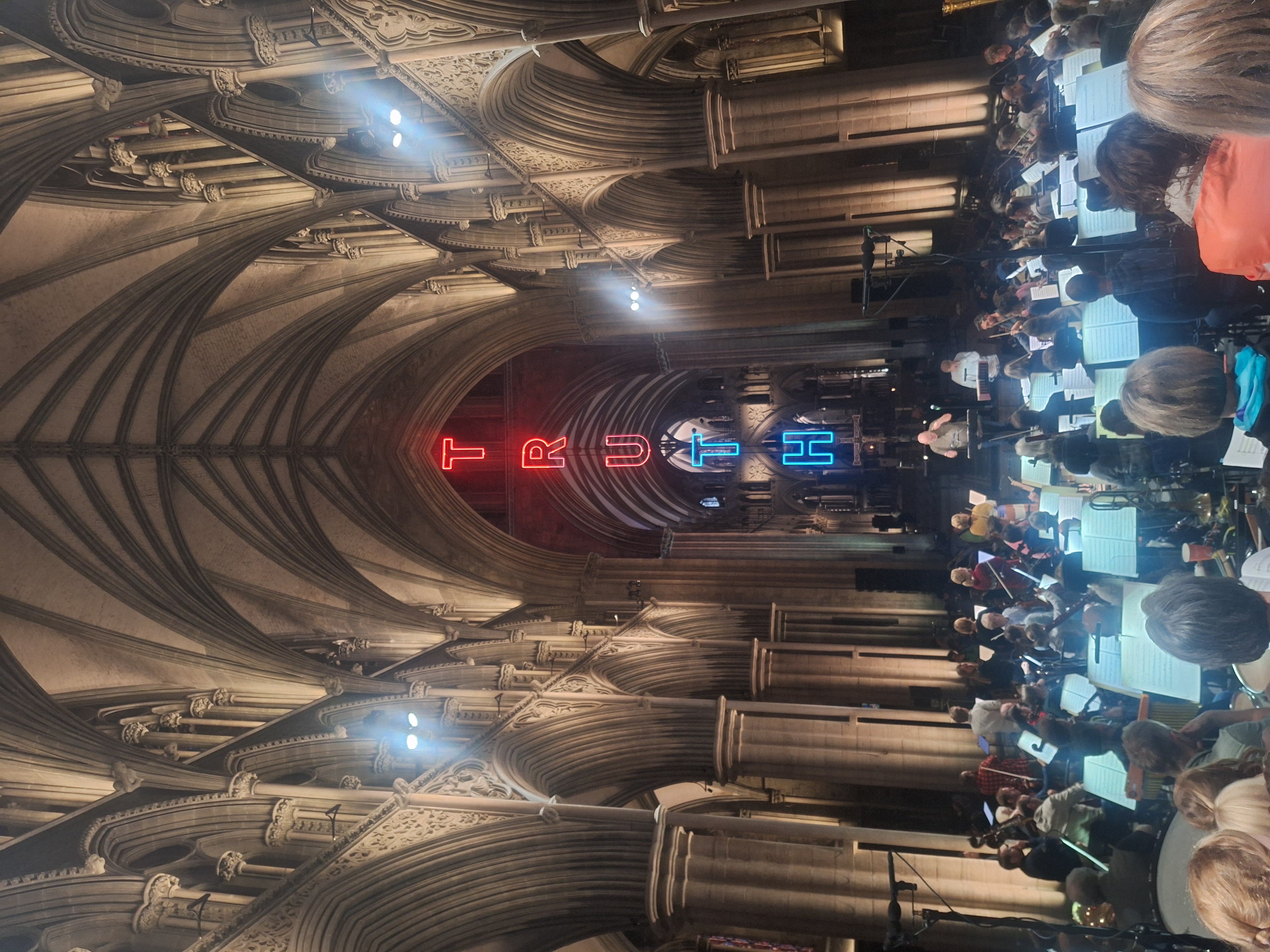
This summer I performed at Olavsfest, a music festival in Trondheim, Norway. The city is located about halfway up the country, at the chokepoint where the rounded rhomboid mass of southern Norway narrows into its slim, sparsely-peopled quiff in the Arctic. Trondheim is today dominated by three presences: firstly, the near-millenium-old Nidaros Cathedral, whose spires rise from the middle of the water-ringed old town; secondly, NTNU, the modern science and technology university that towers over the city from the top of nearby Gløshaugen plateau; and thirdly, more elevated and ancient than them all, the ever-changing weather.
The cathedral is Norway’s only example of the large-scale Medieval gothic church architecture with which the UK is so abundant. The dimensions of the building are of a genuinely breathtaking scale, to an extent that feels somehow un-Norwegian: churches here are either the ancient, gloomy, timber-scented and dragon-encrusted stave churches left to us by the latter-day Christianised vikings, or more modern austere affairs reflecting the minimal and self-denying tendencies of Nordic Lutheranism. Of course, Nidaros cathedral is as Norwegian as they come, with the national patron saint’s bones enshrined in the crypt and the crown jewels in the museum across the square.
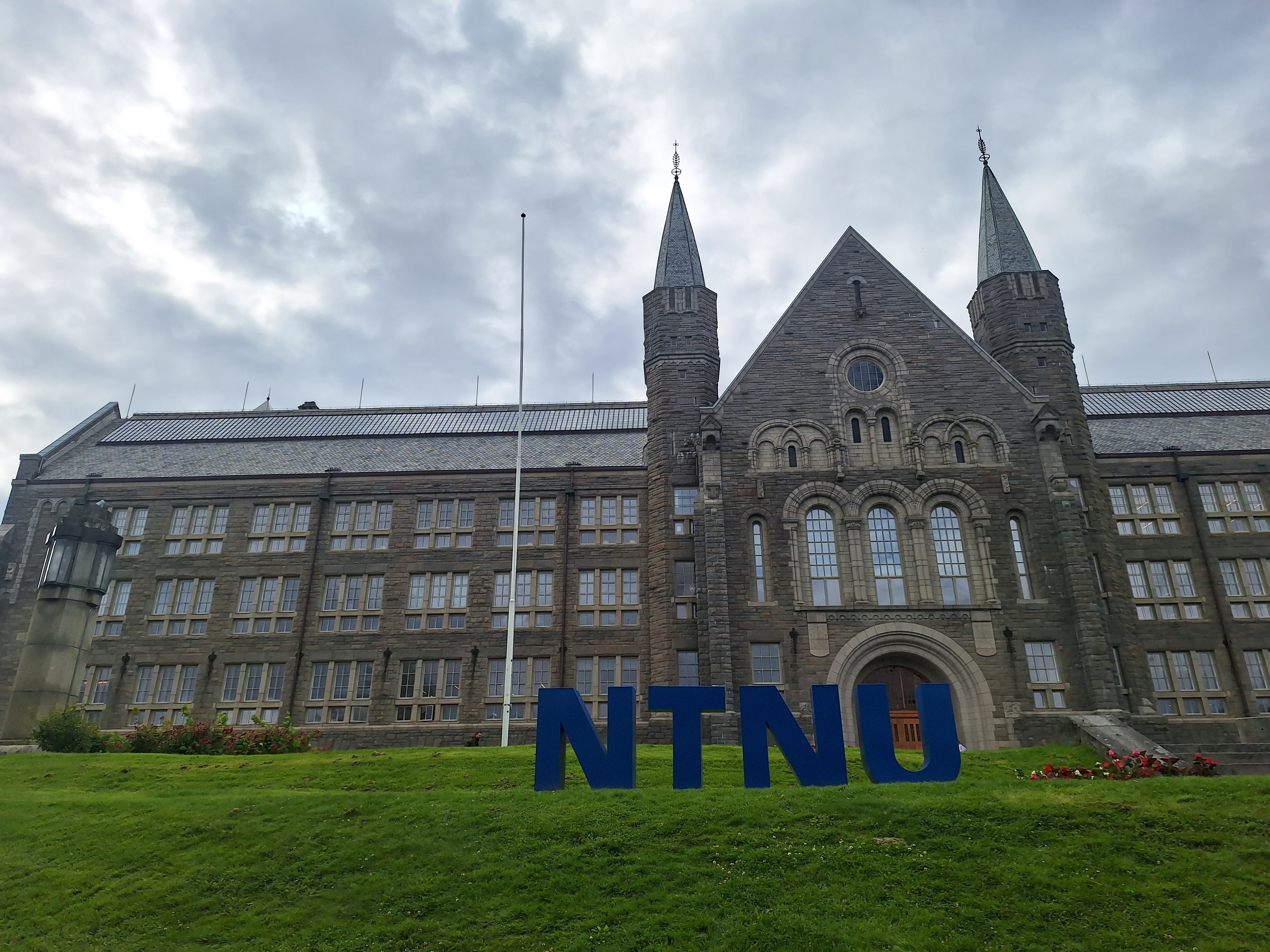
NTNU has a much more recent history, initially as a technical college in 1870 and only taking its present name after a reorganisation in 1996. It positions itself as Norway’s answer to MIT or Imperial College London: a specialist school in science and engineering, it generates some excellent researchers, including Edvard and May Britt Moser, who in 2014 became the nation’s first science Nobel winners in decades. Considering the intertwined history of the origins of our present day academic system from the tradition of monasteries, the two institutions have surprisingly little to do with one another: especially so since NTNU shut down its church music degree programme two years ago.
By some coincidence, I was reading a book during the trip that captured the multiple natures of the city quite effectively: Foucault’s Pendulum by Umberto Eco. The book is a long, dense, interweaving of scientific riddles with obscure Medieval conspiracy theories, all structured reflecting the Kabbalistic tradition of Jewish mysticism1. It felt so pleasing to be able to read the book during rehearsal downtime in the cathedral, with the text of the book in dialogue with the centuries of pilgrims’ inscriptions on the walls, themselves represented in the commissioned Mass of Graffiti that we were performing.
Similarly, the scientific bent of the book felt at home at NTNU. According to Eco, the book’s title has nothing to do with philosopher Michel Foucault, although that is precisely the kind of playful literary misdirection that he would engage in to amuse himself. Instead, the physicist Léon Foucault designed a physics experiment in 1851 demonstrating the rotation of the Earth from a stationary perspective: a pendulum that is left to swing freely under its own mass at the Earth’s surface will appear to rotate its plane of oscillation over the course of a full day.
The mechanism can be best understood through imagining one located at one of the poles: the earth will rotate on its axis directly underneath the constant swing of the pendulum, which will trace out a perfect hyper-petalled floral design on the snow beneath. The effect is most clearly observed at the poles and does not exist at the equator: this is pleasingly reflected in the map of the global distribution of those mentioned on wikipedia:
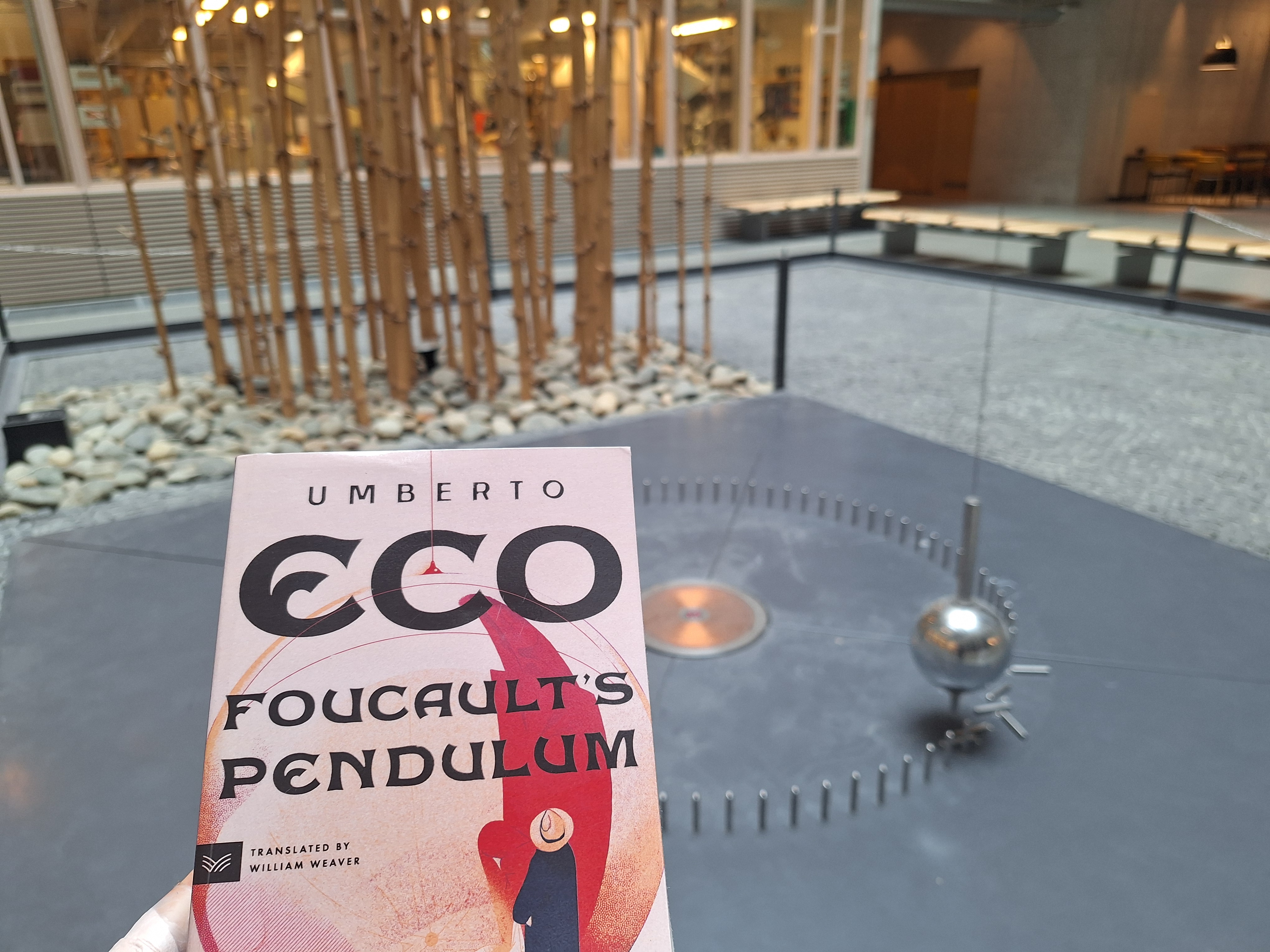
Some medium other than snow is often used to track the precession of the pendulum, more often sand or small sticks that can be knocked over. Of course, owing to air resistance and the capture medium, the pendulum will gradually lose energy, so modern installations often use an electromagnet to compensate, without interfering with the mechanism of interest or demanding human intervention. There is an attractive installation of one on the NTNU campus, where I naturally took a photo:
The book itself was enjoyable, and surprisingly varying in tone, with the scientific themes implied by the title only breaking through explicitly in a handful of places. The pendulum itself crops up as a plot device towards the end as the guide to finding the location of the Umbilicus Telluris, the “Navel of the World”: this is the crucial missing piece in a fabricated conspiracy theory developed by one of the characters, which attracts a particularly intense groups of devotees known as the Diabolicals. Their plan to attain this knowledge is eventually executed at the fabricator’s expense in a particularly gruesome fashion.
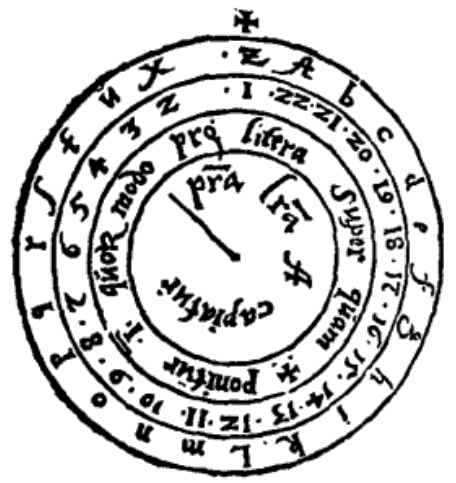
Other mathematically inclined moments include an extended sequence concerning plot-driven codebreaking, including the physical machinery of Cipher disks: these were invented by Leon Battista Alberti in 1471 to encrypt (or decrypt) passages of text much more quickly than using lengthy lookup tables. Some nice diagrams are featured representing them, and fairly practical instructions as to have they would have worked in practice.
The characters end up facing the task of reconstructing a map to locate the Umbilicus Telluris, with an approach that takes a surprisingly computational turn:
Meanwhile, they recorded events, gathered information, and put it all—where? In Abulafia, Belbo joked. But Diotallevi, who had been gathering information himself, said it was no joke. Surely the Jesuits were constructing an immense, tremendously powerful computer that would draw a conclusion from this patiently accumulated, age-old brew of truth and falsehood.
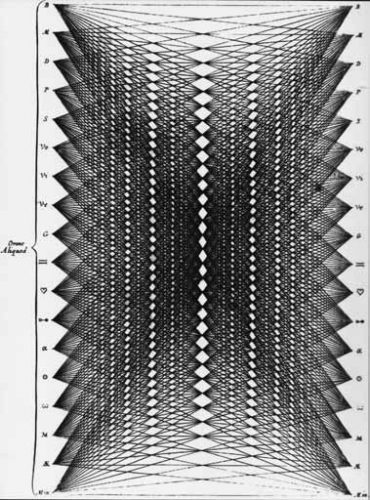
“The Jesuits,” Diotallevi said, “understood what neither the poor old Templars of Provins nor the Baconian camp had yet realized, namely, that the reconstruction of the map could be accomplished by ars combinatoria; in other words, with a method that foreshadowed our modern electronic brains. The Jesuits were the first to invent Abulafia! Father Kircher reread all the treatises on the combinatorial art, from Lullus on, and you see what he published in his Ars Magna Sciendi…”“It looks like a crochet pattern to me,” Belbo said.“No, gentlemen, these arc all the possible combinations. Factor analysis, that of the Sefer Yesirah. Calculation of permutations, the very essence of the temurah!”This was certainly so. It was one thing to conceive Fludd’s vague project of identifying the map by beginning with a polar projection; it was quite another to figure out how many trials would be required in order to arrive at the correct solution. And, again, it was one thing to create an abstract model of all the possible combinations, and another to invent a machine able to carry them out. So both Kircher and his disciple Schott built mechanical devices, mechanisms with perforated cards, computers ante litteram. Binary calculators. Cabala applied to modern technology. IBM: lesus Babbage Mundi, lesum Binarium Magnificamur. AMDG: Ad Maiorem Dei Gloriam? Not on your life! Ars Magna, Digitale Gaudium! IHS: lesus Hardware & Software!”
That “crochet pattern” diagram will immediately trigger the visual memories of anyone who has read up on the methodology behind the AI models that presently sweeping the world: the densely-connected edges between two layers of nodes mimic the exact structure of a single-layer neural network, and it is iterating these single layers that generates powerful “deep learning” models. One example diagram is here:
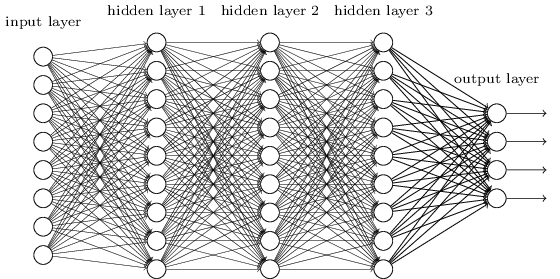
The references to “Binary calculators” and punning on IBM are too direct for Eco to have not been aware of the technological implications: neural networks as a topic were undergoing a revival at the time of writing, including the reissuing of Minsky and Paper’s Perceptrons book in 1988, and Rumelhart and McClelland’s Parallel Distributed Processing in 1986. The analogy between “Cabala applied to modern technology”, limited only by the computational power available in 1988 feels extremely prescient: with 2026’s acres of data centres we can train LLMs that vast amounts of the population are willing to credit with near-divine insight.
Earlier in the book there is a moment in which a character needs to guess a computer password to gain access to the Abulafia, the computer holding the digital repository of collected knowledge. They consider the possibility of exploring the space of all possible strings systematically, again reflecting the combinatoric reasoning that reoccurs later.
Given the religious nature of the book, the character suspects that the password might be a permutation of the Tetragrammaton, or the four letters of the name of God. Never spoken aloud by observant Jews, the four Hebrew letters transliterated into English are YHWH, and are most commonly rendered as a full word in English as Jehovah. The character then goes on to construct a computer program in BASIC to permute these four letters, which is pleasingly discordant in an otherwise prose-heavy novel:
“The problem is to find all the permutations of the name of God, isn’t it? Well, this manual has a neat little program in Basic for listing all possible sequences of four letters. It seems tailor-made for YHVH. Should I give it a whirl?”
10 REM anagrams 20 INPUT L$(1), L$(2), L$(3), L$(4) 30 PRINT 40 FOR I1 = 1 TO 4 50 FOR I2 = 1 TO 4 60 IF I2 = I1 THEN 130 70 FOR I3 = 1 TO 4 80 IF I3 = I1 THEN 120 90 IF I3 = I1 THEN 120 100 LET I4 = 10-(I1+I2+I3) 110 LPRINT L$(I1);L$(I2);L$(I3);L$(I4) 120 NEXT I3 130 NEXT I2 140 NEXT I1 150 END”
“Try it yourself. When it asks for input, type in Y, H, V, H, and press the ENTER key. But you may be disappointed. There are only twenty-four possible permutations.”
Why 24? Well, it is a strict function of the number of letters used as input: any four-letter string should have 24 permutations, since you can start with any of the four letters, then proceed with any of the remaining three, then choose one of the two left, and then be forced to choose the final one. This gives you 4x3x2x1 =4!=24 possibilities2. This naive analysis, however, contains an error. the string YHVH contains a repeated letter, in this case H: this reduces the total number of unique permutations to 12, since solutions in which the two H letters are exchanged will be indistinguishable.
However, the problem specification quickly increases in the book: it is asked what would happen if the name of God were lengthened? Well, the number of possible permutations unsurprisingly increases. The potential length is expanded up to 27 letters, owing to the 27 letters of the Hebrew alphabet. There is something pleasing to the idea that the name of God would justly and universally include each letter exactly once, resulting in 27! possibilities. However, it is then asserted that without a given string to permute, “the name of God could be aleph repeated twenty-seven times”, so we have to move from factorials to exponentials: 21! becomes 2727, which grows substantially faster: instead of multiplying 27 by all 26 integers smaller than it, we multiply 27 by itself 27 times3. Some indulgence is taken in the text with cosmic scale of the numbers produced: real joy appears to be experienced in the utter intractability of the problem of enumerating them all with a computer, something akin to the rapture of the true believer in surrendering themselves to the unknowability of the divine.
In the midst of enjoying himself, while referencing the exploding factorial functions, Eco introduces a misleading pun:
You know what this is called today? Factor analysis.
One could reasonably describe the analysis of factorials as “factor analysis”, but unfortunately that specific pairs of words was already in widespread use by 1988 to refer to something else: statistical models used to decompose observed data into a smaller number of latent factors, somewhat similar to the single-layer neural networks shown in Figure REF. Given his apparently familiarity with the latter, one assumes that he is making this joke out of mischief rather than ignorance.
Of course, the problem is then escalated one last time, with the assertion:
The real and true name of God, the secret name, is as long as the entire Torah.
At this point, the narrative shifts to pure mysticism and drops the quantitative approach, but just to amuse myself I will pick up the numerical thread myself. Confusingly, the Torah has differing numbers of letters depending on whether one is speaking concretely or figuratively. although it is not so unusual to represent a large, precise number by a more rhetorically convenient, larger, rounder number: consider Gustav Mahler’s “Symphony of a Thousand” featuring a mere three to five hundred musicians. Speaking literally, every copy of the Torah has an identical total of 304,805 characters, but idiomatically it is said to have 600,000. A factor of two would be quite meaningful for the scribes tasked with copying them, but the possibly permutations of strings of either of those lengths is so vast that it would be hard to communicate a meaningful intuition of the difference between the two.
27304,805 and 27600,000 are easy to express concisely as exponents, but are inconceivably vast numbers, both larger than any number used to describe anything tangible in the natural sciences, including e.g. the number of atoms in the universe. However, these types of numbers do emerge in statistics through similar reasoning as sizes of state-spaces that one might want to perform inference over. For example, if you were looking to assign data points to 27 exclusive clusters, and had a dataset of 600,000 individuals (conceivable in our post-“Big Data” era), this is is the precise number of possible solutions that you would need to find some way of choosing between in a principled manner.
It is kind of fun to attempt to expand one’s perception to try to gain any conscious traction on what numbers of this scale might mean. This, I think, is the analogy that Eco is trying to communicate with theology: for religious people, the true name or nature of the divine is inherently unknowable and inaccessible, but it is the effort of conscious exploration of the vast possible state-space that is supposed to enlighten us.
Of course, the password in the novel is eventually guessed, not through a misguided brute-force combinatoric search, but instead with some ironic second-order Gödelian logic:
“Do you have the password?” I typed: NO.
There is another specifically Jewish mystical numerological tradition mentioned in Foucault’s Pendulum: “gematria, which seeks sublime affinities between words and their numeric values”. This is a different approach, in which different Hebrew letters are assigned unique numbers. The numbers of the letters in a word are added to give each word a representative number, and then the numbers associated with words are compared to give supposed insight into the relationships between their meaning. This might be considered spiritual-mathematical gold dust, flashy quantitative rhetoric, or numerological nonsense depending on your personal taste.
I first encountered gematria in Chaim Potok’s The Chosen, a beautiful novel about the adolescence of Reuven Malter, a boy coming of age in a strict Orthodox community in 1940s Williamsburg. The gematria features in a virtuosic preaching performance from the respected Rabbi Reb Saunders:
In gematriya, the letters of the word ‘traklin,’ hall, the hall that refers to the world-to-come, come out three hundred ninety-nine, and ‘prozdor,’ the vestibule, the vestibule that is this world, comes out five hundred thirteen. Take ‘traklin’ from ‘prozdor,’ and we have one hundred fourteen. Now listen to me. A righteous man, we said, is two hundred four. A righteous man lives by Torah. Torah is mayim, water; the great and holy rabbis always compare Torah to water. The word ‘mayim’ in gematriya is ninety. Take ‘mayim’ from ‘tzaddik’ and we also have one hundred fourteen. From this we learn that the righteous man who removes himself from Torah also removes himself from the world-to-come!
You get the idea. Of course, it emerges that that Reb Saunders has left a trap for the mathematically-inclined protagonist by deliberately erring in the calculation of on the the word-scores: the student is precocious enough to correct Reb Saunders in front of a crowd, to the congregation’s shock and the Rabbi’s delight. Reuven’s father, however, does not share the Rabbi’s enthusiasm
I saw him grimace when I began to go over the gematriyot. My father did not particularly care for gematriya. He had once referred to it as nonsense numerology and had said that anything could be proved that way, all that had to be done was to shift letters around adroitly so as to make the values come out any way you wanted.
Well, beauty is where you find it. We should not confuse the quantitative nature of gematria with logical rigour, and we are not proving anything in a rational sense. However, I think it is admirable that numbers are used in this tradition to attempt to do something creative or even sublime, transcending the mere tedious bookkeeping with which we might ordinarily associate them. There is no inherent trade-off between how useful something can be and how much fun we can have it, and we have perhaps erred in proposing mathematic as being the sensible, practical and dull education necessary to pursue no-one’s childhood dream career as an actuary. Imagine how magical numbers would be to us if we weren’t taught them in school! As Eco and Potok and have demonstrated above, we should instead be open to the use of mathematics in our leisure time, and we should pursue it out of giddy, hedonistic fun.
-
I should clarify ahead of time that I have a deep and enduring respect and interest in Jewish culture and its intellectual tradition, but am not myself of the community so apologise in advance if I get anything wrong. Indeed, the saying goes that a Jew should not study Kabbalah until they are 40 years old, married, and have children, and even then, to do so can be dangerous. Well, I am unmarried, childless and have been Jewish for precisely zero years of my life, so wish me luck. ↩
-
The exclamation point ! is representing the factorial function, by which a number is multiplied by every integer smaller than itself. ↩
-
Stirling’s approximation would suggest that n! is approximately en smaller than nn for large n. ↩