Do good books make good film adaptations? I statistically compare ratings between Goodreads and Letterboxd to find out.
There was a frisson of excitement to be felt when old-school literary feuding collided with the machinations of modern Hollywood in August this year, when Emily Wilson definitively severed ties with Christopher Nolan’s 2026 film adaptation of Homer’s Odyssey. She had achieved public fame some years previously as the first woman to have a professionally published translation of the Odyssey into English, somehow as late as 2017: her translation received widespread acclaim, and Nolan had spoken in interviews about the inspiration that he had drawn from her version in particular. One imagines that her comments would have stung, but given his power and fame, he will probably not struggle to shrug them off.
Much of the response to the debate feeds on the tension between literature and cinema as media: we relate to these art forms differently, and bring distinct expectations and modes of judgement to them. Considered apart, we have developed mature techniques of criticism and analysis to compare good films with bad films, or indeed good books with bad books. But books and films judged side-by-side presents an immediate conflict of expectations and values that add fuel to the confusion and drama.
Online ratings websites provide a treasure-trove of data for the numerically-inclined among us, and it is tempting to turn to these as an empirical solution the confusion. Let’s take a look at the average goodreads rating of all literary works derived from the Odyssey here:
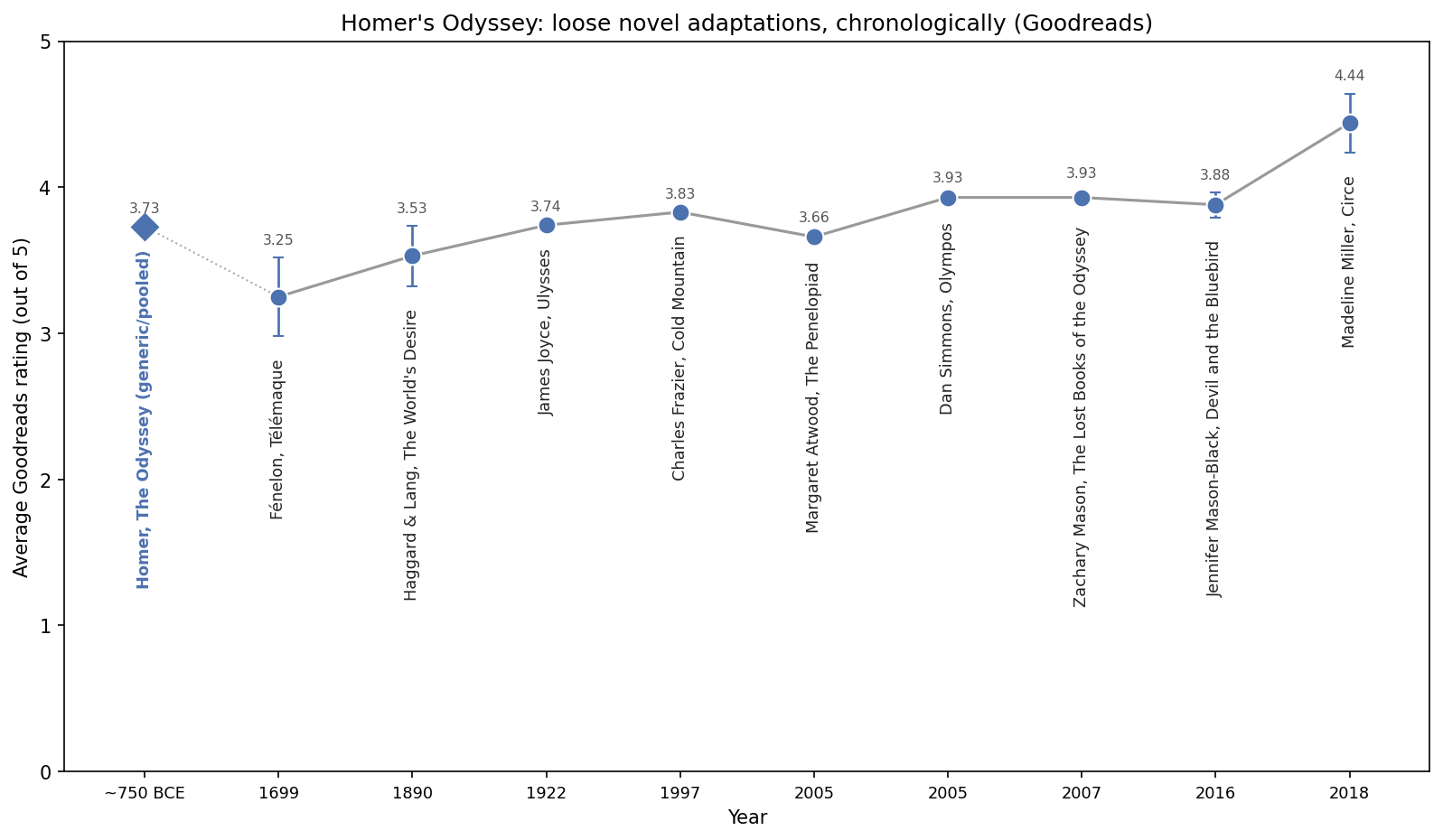
Unfortunately, goodreads does not record ratings for different translations of the same work, so all of the English versions of Homer’s Odyssey get rolled into a middling 3.73/5. This is curiously very close to the score for its most famous literary reworking, James Joyce’s Ulysses: one assumes that this is a coincidence rather than user confusion. There is what looks like a gentle increase in ratings with time (although note the unscaled x-axis), culminating with a clear leader of the pack in the form of Madeline Miller’s Circe.
We should be careful interpreting these numbers as anything other than what they are, however: average ratings from the general public at specific point in time, with all of the fickleness and social biases that may entail. Notably, we have a quite explicit example here of recency bias, in which raters prefer works that they have seen most recently: this would explain the seeming positive trend, and also the high score for Circe. This dataset was extracted and frozen in late 2017, so Circe’s relatively few 77 reviews, presumably from advance copies, would be riding the honeymoon wave awaiting a highly-anticipated work from a well-respected writer. In 2026, Circe’s score has since stabilised to a still-leading but less extreme 4.22.
One other curious phenomenon that emerges in goodreads data can be surprisingly low average ratings for established “classics”. I think this phenomenon comes chiefly from obligatory reading in school leading to large numbers of people giving low ratings to “important” books that they struggled through involuntarily. I cannot find a good way of removing this kind of review systematically, and it is not totally clear to me that I should if I could: these are real people with real opinions, and if Gulliver’s Travels seemingly doesn’t speak to the interests of today’s teenagers, then that tells us something meaningful about how it is being taught to modern high-schoolers. The polarisation manifest in the ratings represents a genuine divide in the minds of the reading public, and what more could you ask for in a dataset? Goodreads remains the most inclusive, and therefore more comprehensive data set for book ratings online: any attempt to find a collection of ratings from a more classics-enthusiastic crowd would come with the trade-off of a much smaller dataset, with fewer ratings per book and smaller coverage of more obscure works.
Let us consider the same methods to letterboxd ratings of films inspired by the Odyssey, with a generous interpretation of “inspired”:
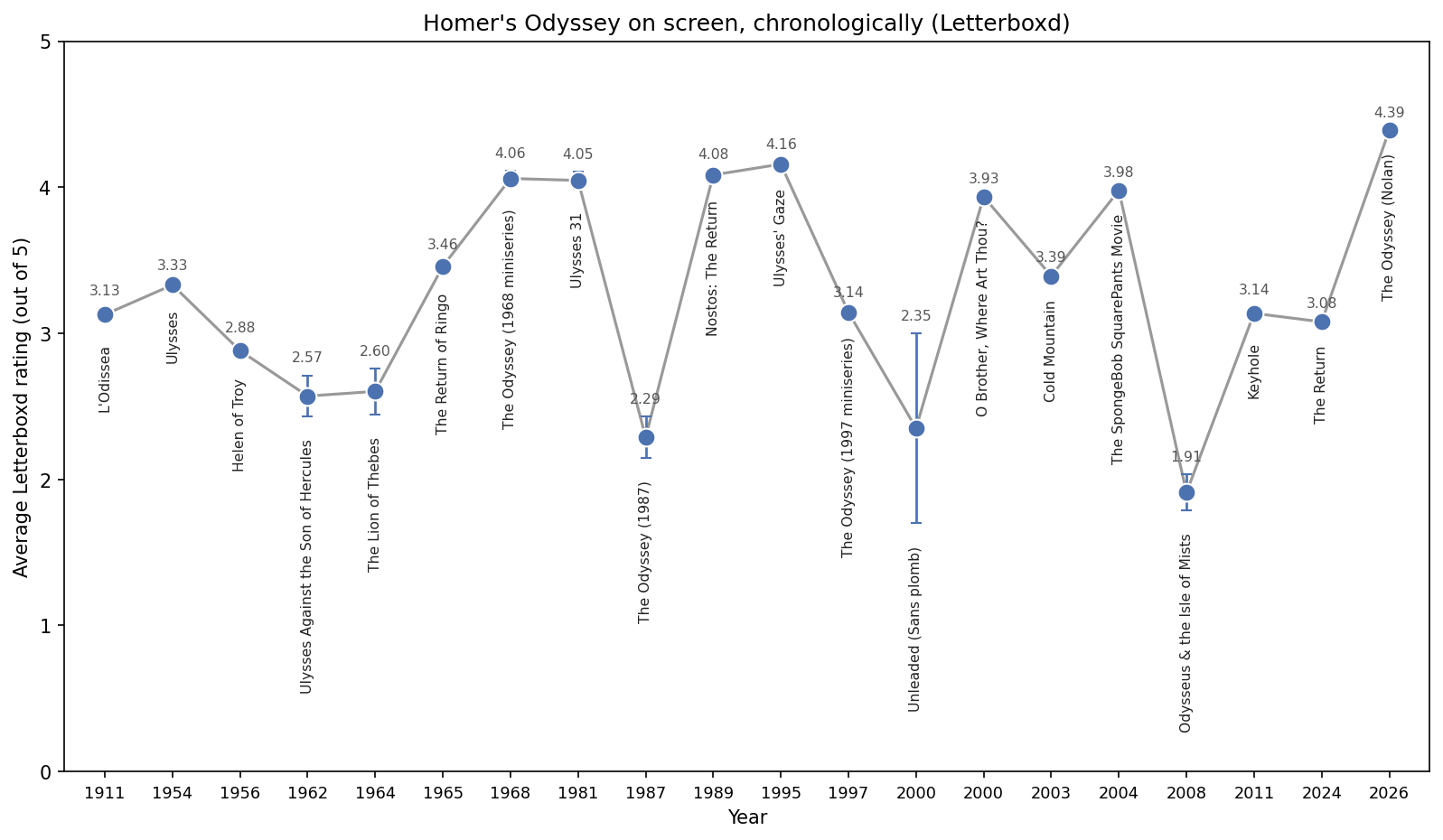
We again see 2026’s The Odyssey riding high on recency bias, now with no future data to indicate where it might stabilise. There are also more film adaptations than book adaptations: this is perhaps surprisingly considering the costs involved and long swathes of literate human history before film-making came into being. It is possible a literary adaptation might have been considered redundant considering the dominance of the original literary text, whereas making a definitive cinematic version has remained an open challenge for the history of film.
The effect of classic films receiving mass low-ratings seems to be less pronounced in film data than book data. This is presumably because students are not forced to consume films as systematically as they are books, with fewer resultant embittered reviews. That said, social pressure to watch and enjoy “classic” films certainly exists, through schools, parents, cinephile friends, and others, so this effect may still be present. We should perhaps be grateful for the limited cinema education in the education system, preserving films as something fun to be appreciated in one’s spare time and not worthy ways to enlighten oneself culturally (even if they are).
As with the goodreads ratings, it is important to not confuse the seeming objectivity of quantitative methods with an objective interpretation of their conclusions: ratings data will often say as much about a work’s positioning in social consciousness, more than any absolute measure of artistic quality. Socially contingent data will beget socially contingent analysis results, and no amount of number crunching will allow us to bootstrap1 our way out of the quagmire.
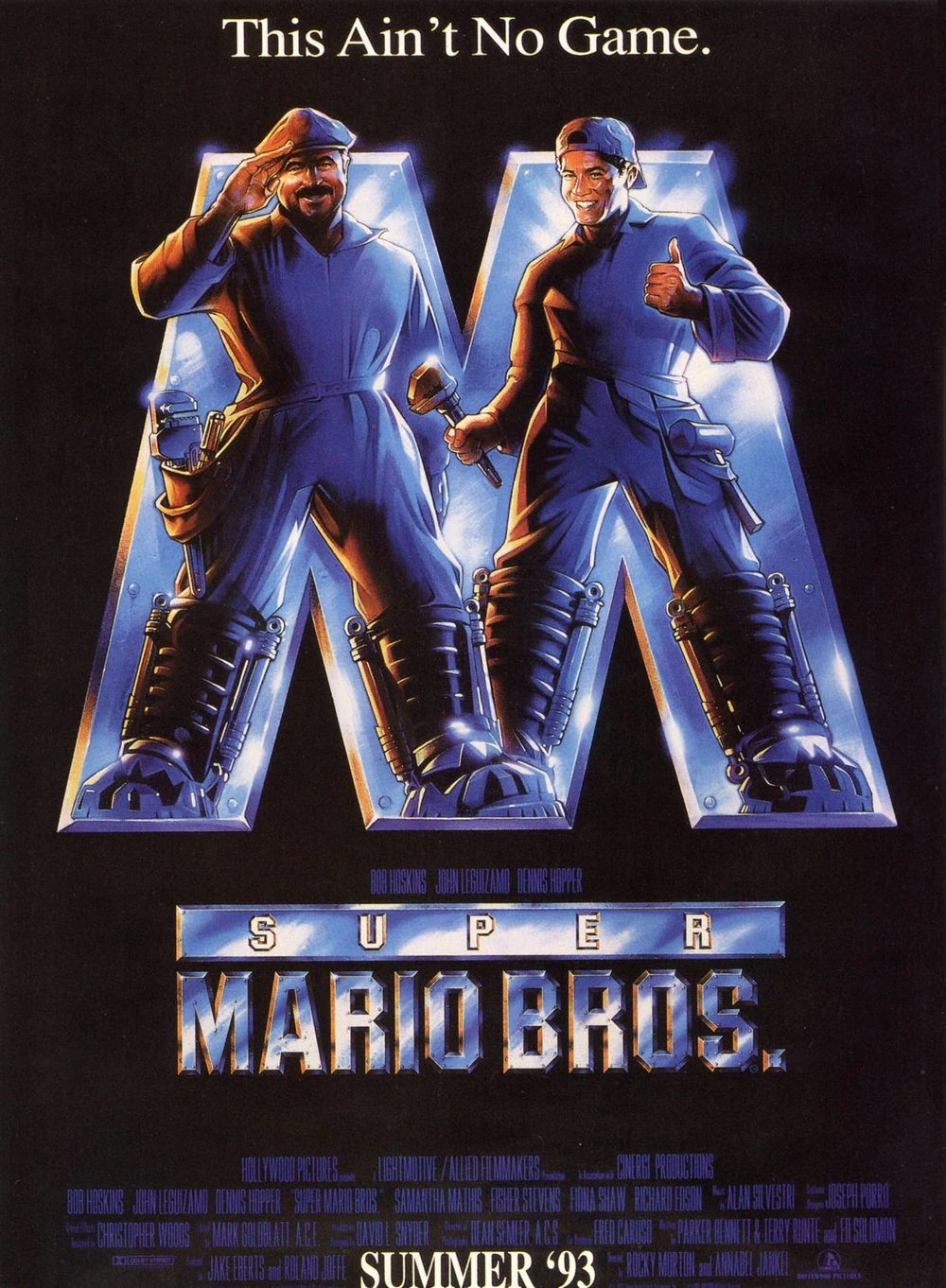
The question lingers in the air as to whether it is possible to compare across forms of media in a meaningful way: when can a book be said to be better than a film, or vice versa? Would it be controversial to suggest that, in the grand scheme of things, Mrs Dalloway is a greater work of art than the 1993 Super Mario Bros. film? Well, maybe, if you particularly despise reading, or are unduly fond of Bob Hoskins.
There are several effects to acknowledge here: there is an implicit historic cultural hierarchy that would place literature above film as a medium. Literature has a longer presence in society, arguably dating back to the birth of language itself, with millennia to embed itself into power structures and develop a dense history of criticism and cross-referencing across society. By contrast, film is a relative upstart on the cultural scene, emerging at a quite distinct point in history enabled by specific post-industrial technological developments. There is no inherent limitation of cinema’s capability of representing the human experience compared to writing, but it still has much momentum to gain before cultural snobbery can be overcome.
That said, many people in the modern day really would prefer to settle down with a streaming service rather than a book: a childhood friend of mine even delayed reading the Lord of the Rings so as not to spoil the films. That does also raise another issue: if the goal is to absorb the narrative as quickly as possible, then films will almost always be the more time-efficient mode of consumption. Some exceptions, notably by their scarcity, include short stories adapted into feature films (Brokeback Mountain, The Curious Case of Benjamin Button), and some particularly indulgent adaptations of relatively short novels (the masterfully slow Sátántangó, and the bloated Hobbit trilogy). I personally would question the wisdom of prioritising time-efficiency of cultural consumption above all else, as the end-point seems to be actively minimising the amount of time spent engaging with great works of art. That is not a reasonable way to live your life.
One way to approach the question would be to standardise the ratings that we have available from goodreads and letterboxd, and then directly compare film adaptations of books for which we have paired data available. The standardisation would help address differences in calibration between the scales used for each medium: this can be done through computing “z-scores”, which linearly transform the populations to have zero mean and unit variance.
How do we find lists of films based on books? Wikipedia has some extensive lists of films based on books. There is some notable systematic missingness here, chiefly of older films less popular among Wikipedia editors, and films that did not received a full theatrical release, e.g. the 1980 PBS TV film version of Ursula K. Le Guin’s The Lathe of Heaven. To maintain focus and tractability, I focused on fiction and poetry, excluding non-fiction, religious works, non-literary mythology or folklore, comic books, and theatre. Theatre is a particular loss considering it contains easily the most adapted author of all time in the form of Shakespeare, but including him would mean he would dominate so thoroughly to make the inference unstable. He may also be the definitive example of the pathology described earlier of obligatory reading generating low ratings.
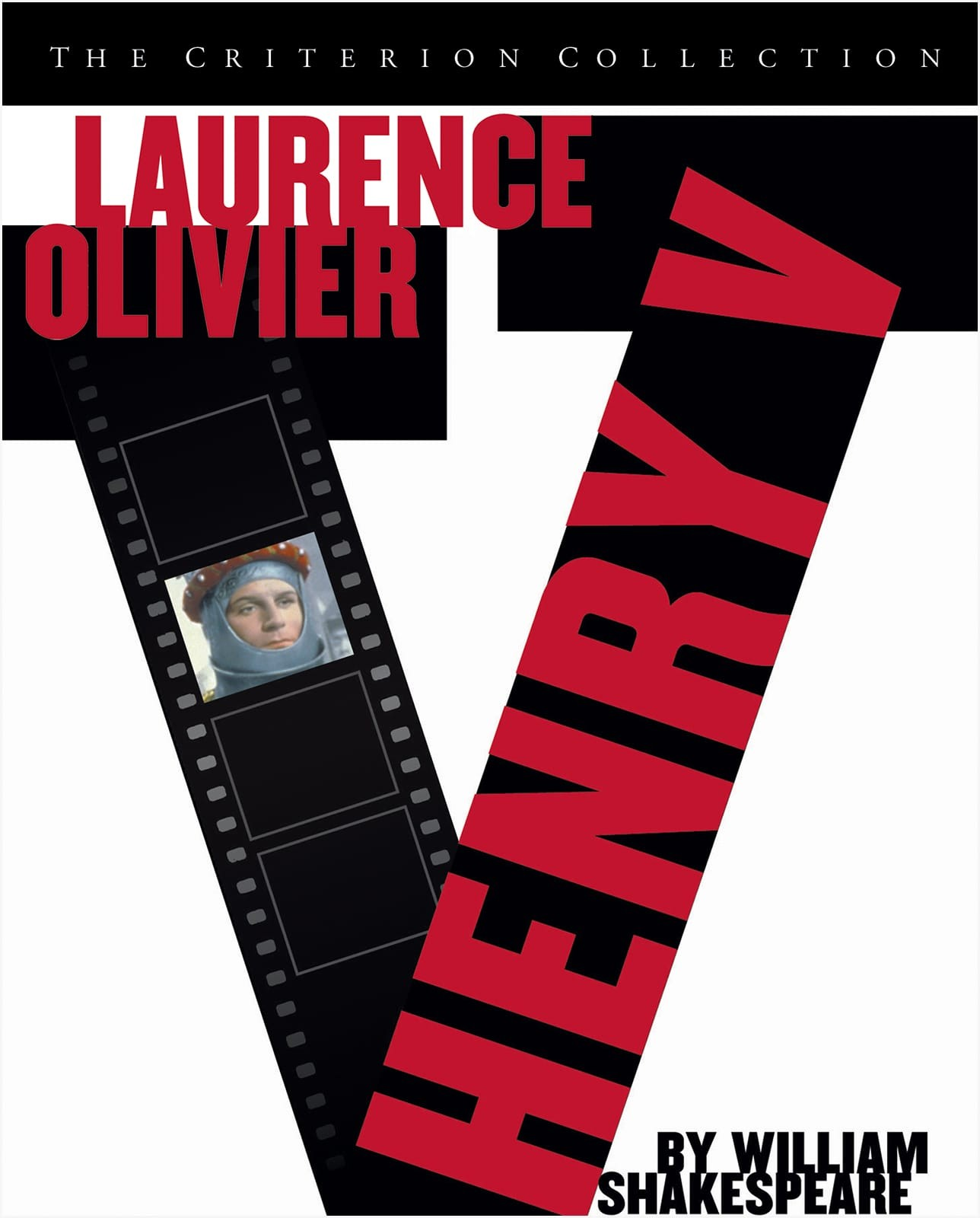
There is another reason for excluding plays, which is that a faithful film adaptation of a play is a direct experience of the play itself, in a way that isn’t true of novels or poems. For example, I have never read or seen Henry V on stage, but I have watched the 1944 Laurence Olivier film, which was loyal enough for me to feel comfortable reviewing the play itself on goodreads. My rating of the book will be coloured by my experience of watching the film, which establishes a reverse causation effect that I would like to avoid. By contrast, simply given the nature of the mediums involved, I don’t think anyone would elide watching a film with reading a novel or poem: even watching the >7 hour Sergei Bondarchuk version of War and Peace doesn’t substitute sitting down with the >1,200 page book.
You might make the case that epic poems like the Odyssey were also originally experienced as live recital performances, but no one has yet made the implied monologue film adaptation. However, I would be happy to include goodreads ratings based on audiobook versions: this might be the closest modern technology has allowed us to reconverge to our ancient roots.
Using these lists as a basis, and with some amount of fuzzy matching for the book titles between wikipedia and goodreads, we end up with a final population of 853 books adapted into 1178 films, and 1192 distinct book-film pairs. Books are sometimes made into multiple films, and films are (less frequently) based on multiple books: consider 2004’s Van Helsing drawing on Dracula and Frankenstein, and other novels.
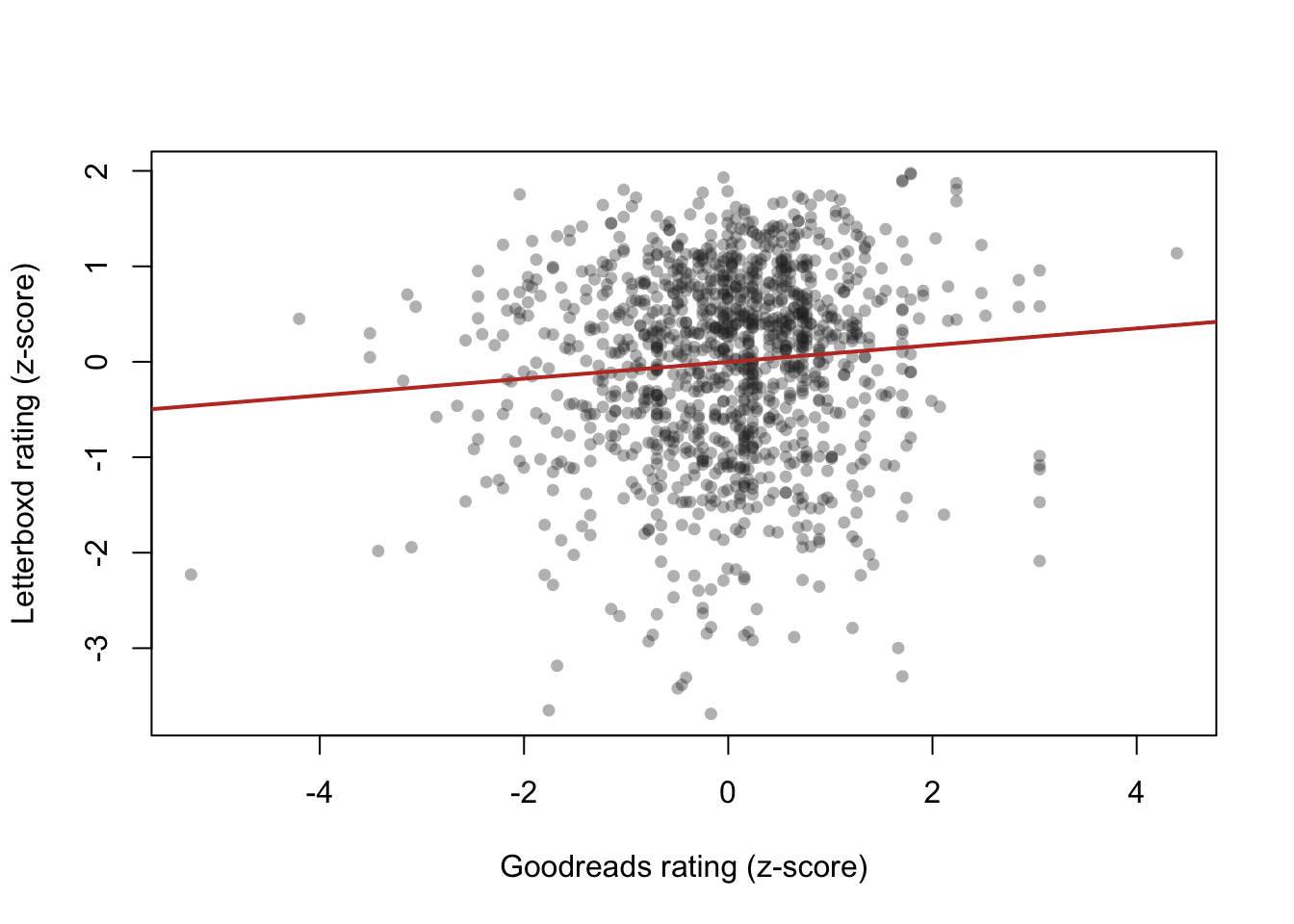
The entire data set is plotted above with a trendline: we see a modest, but highly significant correlation of r = 0.096. Better books tend to beget better films! Not a great shock, but reassuring to see in reality. Two implicit queries underlie this statement:
- Are books that get adapted higher rated than those that don’t?
- Are films based on books higher rated than those that aren’t?
To the first question, a very small positive effect of 0.0254 is observed with borderline significance. To the second, a tiny effect size of no statistical significance. So the population of book-film pairs is broadly representative of the wider populations. This might be considered surprising, but studios may be choosing books that are marketable rather than particularly respected, and similarly will produce films motivated by financial rather than artistic urges.
One potential association to investigate is the role of budget: of course good books results in good films because studios are willing to throw more money at well-respected books, resulting in better films. Perhaps if this budget effect were removed then the correlation observed above would disappear?
Well, this question can be answered through the use of a mediation analysis: a regression model predicting the letterboxd rating, conditioning on the goodreads ratings, budget, and year. We can then observe the relationship of book score with film score separately to that of budget or year. Mediation analysis can be controversial since it invites a causal interpretation, while being itself vulnerable to confounding: for example, what if big-name directors get assigned larger budgets and also independently make higher-rated films? For that reason, the following should be interpreted with some caution.
| variable | effect size | 95% c.i. |
|---|---|---|
| goodreads | 0.1796 | [0.1204, 0.2388] |
| budget | -0.1015 | [-0.1640, -0.0389] |
| year | -0.3730 | [-0.4402, -0.3059] |
| budget×year | -0.0538 | [-0.1109, 0.0033] |
We see that the positive influence of goodreads score remains, even after adjusting for budget and year. There is an extremely clear negative influence of year on letterboxd score, and even more surprisingly a possible negative relationship between budget and film rating score. This would seem to contradict one of my previous posts on the subject, but these are distinct populations of films chosen according to different principles.
Counterintuitively, sometimes looking at the extremes can tell us about the features of the bulk population. With that in mind, let’s look at the outlying values of the book/film ratings, through the mechanism of Pareto-optimality. Pareto-optimality is a way of thinking about outliers when thinking about multiple dimensions at once, as we are doing with goodreads and letterboxd ratings. Consider the top right corner: any work that isn’t “dominated” by another work with both higher goodreads and letterboxd scores, is said to be Pareto-optimal. This logic extends to other directions too: points with no worse film rating but no better goodreads rating would be extremes in the bottom-right, for example.
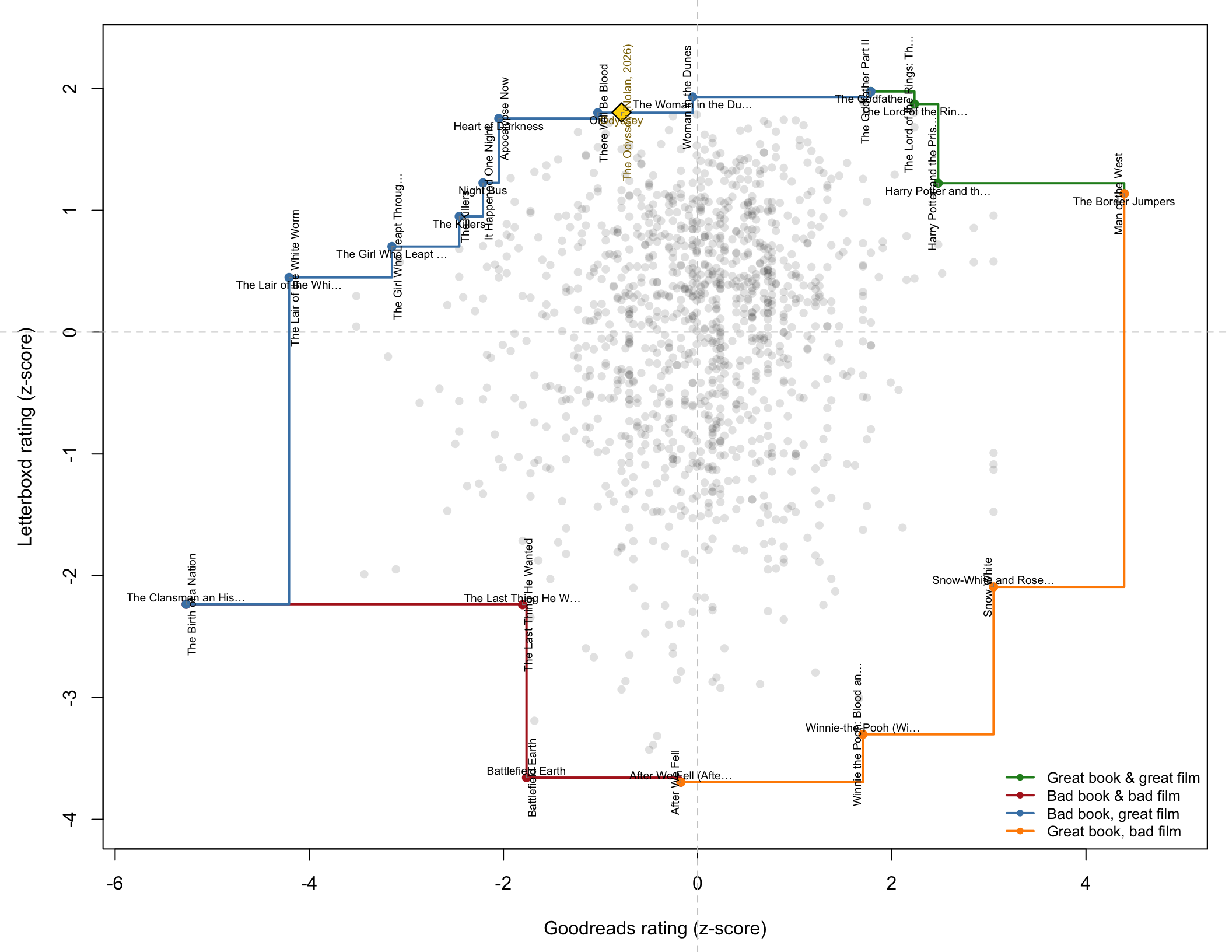
Data points that are Pareto-optimal in each direction are plotted above. We see some curious commonalities in the extremes: books that readers choose to read when they are younger (e.g. The Lord of the Rings, Harry Potter, Snow White, Winnie the Pooh) tend to be highly rated, in contrast to “classics” that they are obliged to read in school (e.g. Heart of Darkness). Some of these youth-oriented books get developed into films with mainstream success (LotR, Harry Potter), and some get unflattering adaptations: it should be pointed out here that the bottom-right low-rated films are the unloved 2015 Snow White film, and the 2023 deliberately poor-taste-joke-rushed-to-meet-a-copyright-expiration-date Winnie the Pooh: Blood and Honey.
In the lower bad-film extremes of the figure we also encounter the tepid romantic drama After We Fell (the lowest-rated novel adaptation on letterboxd), the Scientology propaganda of Battlefield Earth, and the unsuccessful film of the novel The Last Thing He Wanted, by the otherwise well-respected Joan Didion. In the extreme left, we have the toxic pairing of the book The Clansman: A Historical Romance of the Ku Klux Klan, made into the film The Birth of the Nation: the book is an explicitly racist representation of American history and race relations. The film carries this forward without transcending them, but is remembered in cinematic history for its then-unprecedented cinematic scale and technical innovation. It is a regrettable chapter in film history, unfortunately echoed in Hollywood’s first famous talkie film being the blackface-heavy The Jazz Singer.
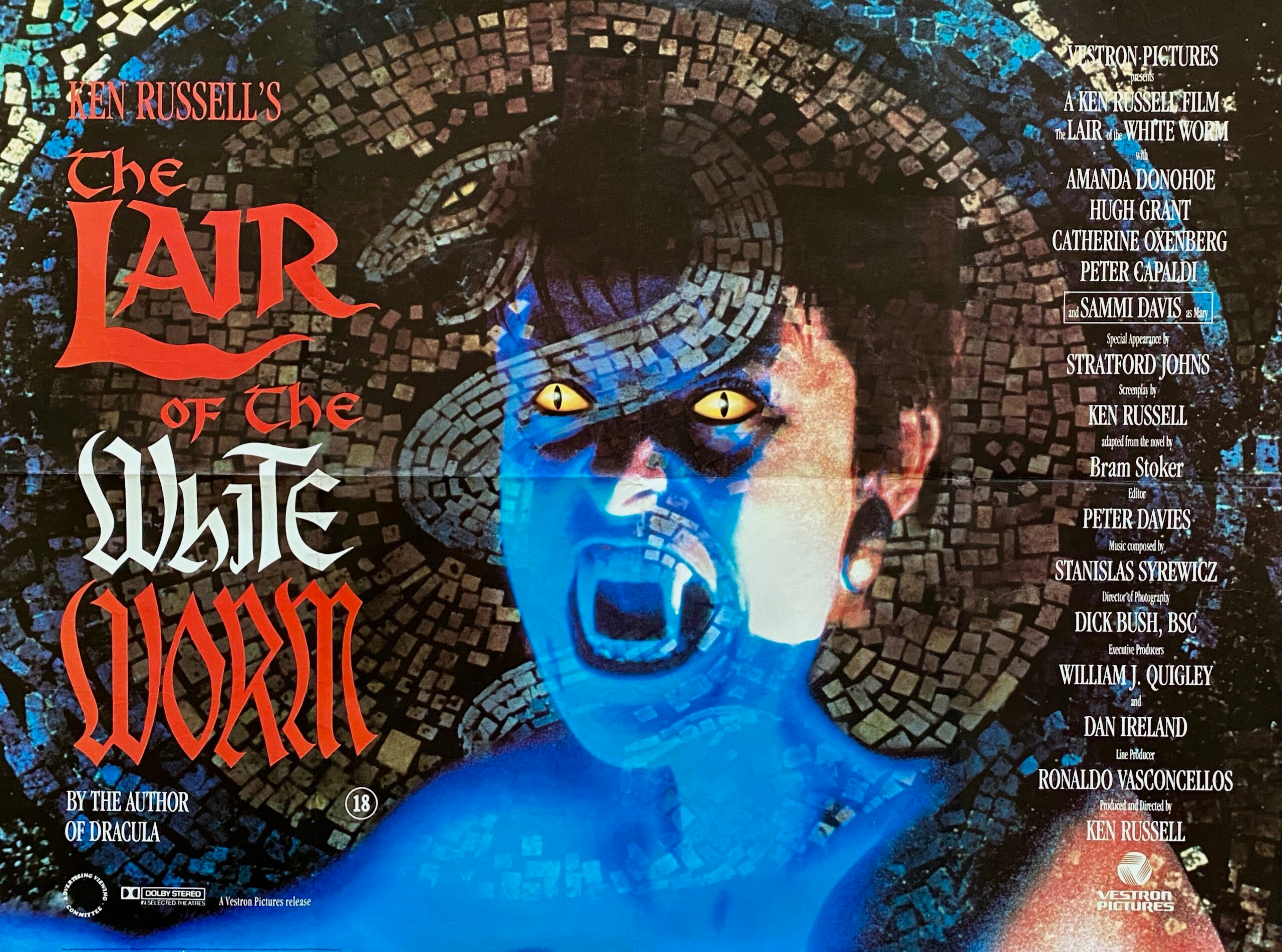
Some interesting points appear in the good-film bad-book top-left corner: Bram Stoker’s ill-remembered The Lair of the White Worm was made into a enjoyably camp phallocentric horror-comedy film: other minor literary works made into surprisingly successfully films abound in this corner.
Towards the top of the graph we encounter films rated among the best of all time: they would approach Pareto-optimality regardless of the book ratings: Apocalypse Now, There Will be Blood, The Godfather Part II, and Hiroshi Teshigahara’s 1964 The Woman in the Dunes (the highest rated novel adaptation on letterboxd). Heart of Darkness is probably unfairly penalised by its presence on high school reading lists, while the other source material is represented as neutral-to-positive in quality. We also see Christopher Nolan’s The Odyssey marked in a golden diamond, just shy of the upper Pareto boundary.
The final point is in the extreme right, and apparently the best book in the data set: the Western novel The Border Jumpers, adapted into the 1958 film Man of the West. I won’t pretend to be familiar with either of them: I suspect that they are of reasonable quality but the extreme high rating of the book is based on only four ratings, so its position would most likely stabilise away from the edge with more thorough coverage.
We can also look at statistics per book:
- The top 5 books with most film adaptations are Dracula (24), Frankenstein (19), Peter Pan (12), Planet of the Apes (10) and Winnie the Pooh (9).
- Of books with multiple film adaptations, the 5 highest average letterboxd ratings go to The Lord of the Rings, The Wages of Fear, Do Androids Dream of Electric Sheep, The Godfather, and The Trial.
- Of novels with multiple film adaptations, the 5 lowest average letterboxd ratings go to Doctor Dolittle, Stuart Little, I Know What You Did Last Summer, Firestarter and Pet Sematary.
We can also extend the reasoning to the writer level: averaged over goodreads and letterboxd ratings, which authors are most adapted, and best/worst adapted?
- The top 5 writers with the most film adaptations are Stephen King (40 films from 24 books), Bram Stoker (25 film from 2 books), Ian Fleming (22 films from 17 books), Mary Shelley (19 films from 1 book), and Charles Dickens (15 films from 4 books).
- Of writers with at least three film adaptations, the 5 highest average letterboxd ratings go to Mario Puzo, Franz Kafka, John Steinbeck, Joseph Conrad, and Michael Bond.
- Of writers with at least three film adaptations, the 5 lowest average letterboxd ratings go to Anna Todd, E. L. James, Hugh Lofting, Lois Duncan, and Jeff Kinney.
The numbers above reveal the limitations of the wikipedia lists used, considering results reported elsewhere from probing IMDB. Consequently, these results should be considered as representative of the source data and the inherited biases: towards more English-language, theatrically released, modern films.
We repeat the Pareto efficiency analysis on ratings aggregated across authors (with more than three film adaptations) and find the following pattern emerges:
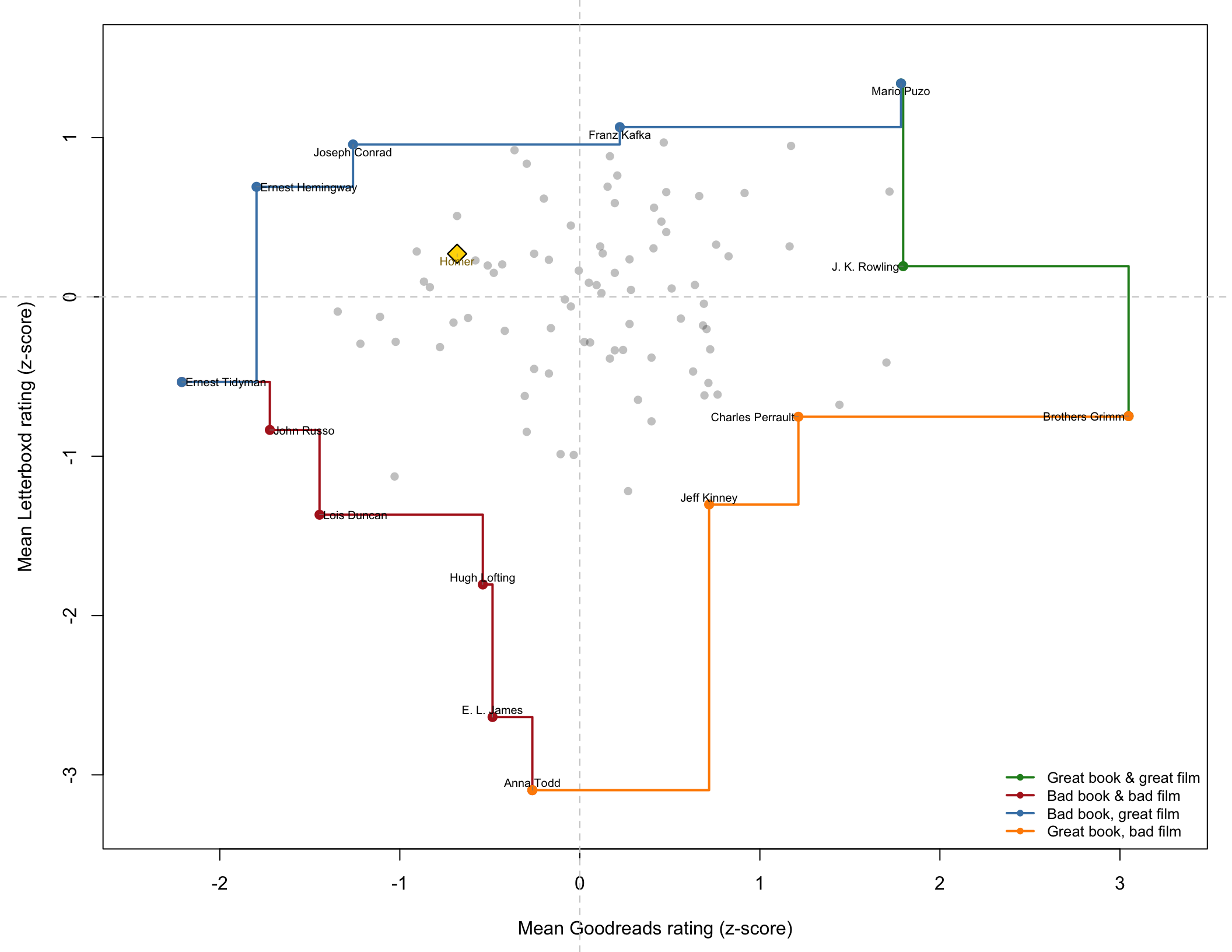
Patterns analogous to the film-level data remain:
- Fairly tale fabulists Charles Perrault and the Brothers Grimm make good books with unflattering films
- Anna Todd (of After We Fell et al.) appears at that bottom
- E. L. James of 50 Shades is not so far away
- Ernest Tidyman of the Shaft series of novels is at the extreme left
- High school staples of Ernest Hemingway and Joseph Conrad populate the top left. Homer is in that direction too, but not so near the Pareto edge.
- Franz Kafka and Mario Puzo make the highest-rated film source material out there.
All of interest, but so what? Have we determined when to save time and watch the film over the book? Or, indeed, indulge oneself and luxuriate in the lengthy novel instead of the film? Well, there appear to be some compelling examples in a few cases, but I reiterate the previous point that these ratings will reveal more about widespread social biases than about the inherent quality of the works themselves. I will not, therefore, claim to have found a conclusive resolution to the tension between the literary and cinematic traditions I mentioned earlier. I do, however, offer some observations:
- Good books beget good films, but adapted books are not much better than average, neither are book adaptations inherently good films.
- People often remember the books of their childhood fondly, the books less so.
- The books we recall grudgingly from our school days often make well-respected films.
- If Bram Stoker’s The Lair of the White Worm was worth gambling on, then maybe Mary Shelley is owed an adaptation of The Last Man. It’s certainly very prescient in our era of pandemics and climate anxiety.
Unfortunately we were not able to read Mary Shelley’s hot take on Guillermo del Toro’s 2025 Frankenstein, although given her fascination with science and technology, one might assume she would approve of film as a medium. One would also imagine that she would dislike the choice of a closing quotation by Lord Byron, the most famous male author in her social circle, and someone from whom she worked hard to maintain a distinct literary career.
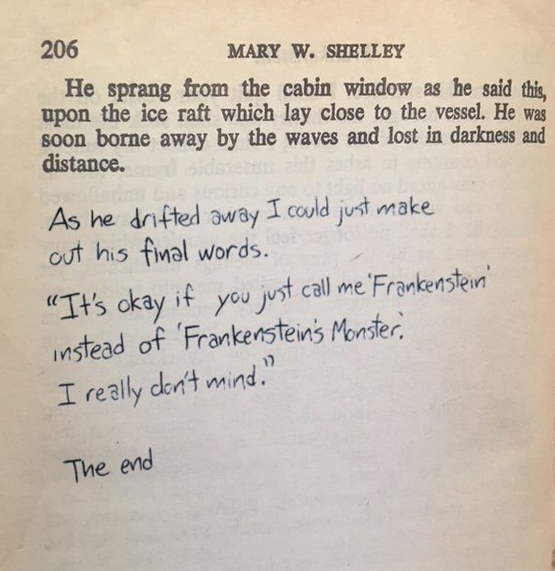
It’s really all the more offensive considering that we already know the perfect fan edit of the ending of Frankenstein, which could so easily have made it on screen:
-
hehehe ↩